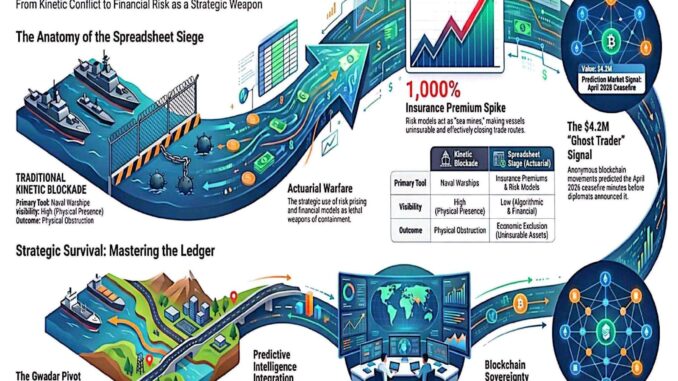
As financial signals increasingly shape geopolitical outcomes, the battlefield is shifting from military force to the pricing of risk.
The cannons of the 21st century do not always roar with gunpowder. Sometimes, they click with the silent finality of a blockchain transaction. On April 15, 2026, as the world braced for a kinetic escalation in the Iran conflict that many feared would ignite a global conflagration, a peculiar thing happened: the digital “oracle” of the prediction markets spoke first. Before the diplomats emerged with their scripted smiles, and before the press releases were drafted in the Situation Room, certain market participants had already positioned themselves for de-escalation.
We are entering an era of Actuarial Warfare, where the pricing of risk is as lethal as the deployment of a battalion. The recent volatility surrounding a specific $4.2 million liquidity movement in decentralized prediction markets tied to mysterious “ghost wallets” with surgical timing reveals a shift in the global power structure. While mainstream observers were tracking carrier strike groups, “smart money” was betting on peace with a statistical accuracy that defies coincidence.
The message is clear: the battlefield has shifted. We are no longer just witnessing geopolitical friction; we are witnessing the dawn of the Spreadsheet Siege.
The Anatomy of the Spreadsheet Siege
To understand the gravity of this transition, we must look at the mechanics of modern containment. For decades, a naval blockade meant warships physically choking off a waterway like the Strait of Hormuz through which 20 million barrels of oil flow daily. Today, you don’t need to sink a tanker to stop it. You only need to make it uninsurable.
During the height of the 2026 tensions, war risk insurance premiums shot up by a staggering 1,000%. For a vessel worth hundreds of millions, this isn’t an “added cost”; it is a strategic shutdown. The sea remains physically open, but the market closes the gates. This is War by Calculator, where financial sanctions, compliance algorithms, and risk models act as the new sea mines.
The emergence of “Ghost Traders” newly created accounts that move millions minutes before major policy shifts suggests that prediction markets have become a “honeypot” for intelligence services and a signaling mechanism for those who truly hold the Ledger Power. Whether it was the political shifts in January or the April 15 ceasefire, the blockchain recorded the intent before the world saw the action.
The 150-Year Shadow: Beyond the Kinetic
Geopolitics used to be about land; then it was about oil; now, it is about systems. Analysis from strategic forums and legal scholars is beginning to recognize that platforms like Polymarket are providing a “source of truth” that traditional media cannot match. In these markets, participants must “put their money where their mouth is,” creating a high-stakes transparency that bypasses official narratives.
The $4.2 million truce was more than a wager; it may have served as a signal of prevailing expectations among market participants. When massive liquidity moves toward a specific outcome like a ceasefire, it may reflect expectations about political decisions or an emerging consensus among informed participants.
We are seeing the birth of a new architecture of power where the ability to manipulate or read market sentiment is as vital as air superiority.
The fact that the ceasefire was “sold” on the markets before it was “bought” by the public reveals a terrifying level of transparency for those who know how to read the ledger, and a total blackout for those who do not.
Pakistan’s Stakes: Navigating the Geographic Gambit
For Pakistan, this shift from kinetic to actuarial warfare isn’t academic, it’s existential. We are a nation uniquely exposed to shocks in the Strait of Hormuz, where a severe disruption could spike domestic inflation by over 12% and cost our economy $4.6 billion annually. We live in the direct line of sight of the Spreadsheet Siege.
However, within this vulnerability lies a strategic masterstroke: The Gwadar Pivot. Pakistan’s geography offers a “get out of jail free card” for the region. By developing Gwadar as a commercial alternative that sits outside the traditional choke points of the Gulf, we are effectively building a physical bypass to the financial and naval blockades of the future. But infrastructure alone isn’t enough. To survive the era of Ledger Power, we must:
- Enhance Digital Resilience: Build financial defenses capable of weathering “actuarial” shocks and sudden premium spikes.
- Foster South-South Cooperation: Lead the charge in creating regional insurance pools and shared trade platforms with Asian partners, who consume 84% of the energy flowing through these contested waters.
- Implement Algorithmic Diplomacy: Our policy must now account for how our national stability is being “traded” on global prediction markets.
Policy Recommendations: Writing the New Rules
If the real battle is about who gets to write the rules of the ledger, then developing nations cannot afford to be mere observers. We must move from being the “subjects” of risk models to the “authors” of resilience.
- Counter-Compliance Frameworks: Prepare for “compliance warfare,” where administrative hurdles are used to stall national projects. We need GRC (Governance, Risk, and Compliance) frameworks that are agile enough to pivot when global spreadsheets turn hostile.
- Predictive Intelligence Integration: National security apparatuses must monitor prediction markets as a primary intelligence feed. Mysterious wallet movements shouldn’t just be a curiosity for crypto-analysts; they are data points for national security advisors.
- Blockchain Sovereignty: Exploring decentralized finance (DeFi) as a way to circumvent traditional “ledger blockades” is no longer optional. It is a tool for economic survival.
Conclusion: The Ledger is the Battlefield
The “Apocalypse Canceled” headlines of April 2026 were not a victory for traditional diplomacy alone; they were a testament to the power of the invisible paperwork that now controls the oceans. The $4.2 million truce reminds us that while we look at the horizon for missiles, we should be looking at our screens for the next trade.
We are living through a fundamental shift in the human story. For centuries, we fought over who controlled the land. Today, we fight over who controls the truth of the transaction.
The Spreadsheet Siege is here. The question is no longer whether we can win a war of attrition, but whether we can survive a war of algorithms. For Pakistan and the broader Global South, the path forward is clear: we must master the ledger, or be erased by it.
The sea is open. But the market? That is where the real war is won.
The views presented in this article are the authors’ own and do not necessarily reflect the views of Global Strategic Forum – GSF.

Imran Bhatti
Imran Bhatti holds an M.Phil. in Governance and Public Policy and professional certifications as a Certified Information Systems Security Professional (CISSP) and Project Management Professional (PMP). He is a geopolitical analyst and writer specializing in energy geopolitics, great-power competition, Eurasian strategic affairs, and South Asian security dynamics. His work explores regional geopolitics, border disputes, infrastructure, security, and economic statecraft in an increasingly multipolar world.
- Imran Bhatti

- Imran Bhatti

- Imran Bhatti

- Imran Bhatti


Leave a Reply