Iran’s warning to Ukraine, the Washington meetings, and the case for a Community of Shared Future
On the world’s largest inland sea, a single drone strike has quietly widened the aperture of two wars that, until last weekend, had run on separate tracks. Ukrainian forces struck vessels in the Caspian Sea that Kyiv says were ferrying Iranian-linked military cargo toward Russia, and, in the process, killed an Iranian sailor. Tehran called it “unanswerable.” Within forty-eight hours, President Trump was hosting Volodymyr Zelensky and Benjamin Netanyahu at the White House in quick succession. The coincidence of timing, whether accidental or not, has sharpened a question that strategists across the world have been reluctant to ask aloud: are the Russia-Ukraine war and the Israel-Iran confrontation now converging into a single, wider theatre of conflict? For a world already strained by fragmentation, the answer matters far beyond the Caspian’s shores.
What Happened on the Caspian
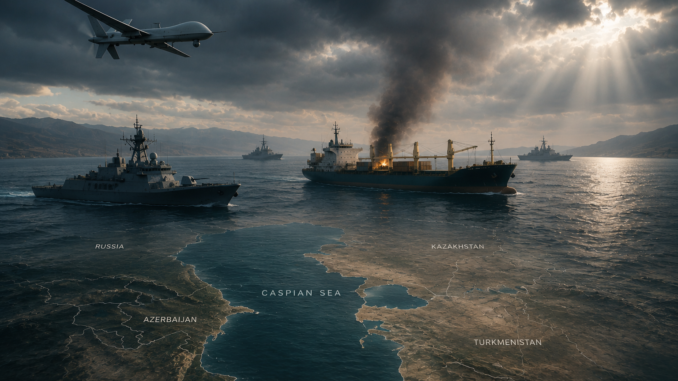
The reconstructed sequence is by now reasonably clear from Iranian, Ukrainian, and international reporting. Ukraine’s security services struck at least two vessels in the Caspian Sea, including a Russian missile boat and ships Kyiv identified as carrying military cargo moving between Iran and Russia. Iran’s Foreign Ministry said the strike caused an explosion aboard an Iranian commercial vessel, the Ana, sailing from the Russian port of Astrakhan to Anzali, killing one sailor and injuring several others. Iran described the ship’s cargo as civilian, a claim Russian Foreign Minister Sergey Lavrov echoed when he offered condolences for the sailor’s death. Ukraine’s account differs: President Zelensky said Kyiv had tracked what he described as a pattern in which Russian satellite surveillance of Gulf states and American facilities in the region was subsequently followed by Iranian strikes, and that the vessels hit were part of that logistics chain.
Iran’s Foreign Minister, Abbas Araghchi, went further than a routine protest. He called the strike a violation of the UN Charter that “cannot go unanswered,” summoned Ukraine’s chargé d’affaires in Tehran, and, notably, accused Israel of provoking the episode in an effort to “drag Europe into its war.” Ukraine’s Foreign Minister, Andrii Sybiha, rejected the framing outright, arguing that Tehran has been “a direct accomplice to Russian aggression” since 2022 through drone and missile transfers that have killed Ukrainian civilians. Both narratives cannot be fully true, and neither side has offered conclusive public evidence for its version of the cargo’s contents. What is not in dispute is the human cost, an Iranian sailor’s death, and the fact that a maritime corridor built for sanctions-evasion and wartime trade has now become a flashpoint in its own right.
The Washington Convergence
The timing in Washington deserves careful, unemotional reading rather than conspiratorial shorthand. Trump’s back-to-back meetings with Zelensky and Netanyahu on July 28 were long-planned, tied in part to the funeral of Senator Lindsey Graham, a figure who had championed both Ukraine and Israel in Washington’s corridors of power. Netanyahu came seeking continued American backing as Israel’s confrontation with Iran, now five months past the February strikes on Iranian nuclear-linked sites, reaches what officials describe as a pivotal and unresolved stage. Zelensky came seeking air-defense commitments and a path back toward negotiations with Moscow. Neither visit was engineered around the Caspian incident.
Yet coincidence of timing is not the same as absence of consequence. When the leaders of Israel and Ukraine sit in the same city, on the same day, discussing overlapping adversaries, with Washington positioned as principal security partner to both, the optics alone feed a narrative that Tehran and Moscow are eager to use: that a coordinated Western strategy is exerting simultaneous pressure on both Russia and Iran. Whether or not that is an accurate description of intent, it is precisely the kind of perception that accelerates alignment on the other side, drawing Moscow and Tehran, already bound by drone transfers, oil trade, and now a shared maritime grievance, into tighter strategic lockstep.
The Danger of Merging Two Wars
Every serious student of conflict escalation knows that wars rarely expand through a single dramatic decision. They expand through accumulated linkage, shared battlespaces, shared suppliers, shared adversaries, until actors that once fought separate wars for separate reasons find themselves entangled in one another’s calculus. The Caspian is precisely such a linkage point. It sits at the intersection of the Russia-Ukraine war’s logistics and the Iran-Israel confrontation’s supply lines. A strike there is not merely a tactical operation against a cargo route; it is a strike at the seam between two conflicts.
The risk is threefold. First, retaliatory logic: if Iran responds against Ukrainian assets or interests to satisfy its declared need to “answer” the attack, Kyiv’s Western partners, however reluctant, will face pressure to treat Iran as an active belligerent rather than a peripheral arms supplier to Russia. Second, alliance cohesion under strain: NATO members have carefully calibrated their support for Ukraine to avoid direct confrontation with Iran, and a widening of hostilities complicates that calibration considerably. Third, and most consequential, is the erosion of the very idea that regional conflicts can be contained. Once the precedent is set that a strike in one theatre can be answered in another, the door opens to a genuinely multi-front confrontation involving Russia, Iran, Ukraine, Israel, and by extension the United States and NATO, a scenario that serves no state’s declared interests and that most capitals, if asked privately, would say they wish to avoid.
Consequences for NATO, the Gulf, and Global Stability
For NATO, the danger is one of overstretch and internal disagreement. Alliance members are already divided over the pace and scale of support to Ukraine; a scenario in which that support becomes entangled with an active Iran-Israel war would test unity further, particularly among members wary of any steps that could be read as expanding NATO’s indirect footprint into the Middle East. For Gulf states, many of which have spent years carefully building working relationships with both Washington and Tehran, and increasingly with Moscow and Beijing as well, the merging of these conflicts threatens the delicate hedging strategy that has allowed them to pursue development and diversification rather than confrontation. A wider war raises insurance costs, disrupts energy and shipping routes, and forces uncomfortable choices on states that have deliberately avoided taking sides.
More broadly, the episode illustrates a pattern familiar to observers of the post-unipolar order: conflicts that begin as bilateral or regional disputes increasingly ripple outward because the world’s major supply chains, of weapons, energy, and information, are now genuinely global and interlinked. Zelensky’s own claim, that Russian satellite intelligence gathered over the Gulf has found its way into Iranian targeting, is itself evidence of how deeply intertwined these theatres have become, regardless of who struck first in the Caspian. In such an environment, unilateral military action anywhere carries second-order effects everywhere, and no single power, however capable, can fully control the consequences of escalation it initiates.
The Case for a Community of Shared Future
One proposed framework for addressing such interconnected security challenges is the concept of a Community of Shared Future for Mankind. That vision rests on a simple but often neglected premise: in a genuinely multipolar world, security cannot be built by one bloc at the expense of another, and sovereignty, including the sovereignty of states like Iran and Ukraine to determine their own security policies without becoming proxies in wars not entirely their own, must be respected as a foundation rather than treated as negotiable. Non-interference does not mean indifference to conflict; it means recognising that external involvement, including military assistance and intelligence cooperation, can increase the risk of escalation between the two conflicts.
The path forward is neither romantic nor complicated in principle, even if difficult in practice. It requires, first, an immediate and verifiable de-escalation channel between Kyiv and Tehran, ideally mediated by a party trusted by both, to prevent further maritime incidents from cascading into direct confrontation. Second, it requires the great powers most invested in these theatres, the United States, Russia, and by extension China and the European Union, to resist the temptation to treat the merging of these conflicts as strategic opportunity rather than collective danger. Third, and most fundamentally, it requires a renewed global commitment to dialogue over deterrence-by-escalation, recognising that a world of overlapping wars serves no civilisation’s long-term interest, prosperous or otherwise. Pakistan and much of the developing world have consistently argued, in forums from the United Nations to the Shanghai Cooperation Organisation, that peace is not a reward for the powerful but a shared public good that every state, large or small, has a stake in protecting. The Caspian Sea incident is a warning shot in more ways than one. Whether it becomes a turning point toward broader war or a sobering reminder to step back from the brink now depends less on who fired first than on whether the world’s major powers choose restraint over the seductive logic of an ever-widening fight.
The views presented in this article are the authors’ own and do not necessarily reflect the views of Global Strategic Forum – GSF.

Imran Bhatti
Imran Bhatti holds an M.Phil. in Governance and Public Policy and professional certifications as a Certified Information Systems Security Professional (CISSP) and Project Management Professional (PMP). He is a geopolitical analyst and writer specializing in energy geopolitics, great-power competition, Eurasian strategic affairs, and South Asian security dynamics. His work explores regional geopolitics, border disputes, infrastructure, security, and economic statecraft in an increasingly multipolar world.
- Imran Bhatti

- Imran Bhatti

- Imran Bhatti

- Imran Bhatti


Leave a Reply