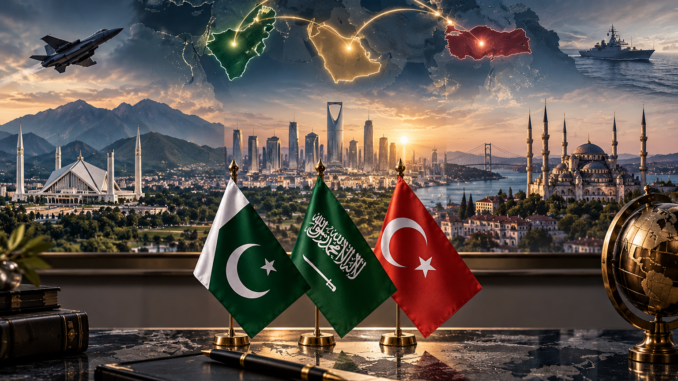
Decoding the Pakistan–Saudi Arabia–Türkiye Defence Pact: A New Regional Security Architecture, or a Calculated Strategic Understanding?
Will this become a durable regional security architecture or remain a calculated strategic understanding shaped by passing pressures?
The Middle East has always been a region where alliances are formed quietly and dissolved loudly. But something different appears to be taking shape three countries, each carrying significant strategic weight, are inching toward a formal defence arrangement that could, if it holds, redefine the region’s security grammar. Pakistan, Saudi Arabia, and Türkiye are not newcomers to strategic cooperation. What is new is the ambition: to build something institutional, something durable, out of a convergence of interests that, until recently, each pursued separately. Whether this becomes a genuine regional security architecture or remains a limited strategic understanding shaped by passing pressures is the central question diplomats, analysts, and policymakers are now asking with increasing urgency.
The Shifting Ground Beneath the Gulf
The impetus for a trilateral arrangement did not appear from nowhere. It grew out of a regional security environment that has been visibly deteriorating for years. Traditional external security guarantees long anchored by American military presence and commitment — have grown less certain. Washington’s posture in the Gulf has repeatedly signalled strategic fatigue: a reluctance to guarantee outcomes, a preference for burden-sharing, and an increasing unwillingness to absorb the political costs of direct military involvement in regional disputes.
This created a vacuum. Riyadh, Ankara, and Islamabad each drew their own conclusions, but the conclusions rhymed. The era of outsourcing one’s security to a distant power reliable in the Cold War, partial in the 2000s, uncertain today appears to be ending. In its place, regional actors are exploring what security self-reliance might look like. The proposed trilateral is one answer to that question, but it is still being written. The arrangement, as reported in early 2026 by Pakistani officials, draws on an existing bilateral Saudi-Pakistan Strategic Mutual Defence Agreement (SMDA) signed in September 2025, a framework that reportedly treats aggression against one party as aggression against both. Extending that logic to Türkiye, the second-largest military in NATO, is not a small step. It is a statement about the direction in which these three governments believe the regional order is moving.
Pakistan’s Unusual Position
Among the three partners, Pakistan occupies perhaps the most complex position. Islamabad has deep, institutionalised military ties with Riyadh from training Pakistani officers to deploying troops in Saudi Arabia. And yet Pakistan has consistently maintained workable relations with Tehran, navigating a narrow diplomatic lane that few countries manage with consistency. During the recent Iran-related regional crises, Pakistan did not simply pick a side. It quietly continued military commitments to Saudi Arabia while keeping diplomatic channels to Iran open. This is not strategic confusion, it is strategic flexibility, and it has earned Pakistan a kind of credibility that is genuinely rare. If the emerging pact aims to become more than a mutual defence clause on paper, Pakistan’s bridge-building capacity may be its most valuable asset.
Islamabad can speak to Riyadh without alarming Tehran, and to Tehran without destabilising Riyadh. That role is difficult to sustain indefinitely, especially if the pact hardens into an explicitly anti-Iran posture. But for now, it is precisely what gives the arrangement diplomatic breathing room, a window for principled engagement rather than forced alignment. Few regional powers can claim that kind of dual credibility, and Pakistan would be wise to guard it carefully.
Türkiye — The Reluctant but Rational Partner
The inclusion of Türkiye adds both capability and complexity. As NATO’s second-largest military and a country with an increasingly autonomous foreign policy, Türkiye brings real assets: advanced drone technologies that have already proven decisive in multiple theatres, a capable navy, a growing domestic defence industry, and significant expeditionary experience. But Ankara also brings complicated histories. The breakdown of Saudi-Turkish relations following the 2018 Khashoggi affair was severe. Erdoğan did not merely criticise Riyadh, he challenged Saudi leadership publicly, creating a rupture that many believed was irreparable.
Strategic necessity proved more powerful than political memory. Saudi-Turkish ties have been carefully rebuilt since 2022, with economic cooperation preceding and enabling security dialogue. Pakistan, which maintained strong defence relationships with both Ankara and Riyadh throughout this difficult period, helped keep the channels of communication open. The Al Jazeera Centre for Studies described this emerging regional framework not as a traditional alliance, but as a “pragmatic coordination mechanism” a telling phrase that hints at both the possibilities and the limits of what Türkiye’s participation can deliver. Coordination is not commitment. Participation is not obligation. But it is a beginning, and in regional security terms, beginnings have a way of accumulating into something more substantial when the pressures that created them persist.
What Kind of Pact? The Unanswered Questions
The critical details of the proposed arrangement remain, for now, confidential. And those details matter enormously. A mutual defence clause, the kind that treats an attack on one member as an attack on all — is politically significant but operationally meaningless without clarity on what threats trigger it, how forces would actually be deployed, and under what conditions the clause activates. Several likely operational domains have emerged from public reporting: air defence support in the event of sustained attacks on Saudi infrastructure; maritime security in key chokepoints, including the Strait of Hormuz and Bab el-Mandeb, where a Saudi-led coalition of 14 countries (including both Pakistan and Türkiye) already coordinates; infrastructure protection against drone and missile threats; and counter-terrorism cooperation.
These are defensible, practical, and relatively uncontroversial. What would be more consequential and more difficult is a formal collective defence commitment comparable to NATO’s Article 5. Whether the final text includes such a provision, and how broadly or narrowly it is defined, will determine whether this arrangement becomes transformational or tactical. A pact that addresses real security gaps in a measured, practical way may ultimately prove more durable than one that over-promises and under-delivers.
The Sectarian Shadow — and Why It Must Be Avoided
One risk deserves frank acknowledgement: the trilateral pact could come to be perceived as a Sunni military bloc. That perception, even if inaccurate, would be damaging. It would reduce Pakistan’s usefulness as a diplomatic bridge. It would foreclose Saudi Arabia’s ongoing efforts to manage its relationship with Iran without permanent rupture. It would hand adversaries a narrative that transforms a security arrangement into a civilisational provocation. None of the three governments has framed the arrangement in sectarian terms. All three have publicly maintained that they are building defensive, not offensive, structures. Sustaining that framing requires discipline and it requires resisting pressure, from domestic audiences and foreign commentators alike, to cast the pact as something it is not. Political coherence, in other words, may prove harder to maintain than military interoperability. Soldiers can be trained to work together across borders. Politicians and publics are harder to align.
Strategic Hedging, Not Strategic Rupture
It is also important to resist overstating what this arrangement means for American interests. This is not a bloc forming against Washington. It is, more accurately, a hedge against a future in which Washington is less available. The three countries do not seek to evict American influence from the region, they seek to ensure that their security does not depend entirely upon it. That is a rational response to the uncertainty of the current international order, not a declaration of opposition. For the United States, the arrangement should be read as an invitation to engage rather than a signal to disengage. A stronger regional security structure that shares burdens could serve American strategic interests, provided it remains defensive in character and transparent in intent. The alternative a vacuum filled by less accountable actors serves no one’s long-term interests, least of all Washington’s.
The Architecture of Uncertainty
The Pakistan–Saudi Arabia–Türkiye defence pact is best understood as a work in progress, a strategic possibility rather than a settled reality. Its ambition is visible; its durability is yet to be tested. The geopolitical drivers that brought these three countries to the table are real and unlikely to disappear. The institutional challenges that must be overcome to make the arrangement durable are equally real. For policymakers, the lesson is that regional security architectures are built not by signing documents but by accumulating trust, resolving divergent threat perceptions, and maintaining political coherence under pressure. For Pakistan in particular, the challenge is to remain what it has been at its best: a bridge between rivals, a mediator with muscle, and a partner that amplifies stability rather than contributing to polarisation. The region does not need another alliance built on fear. It needs one built on judgment. Whether the emerging pact can become that kind of arrangement principled, practical, and genuinely stabilising is the question that the next few years will answer. The stakes are high enough that the question deserves to be asked carefully, and answered honestly.
The views presented in this article are the authors’ own and do not necessarily reflect the views of Global Strategic Forum – GSF.

Imran Bhatti
Imran Bhatti holds an M.Phil. in Governance and Public Policy and professional certifications as a Certified Information Systems Security Professional (CISSP) and Project Management Professional (PMP). He is a geopolitical analyst and writer specializing in energy geopolitics, great-power competition, Eurasian strategic affairs, and South Asian security dynamics. His work explores regional geopolitics, border disputes, infrastructure, security, and economic statecraft in an increasingly multipolar world.
- Imran Bhatti

- Imran Bhatti

- Imran Bhatti

- Imran Bhatti


Leave a Reply