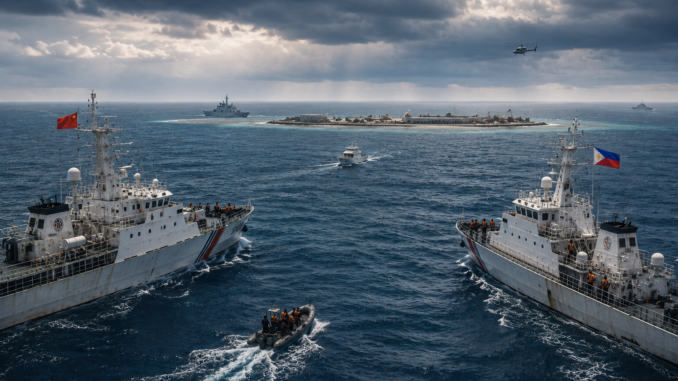
As strategic competition intensifies across the Indo-Pacific, the South China Sea has emerged as a critical arena where maritime disputes, gray-zone coercion, and the limits of international law are reshaping regional security and the international order.
1. Introduction
Starting in 2022, the conflict over the South China Sea got worse and more dangerous. What had once been characterized by gradual island-building, diplomatic protests, and occasional maritime standoffs evolved into regular confrontations between Chinese and Philippine forces. This was the most important change to Indo-Pacific security architecture since the end of the Cold War. The sea is home to some of the world’s most productive fisheries and large hydrocarbon reserves.
It is also the route for about 3.4 trillion US dollars in global trade each year. Hundreds of millions of people in Southeast Asia depend on these fisheries for their food security (USGS,2010; AMTI/CSIS, 2025). China’s nine-dash line claims approximately 90 percent of the South China Sea. The Permanent Court of Arbitration (PCA) said in 2016 that it had no legal basis (PCA, 2016). Beijing’s refusal to accept the ruling has turned the South China Sea into the most important test case for whether international law can work when a big power chooses to ignore it.
2. Strategic Context: The 2016 Precedent, Claims, and the Law:
China signed the United Nations Convention on the Law of the Sea (UNCLOS) in 1996. It sets up exclusive economic zones (EEZs) of 200 nautical miles where coastal states have sovereign rights to marine resources. China’s nine-dash line claim is based on assertions of historical rights that many legal scholars argue are inconsistent with UNCLOS. The Permanent Court of Arbitration’s decision in July 2016 made the legal issue very clear.
The tribunal ruled that China’s claims to historic rights had no legal basis under UNCLOS and that China had violated the Philippines’ sovereign rights by interfering with fishing and energy exploration in the Philippine EEZ, and that none of the Spratly features could be called an island that could give rise to EEZ rights (PCA, 2016). China firmly rejected the ruling, calling it “null and void,” and has never followed any of the findings.
This refusal has turned out to be a significant challenge to the authority of international maritime law. It established that permanent members of the UN Security Council can openly disregard binding international rulings without facing proportionate consequences. Since 2021, the real-world effects have gotten worse. The China Coast Guard Law of February 2021 gave Chinese coast guard ships the right to use weapons against foreign ships in waters that Beijing claims, which is a definition so broad that it includes the EEZs of every SCS claimant (China Coast Guard Law, 2021).
3. China’s Island-Building Campaign
3.1 Facts on the Sea
Between 2013 and 2016, China built around 3,200 acres of artificial islands on submerged reefs in the Spratly chain. This amount is more land than all other claimants combined created in the previous four decades, and it was accomplished in much less time (AMTI/CSIS, 2024). On three major features Fiery Cross Reef, Subi Reef, and Mischief Reef China constructed military runways about 3,000 meters long that can accommodate long-range bombers and maritime patrol aircraft. They also deployed deep-water ports, surface-to-air and anti-ship missile batteries, advanced radar installations, and signals intelligence facilities. Transforming previously submerged reefs into fully equipped military forward operating bases has permanently changed the regional military balance.
3.2 Strategic Logic
The campaign serves several strategic purposes. Operationally, the artificial islands greatly extend China’s anti-access and area-denial capabilities. This complicates the ability of US carrier strike groups to operate freely within the first island chain during a crisis (Fravel, 2020). Diplomatically, the islands create permanent realities that Beijing believes its exhausted neighbors will eventually accept. Domestically, its assertiveness in the South China Sea signals the Communist Party’s commitment to
national rejuvenation and reversing what Chinese political discourse terms the ‘century of humiliation’ (Hayton, 2014). This aspect explains why China has been willing to face significant reputational costs in pursuing claims that hold symbolic value for Party legitimacy, surpassing any simple calculation of material interest.
4. Gray-Zone Coercion: Second Thomas Shoal
4.1 The Architecture of Gray-Zone Operations
China’s strategy in the South China Sea is best understood as a systematic campaign of gray-zone coercion. This involves deliberate actions below the level of armed conflict, designed to achieve strategic objectives while denying adversaries a clear reason for a strong response (Green et al., 2017). The China Coast Guard, which came under direct PLA command in 2021, deploys some of the largest coast guard vessels in the world to crowd, block, and obstruct Philippine and Vietnamese ships operating within their own legal Exclusive Economic Zones (EEZs). The maritime militia, made
up of ostensibly civilian fishing vessels crewed by PLA-trained personnel, adds a second layer of coercion through its presence.
4.2 Second Thomas Shoal: The Live Flashpoint
Second Thomas Shoal, about 105 nautical miles from Palawan within the Philippine EEZ, has seen near-constant confrontation since 2023. The Philippines maintains a rotating garrison of marines aboard the deliberately grounded BRP Sierra Madre. China has systematically tried to prevent resupply of this garrison, aiming to starve the Filipino military presence without outright attacking (Philippine DND, 2024).
Between August 2023 and early 2025, Chinese coast guard vessels carried out multiple documented confrontations using military-grade water cannons. They blinded Philippine sailors with military-grade lasers and, in October 2023, boarded and seized Philippine Navy rigid inflatable boats, confiscating weapons and supplies. These actions led to formal US invocations of the Mutual Defense Treaty and condemnations from Japan, Australia, Germany, the United Kingdom, and the
The Marcos administration responded with a strategy of visible deterrence, deploying journalists and cameras on resupply missions starting in late 2023. They broadcast footage of Chinese aggression to a global audience in real time. This approach made coercive incidents visible internationally, raising the reputational cost of each Chinese escalation and generating unprecedented third-party support for Manila (AMTI/CSIS, 2025).Gray-zone coercion works precisely because it prevents adversaries from finding a clear trigger for response. Each incident stands alone as defensible; together, they achieve significant territorial change.
5. The Counter-Coalition: AUKUS, Quad, and EDCA
The intensification of the dispute has driven the most significant restructuring of Indo-Pacific security architecture since the Cold War. AUKUS, announced in September 2021, became operational through the 2023 Optimal Pathway agreement.
This plan commits the United States and the United Kingdom to transferring nuclear-powered submarine technology to Australia (US DoD, 2023). The acquisition of Virginia-class submarines by Australia, expected to begin in the early 2030s, would offer a new level of underwater deterrence within China’s A2/AD envelope.
The Quadrilateral Security Dialogue, or Quad, includes the United States, Japan, India, and Australia. It has regular maritime exercises focused on Indo-Pacific security, with specific mentions of freedom of navigation in the South China Sea in recent summit statements. Japan’s 2022 National Security Strategy marked a major shift from its post-war pacifist policies.
It committed to doubling defense spending to two percent of GDP and acquiring counter-strike capabilities (Japan MOD, 2022). The United States and the Philippines also expanded the Enhanced Defense Cooperation Agreement in 2023 to include four new base sites in Luzon and Palawan, relevant to both the South China Sea and any Taiwan contingency (US DoD, 2023).
In contrast, ASEAN still struggles with its consensus requirement, which allows Cambodia and Laos, often viewed as closer to Beijing, to block unified positions. The Code of Conduct negotiations, promised since 2002, have remained unresolved after over two decades of discussions. China has reportedly sought provisions that would exclude the United States from regional security arrangements, effectively securing its dominant position (Hayton, 2014).
Middle powers like Japan and Australia are increasingly influencing the dispute through capacity-building, joint exercises, and diplomatic pressure. European actors, including the European Union, have also started engaging through freedom of navigation operations and political statements. This growing involvement indicates that the South China Sea is no longer just a regional issue but a global strategic concern.
6. Theoretical Analysis
6.1 Realism: Confirmed at the Margins
From a realist viewpoint, the South China Sea dispute is a predictable outcome of a rising great power using its growing resources to establish regional dominance (Mearsheimer, 2001). China’s advancement has been limited solely by the opposing military power of the United States and its partners, not by legal norms or diplomatic protests. Where deterrence has worked, it has done so through credible military signals: reaffirming the Mutual Defense Treaty, the AUKUS submarine deal, and Japan’s defense expansions. This supports the realist idea that material power, rather than legal rights, dictates territorial control.
6.2 Liberal Institutionalism: Challenged but Not Nullified
Liberal institutionalism faces a significant challenge in the South China Sea (Ikenberry, 2011). China has taken on the reputational costs of non-compliance, which can be seen in the growing anti-China coalition. Yet, it has continued its campaign unchanged. The South China Sea dispute raises questions about the effectiveness of binding legal rulings in influencing the behavior of major powers. Still, the PCA ruling remains the legal foundation
for the Philippines’ protests, US Freedom of Navigation Operations (FONOP) justifications, and third-party condemnations. Institutions may lack the power to coerce great powers, but they lay the groundwork for political legitimacy contests.
6.3 Constructivism: Identity and the Impossibility of Compromise
Constructivist analysis highlights aspects that realism and liberal institutionalism miss (Wendt, 1999). China’s strong political investment in the nine-dash line, maintained at significant diplomatic and reputational costs, shows how the claim is deeply tied to Chinese national identity and Party legitimacy. The narrative of the ‘century of humiliation’ and ‘great rejuvenation’ frames the South China Sea not just as a strategic asset but as a symbol of regained sovereignty. This aspect severely limits Beijing’s political ability to compromise, even when a rational look at material interests suggests that accommodation would be strategically smarter. The Philippines’ transparent deterrence strategy itself is a constructivist move, using information and narrative to reshape the legitimacy of the dispute and increase international support.
7. Future Trajectories of the South China Sea Dispute
The South China Sea dispute will likely evolve along several paths, influenced by power distribution, alliance unity, and domestic politics within claimant states. One possible path is controlled escalation, where gray-zone tactics continue without leading to open conflict. Another potential trajectory is a militarized crisis, especially if an incident at Second Thomas Shoal triggers the Mutual Defense Treaty. A third, less likely scenario is managed de-escalation through diplomatic compromises or economic ties. However, based on current trends, gradual intensification seems the most probable outcome.
The South China Sea must be viewed in the context of Taiwan. Any conflict over Taiwan would quickly turn the South China Sea into a logistical and operational arena for naval forces. US bases in the Philippines under the Enhanced Defense Cooperation Agreement (EDCA) and Chinese military outposts in the Spratlys would become crucial. This connection increases the strategic importance of the South China Sea and raises the risk that a localized dispute could escalate into a broader regional war.
Emerging technologies are changing the dynamics of the dispute. The rising use of drones, satellite surveillance, cyber capabilities, and artificial intelligence enhances both monitoring and coercion. China’s integration of maritime militia and coast guard assets plays a significant role in this transformation. While the US and its allies invest in new naval and undersea technologies, this technological competition will likely increase gray-zone operations instead of replacing them.
The militarization and overexploitation of the South China Sea are causing severe environmental damage. Coral reefs are being destroyed by island-building and overfishing, which threatens marine biodiversity. Climate change, especially rising sea levels, may change the physical geography of contested features and could affect legal claims under UNCLOS. Environmental stress may become an additional driver of conflict in the future.
8. Economic and Energy Security Implications
Beyond military tensions, the dispute has major consequences for global economic stability. About one-third of global maritime trade goes through this region, making it a vital part of globalization. Disruptions could impact energy supplies, supply chains, and food security. Control over fisheries and seabed hydrocarbons heightens competition, especially for developing Southeast Asian countries dependent on these resources.
9. Policy Recommendations and Strategic Options
To manage the dispute, several policy options arise:
- Strengthen deterrence through a credible military presence
- Increase legal and diplomatic pressure using international forums
- Promote ASEAN unity to lessen internal divisions
- Expand transparency strategies similar to the Philippines’ model
- Encourage crisis communication mechanisms to prevent escalation
- A balanced approach combining deterrence and diplomacy offers the most realistic path forward.
10. Conclusion
The South China Sea dispute represents a crucial test for the resilience of the global rules-based order. China’s dismissal of the South China Sea Arbitration challenges the authority of international legal institutions. If this behavior becomes normal, it could undermine compliance mechanisms globally and encourage other nations to favor power over law. The outcome of this dispute will shape norms well beyond Southeast Asia.
The South China Sea is not just a regional conflict; it is a defining arena of 21st-century great-power competition, especially between the United States and China. The patterns seen here gray-zone coercion, disputed legality, and coalition balancing are likely to occur in other regions as well. Thus, this dispute serves as a testing ground for the future of international politics.
The South China Sea dispute in 2025 is no longer a slow-moving strategic contest. It is an active confrontation where fundamental questions about the contemporary international order are being resolved through daily operations. The answers emerging from this practice are uncomfortable but instructive. Without enforcement power, international law cannot change the behavior of a determined great power with critical interests.
Multilateral institutions can be divided and paralyzed by ongoing pressure. Gray-zone tactics work because they prevent adversaries from setting clear boundaries for forceful response. Nonetheless, deterrence operates at the margins, normative frameworks influence legitimacy contests even when broken, and the formation of an Indo-Pacific counter-coalition has imposed significant costs on China’s strategic position.
The deeper implication of the South China Sea on current International Relations is that the post-war order is not collapsing in a dramatic event but is being chipped away through small, deniable steps each defensible on its own but cumulatively transformative. The South China Sea is not just a regional hotspot; it is a glimpse of the future world.
The views presented in this article are the authors’ own and do not necessarily reflect the views of Global Strategic Forum – GSF.

Zahra Asad
The writer is a BS International Relations student at the National University of Modern Languages (NUML), Rawalpindi. Her interests include geopolitics, international security, foreign policy, and great-power competition. She can be reached at kayanizahra7@gmail.com.
- Zahra Asad


Leave a Reply