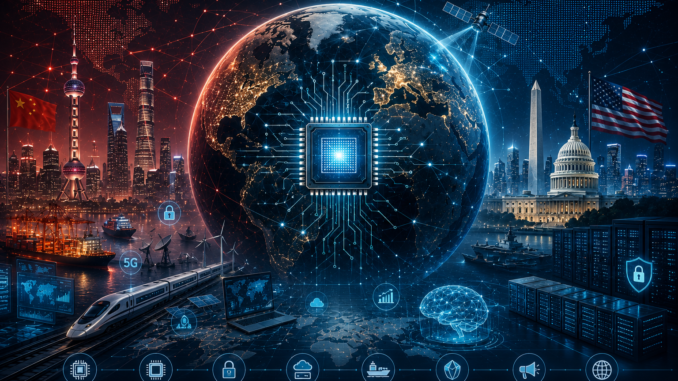
How China’s AI Strategy Is Reshaping the Global Order
Beijing’s investment in artificial intelligence is not simply a technology race. It is a deliberate attempt to rewrite the rules governing international power, economic dependency, and military advantage.
In January 2025, a relatively obscure Chinese AI lab called DeepSeek did something Wall Street did not see coming. Within a single trading session, Nvidia alone lost nearly $600 billion in market value, triggering a broader sell-off across U.S. technology stocks. Analysts spent days trying to work out how a Chinese company had built a large language model competitive with OpenAI’s best — apparently at a fraction of the cost, and reportedly using chips that were supposed to be off-limits under U.S. export controls. It wasn’t a one-off. It was a warning shot.
The message behind it is straightforward, even if its implications are not: American dominance in artificial intelligence can no longer be taken for granted. And the more important point is this — Beijing isn’t simply trying to close a technology gap. It is pursuing a strategic vision that spans generations, one in which AI functions as the central lever for reshaping the global order. That is not a hypothetical for policymakers, military planners, intelligence officers, and governance scholars to prepare for someday. It is already happening.
China’s AI ambitions are not a technological race. They are a calculated bid to rewrite the rules of international power.
Historical Context: From Sputnik to Algorithms
History has seen this pattern before — a rival power’s sudden technological leap forcing an existing order to recalibrate. When the Soviet Union launched Sputnik in 1957, Washington’s response went well beyond building its own satellite. It rewrote school curricula, stood up DARPA, and restructured how the nation approached science policy altogether. That was never really about the satellite; it was about what the satellite implied. The current AI moment carries a similar weight.
China’s push into artificial intelligence didn’t happen by accident. It was planned. In 2017, Beijing published its New Generation Artificial Intelligence Development Plan, laying out an explicit target: become the world’s leading AI power by 2030. What followed was a coordinated set of policies — the Made in China 2025 industrial programme, the Digital Silk Road strand of the Belt and Road Initiative, and a Civil-Military Fusion doctrine that effectively erased the line between commercial tech development and military application. Where the Soviet programme was largely inward-facing, China’s AI strategy points outward. It is built to reshape the infrastructure of the global economy and to embed Chinese technical standards inside other countries’ systems of governance.
Current Developments: The Architecture of a New Paradigm
By mid-2026, the scale of China’s AI mobilisation is hard to overstate. Industry estimates suggest Huawei’s AI chip revenue could approach $12 billion in 2026, a 60 percent jump year-on-year, as domestic semiconductor makers work to route around U.S. export restrictions. SMIC is ramping up 5-nanometre production. At the 2026 World Economic Forum, 87 percent of surveyed Chinese companies said they were accelerating AI investment, and more than half reported progress moving faster than expected. DeepSeek’s open-source strategy fits neatly into this picture: giving the code away for free builds global reliance on Chinese AI architecture while winning goodwill among developers and governments across the Global South who simply cannot afford American-priced alternatives.
China’s 2025 Global AI Governance Action Plan adds a normative layer to all of this. Framed as a contribution to UN-based multilateralism, it positions Beijing not as a country that follows the rules others set, but as one writing new ones — proposing frameworks for AI safety, data sovereignty, and international standards that happen to align closely with China’s own model of state-led digital governance. Meanwhile, the Digital Silk Road has become the delivery mechanism, embedding Chinese AI platforms into national infrastructure across more than sixty countries, from surveillance networks in East Africa to smart-city systems throughout Southeast Asia.
Strategic Implications: The New Geometry of Power
The strategic consequences of China’s AI progress run deep. At the most basic level, AI is compressing the decision cycle of statecraft. Intelligence analysis, logistics planning, signals processing, and battlefield command — tasks that once took days or weeks — can now happen in minutes. The People’s Liberation Army has already folded AI into drone swarms, autonomous naval systems, and predictive battlefield tools, drawing openly on the swarming behaviour of hawks and coyotes for inspiration. For the PLA, AI isn’t an add-on to existing capability. It’s the variable expected to define the next era of warfare outright.
For the United States and its allies, this presents a pacing problem unlike anything in previous arms races. Nuclear weapons were expensive to build and physically hard to proliferate. AI is neither. It scales quickly, gets cheaper by the month, and spreads across state and non-state actors alike at a pace that should worry anyone paying attention. A country that pulls ahead in AI isn’t just acquiring a new weapon — it’s gaining leverage across nearly every domain of statecraft at once.
The nation that sets the global standard for AI governance will, in effect, be setting the rules for the next century of international order.
Political Implications: The Battle for the Norm
Geopolitical rivalry has always been as much about legitimacy as it is about territory or resources. After 1945, the United States largely succeeded in building its preferred norms — liberal democracy, open markets, rule of law — into the fabric of international institutions. China appears to be attempting the same manoeuvre, this time in the digital domain. By promoting a governance model built around national sovereignty, state control of data, and managed information flows, Beijing is offering an alternative that carries real appeal for governments wary of Western liberal norms.
This isn’t purely a matter of ideology, either. Countries that adopt Chinese AI platforms, standards, and regulatory approaches end up with structural dependencies that gradually shape their own governance choices. A country whose surveillance infrastructure runs on Huawei hardware, and whose e-government services sit on Chinese AI platforms, is not a neutral bystander in the US-China rivalry. In the digital age, political alignment increasingly follows technological alignment — whether or not that was the intention.
Economic Consequences: Dependency by Design
China’s approach to AI deserves closer economic scrutiny than it usually gets. Its open-source model is frequently mistaken for generosity. In reality, it’s a long-game market strategy. By giving away powerful AI models to developers in emerging economies at no cost, China builds the human capital and technical foundations of those economies on Chinese infrastructure from the ground up. When those countries eventually need AI capacity at national scale — cloud computing, data centres, semiconductor supply chains — Chinese firms are already positioned as the cheapest and most familiar option.
The U.S.-China Economic and Security Review Commission’s March 2026 analysis calls this a ‘two-loop’ strategy: an inner loop that builds domestic industrial capacity, reinforced by an outer loop that captures international markets. For developing economies — Pakistan among them, along with India’s neighbours and much of sub-Saharan Africa — this creates a genuine dilemma. Nations without independent AI capability are left choosing between two forms of dependency, American or Chinese. Neither comes free of cost.
Security Implications: Intelligence, Surveillance, and the Invisible War
For intelligence professionals and national security planners, China’s AI progress opens up threats that sit well below the threshold of open conflict. Senior U.S. officials have assessed that DeepSeek’s models could potentially assist Chinese military and intelligence operations — a concern serious enough that the U.S. military has barred service members from using the platform. Wherever Chinese AI systems get embedded into national infrastructure, they create a persistent channel for intelligence collection, influence operations, and, in the worst case, sabotage.
More broadly, because China’s Civil-Military Fusion doctrine makes commercial AI development inseparable from state intelligence requirements, many governments increasingly assess Chinese AI products through both commercial and national-security lenses because of China’s Civil-Military Fusion strategy. The deployment of Chinese AI platforms in another country’s critical infrastructure may introduce potential intelligence and cybersecurity considerations that governments should assess carefully. Cybersecurity teams and procurement officials in allied nations need frameworks that actually account for this.
Regional Impact: South Asia at the Intersection of Competing Visions
For South Asia, and Pakistan especially, China’s rise as an AI power isn’t an abstract concern — it’s already a live governance, economic, and security question. Pakistan’s deep integration with China through the China-Pakistan Economic Corridor means Chinese digital technologies and infrastructure have become increasingly integrated into Pakistan’s telecommunications, energy, and smart-city initiatives. The governance questions this raises — around data sovereignty, civil liberties, and the independence of regulatory bodies — need attention from policymakers now, not later.
India offers a useful contrast. New Delhi has pursued technological self-reliance, investing heavily in domestic AI development through its National AI Mission, while at the same time deepening ties with Western technology partners. The India-US Initiative on Critical and Emerging Technologies (iCET) is a concrete attempt to keep India’s AI development compatible with democratic governance norms. How India and Pakistan diverge on AI infrastructure over the next decade could turn out to be one of the more consequential fault lines in the region.
International Reactions: Coalition-Building and the Limits of Decoupling
The international response to China’s AI rise has been urgent, fragmented, and increasingly aware that full decoupling simply isn’t realistic — economically or strategically. Washington has pursued a layered approach: export controls on advanced semiconductors, the CHIPS and Science Act to rebuild domestic manufacturing, and active technology diplomacy aimed at building coalitions of democracies committed to AI norms that preserve openness and civil liberties.
The European Union’s AI Act, the G7’s Hiroshima AI Process, and the UK’s Safety Summit framework are all attempts to build a normative counterweight to China’s model. But their reach is limited by one glaring gap: the near-total absence of the Global South from these conversations. Countries across Africa, the Middle East, and South and Southeast Asia aren’t passive observers here — they are, in many ways, the actual battleground. Any international AI governance framework that ignores their interests will simply hand the field to Beijing by default.
Risks and Opportunities: The Strategic Paradox
China’s AI rise carries real risks for the global order, but it also opens up opportunities that policymakers shouldn’t dismiss out of hand. On the risk side: military AI advancing without agreed rules of engagement, surveillance infrastructure spreading that lets authoritarian governments tighten their grip on citizens, and single-point technological dependencies getting locked into critical national infrastructure in ways that are hard to reverse later.
On the opportunity side, the competitive pressure itself has value. American investment in AI has accelerated sharply precisely because of the Chinese challenge. That same dynamic could push democratic nations toward a new era of scientific collaboration, help build AI safety frameworks with genuine multilateral legitimacy, and give developing nations real incentive to build their own AI capacity rather than default to one patron or another. Competition, handled well, doesn’t have to be purely destructive.
Future Scenarios: Three Possible Worlds
Looking a decade out, three broad scenarios seem plausible. The first — call it a ‘Bifurcated World’ — sees the internet and AI landscape splitting into two incompatible ecosystems, one led by Washington and one by Beijing, with smaller nations forced to pick a side because switching later would be prohibitively expensive. Given current trajectories, this is arguably the most likely outcome if nothing changes.
The second scenario, ‘Managed Competition,’ imagines the United States and China recognising the mutual danger of unmanaged AI rivalry — particularly in the military sphere — and establishing limited but durable channels for communication and risk reduction. It would look something like Cold War arms control: imperfect, often adversarial, but functional enough to prevent catastrophic miscalculation.
The third, ‘Multilateral Convergence,’ is the most optimistic and, realistically, the least likely in the near term — though arguably the most desirable outcome for global stability. It would mean a genuinely inclusive international AI governance framework, anchored in the UN but carrying real authority, setting binding norms on military AI, data governance, and the rights of individuals living in AI-mediated societies. Reaching that point would take a degree of strategic foresight and diplomatic investment that current political conditions in both Washington and Beijing make unlikely. Not impossible — just unlikely.
Policy Recommendations
1. Build national AI security frameworks.
Generic cybersecurity policy isn’t enough anymore. Governments need AI-specific national security frameworks that account for procurement risk, exposure to Civil-Military Fusion, and the intelligence dimensions of foreign AI platforms sitting inside critical infrastructure. Not having such a framework isn’t a neutral choice — it’s a vulnerability.
2. Invest in AI sovereignty for the Global South.
Western democracies and international financial institutions should treat domestic AI capability-building in developing nations as a priority, not an afterthought. Offering credible, affordable alternatives to Chinese AI infrastructure is both the right thing to do and a strategic necessity. The current financing gap here is one of the more costly unforced errors in Western AI policy.
3. Build genuinely inclusive AI governance architectures.
International AI governance efforts need to bring Global South governments in as co-designers, not just as parties to be consulted after the fact. Frameworks built only among Western democracies won’t carry the legitimacy or reach needed to counter China’s normative ambitions in the digital space.
4. Pursue military AI risk reduction.
Washington and Beijing should open dedicated diplomatic channels to manage military AI risks — protocols for autonomous systems, AI-enabled cyber operations, and crisis communication among them. In a landscape where AI-enabled weapons are proliferating fast, the absence of such channels is a structural danger neither side can really afford.
5. Raise AI literacy among policymakers.
AI can’t be left to technologists alone. Governments need to build real AI literacy inside foreign ministries, legislatures, military commands, and intelligence services. Decisions about procurement, governance, and international negotiation need to be grounded in genuine understanding — not deference to whatever vendors happen to be pitching.
Conclusion: The Stakes of the Algorithm
China’s emergence as a transformative force in global AI is no longer a matter for debate — it’s an empirical fact that policymakers can’t keep treating as an abstraction. DeepSeek’s January 2025 shock wasn’t the start of this story; it was simply the moment the story became too loud to ignore. What lies behind it is years of sustained investment, strategic patience, and institutional follow-through — the kind of long-horizon commitment that democratic governments, hemmed in by four-year election cycles and short-term political incentives, have consistently struggled to match.
The real question facing policymakers isn’t whether China will become a major AI power. It already is one. The question is whether the international community will help shape the terms on which that power gets exercised — or whether inaction, fragmentation, and a failure of imagination will let Beijing set those terms alone. The architecture of the next global order is being written right now, in algorithms, data centres, and governance frameworks. History tends not to be kind to those who looked away.
The architecture of the next global order is being written in algorithms, data centres, and governance frameworks — today.
The views presented in this article are the authors’ own and do not necessarily reflect the views of Global Strategic Forum – GSF.

Imran Bhatti
Imran Bhatti holds an M.Phil. in Governance and Public Policy and professional certifications as a Certified Information Systems Security Professional (CISSP) and Project Management Professional (PMP). He is a geopolitical analyst and writer specializing in energy geopolitics, great-power competition, Eurasian strategic affairs, and South Asian security dynamics. His work explores regional geopolitics, border disputes, infrastructure, security, and economic statecraft in an increasingly multipolar world.
- Imran Bhatti

- Imran Bhatti
- Imran Bhatti
- Imran Bhatti


Leave a Reply