A perspective on Sky47, and the case for building AI capacity at home
Pakistan has quietly crossed a threshold. With the launch of Sky47, its first large-scale, AI-ready network of data centers, the country is no longer just talking about digital transformation — it is building the physical backbone for it. Developed by Mari Technologies, a subsidiary of the Fauji Foundation’s energy arm Mari Energies, the project is less about servers and cooling systems than it is about intent: a statement that Pakistan wants a seat at the table in the global AI economy, rather than remaining a spectator to it.
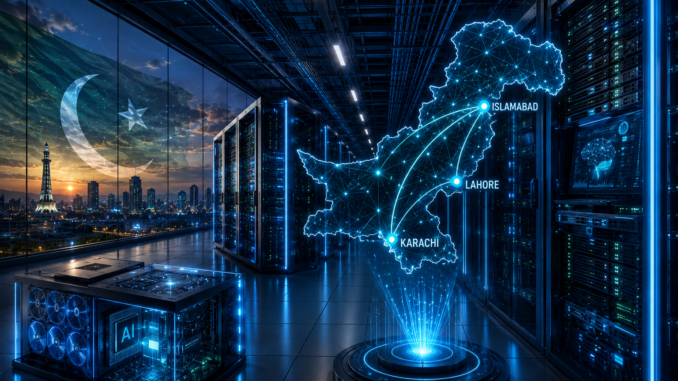
I have tracked Pakistan’s technology sector for years, from its early days as an IT-outsourcing hub to the current, more ambitious conversations about data sovereignty and homegrown AI talent. What makes Sky47 notable is both its scale and its timing. Facilities are live or nearing completion in Islamabad and Karachi, with Lahore next in line, forming the outline of a national backbone for cloud computing, high-performance computing, and AI workloads. Having a major energy company behind the project brings something the sector has often lacked: serious capital, engineering discipline, and the kind of long-horizon patience that infrastructure projects, unlike software startups, actually require.
It is worth pausing on why that backing matters so much. Pakistan’s tech ecosystem has no shortage of ambition, but it has historically struggled to convert ambition into durable infrastructure. Telecom rollouts have been uneven, power supply to industrial zones has been inconsistent, and large capital projects have often stalled somewhere between announcement and completion. An energy conglomerate stepping into the data-center business changes that calculus, because it brings exactly the two things infrastructure of this kind needs most: money that can be deployed over a decade rather than a single funding cycle, and firsthand experience managing power-hungry, safety-critical assets.
Why Infrastructure Is the Real AI Bottleneck
Modern AI is no longer just a software problem. Training and running today’s models demands enormous computing power, dependable energy, low-latency connectivity, and tight security controls. Countries that lack this capacity end up exporting their data — and with it, a measure of their sovereignty — to foreign hyperscale providers such as AWS, Azure, or Google Cloud. That arrangement is not without merit; renting compute from a hyperscaler is often faster and cheaper than building your own. But it comes at a cost that is easy to underestimate: every workload that runs on foreign soil is a workload governed, in practice, by foreign law, foreign outages, and foreign pricing decisions.
Sky47’s facilities are being developed to Tier III/IV standards, with the Islamabad facility having achieved Tier III Certification of Design Documents. That combination gives Pakistani banks, hospitals, government bodies, and startups a way to process sensitive data domestically while still tapping into serious AI compute. It also, notably, gives them a fallback: if a foreign provider changes its terms, raises its prices, or becomes politically unavailable, there is now a domestic alternative that did not exist before.
From a cybersecurity standpoint — an area I care about deeply as a CISSP and CEH — keeping infrastructure local sharply reduces the exposure that comes with sending data across borders. Easier regulatory compliance, lower latency for real-time applications, and tighter control over physical and logical security are not abstract benefits; in a climate of rising geopolitical friction and data-localization rules, they are strategic assets. A bank that can point to a
domestic, auditable data center is in a fundamentally stronger position with regulators than one that has to explain a contract with a provider on another continent.
The Upside for Pakistan’s Economy
The possibilities here are genuinely exciting. Pakistan’s software industry, already known for serving global clients, has an opening to move beyond outsourcing and into higher-value, AI-driven work. Picture local fintech platforms using machine learning for credit scoring and fraud detection, or hospitals running AI-assisted diagnostics without ever sending patient records abroad. The effects could ripple well beyond tech, and a few sectors stand out as particularly ready to benefit.
Agriculture, still the backbone of the national economy, could see real gains from smarter irrigation scheduling, early crop-disease detection through image analysis, and better supply-chain forecasting that reduces the waste baked into current distribution networks. Healthcare stands to benefit from AI-assisted diagnostics and predictive analytics that keep sensitive patient data onshore, which matters both for privacy and for the simple practical reason that Pakistani clinical data trains models that actually understand Pakistani patients, rather than models trained exclusively on Western datasets.
In finance, real-time fraud detection and more accurate, locally-calibrated credit scoring could extend formal financial services to segments of the population that conventional banking has historically underserved. And in governance and education, AI-enabled tools could improve public service delivery and personalize learning in ways that a chronically under-resourced public sector has struggled to do manually.
This infrastructure push also complements Pakistan’s emerging National AI Policy and broader efforts to expand AI education and workforce development. If Sky47 supplies the hardware layer, that policy supplies the people — and together they could position Pakistan as a regional AI hub for neighboring countries wrestling with similar data-sovereignty questions. Central Asian states, for instance, face many of the same tradeoffs Pakistan does: real digital ambitions, limited domestic hyperscale capacity, and an understandable reluctance to route sensitive government or financial data through infrastructure they do not control. A credible, secure, well-connected regional option could become an export in its own right.
The Obstacles That Could Slow It Down
None of this comes without real risk, and it would be dishonest to write about Sky47 without dwelling on the obstacles as seriously as the opportunities. Power reliability is the most obvious constraint. Data centers are notoriously energy-hungry, and while Mari’s backers bring genuine expertise in this area, scaling to hyperscale levels will demand sustained investment in grid stability, renewable capacity — Pakistan’s solar potential is considerable and largely untapped — and redundant backup systems that can absorb the kind of outages that still affect parts of the national grid.
Talent retention is another open question, and arguably the harder one to solve with capital alone. Pakistan trains strong engineers, but many leave for opportunities abroad, drawn by salaries and research environments that domestic employers currently struggle to match. Keeping that talent will require more than competitive pay; it will require credible research environments, access to startup funding, and a visible career path that makes staying feel like an upgrade rather than a compromise.
Regulatory clarity and genuine public-private collaboration will likely determine whether Sky47 becomes a launchpad for that kind of ecosystem or simply an underused physical asset. Security maturity has to keep pace as well. As more critical systems migrate to these facilities, strong incident response, zero-trust architecture, routine audits, and a skilled defensive workforce become essential rather than optional.
My own work in governance, risk, and compliance is a constant reminder that infrastructure without sound policy and human oversight is infrastructure waiting to be breached. A data center is only as sovereign as the practices that run it; concentrating sensitive workloads in one place raises the stakes of getting security wrong, even as it lowers the risk of foreign exposure.
There is also a geopolitical dimension worth naming honestly. That balancing act is not unique to Pakistan; nearly every country building AI infrastructure today is navigating some version of the same tension between wanting full control and needing outside capital or technology to get there quickly.
A Cautious but Genuine Optimism
Even accounting for the risks, this feels like a real inflection point. Pakistan has a young population, an entrepreneurial streak, and a digital economy that is expanding fast — e-commerce is growing, mobile access is high, and awareness of technology’s role in national development is rising with it. None of that guarantees success, but it does mean the demand side of this equation is already in place; what has been missing is the supply of trustworthy, domestic compute.
Sky47 is not just about server racks in Islamabad or Karachi. It is about building the foundations of digital sovereignty — making sure Pakistani data can power Pakistani progress, and giving local innovators the tools to compete on a global stage rather than simply supply labor to it. That distinction matters more than it might sound. An outsourcing economy exports effort and imports value; a sovereignty-first digital economy does the reverse, and Sky47 is one of the clearest bets yet that Pakistan intends to move toward the latter.
Having spent years working on secure systems, I see this moment as an invitation: for government, industry, academia, and the cybersecurity community to work together rather than in the silos that have too often defined past initiatives. That means policy that encourages adoption instead of merely permitting it, capital that scales infrastructure responsibly rather than chasing short-term returns, and education that prepares the next generation to actually run all of it, not just consume it.
Pakistan’s entry into the global AI infrastructure race will not be won quickly, and anyone promising otherwise is selling something. But with Sky47 as a flagship project, the foundation is in place, and the harder, more interesting work — execution, iteration, and genuinely inclusive growth — can finally begin in earnest. The real question is no longer whether Pakistan can participate. It is how boldly the country chooses to execute from here.
The views presented in this article are the authors’ own and do not necessarily reflect the views of Global Strategic Forum – GSF.

Imran Bhatti
Imran Bhatti holds an M.Phil. in Governance and Public Policy and professional certifications as a Certified Information Systems Security Professional (CISSP) and Project Management Professional (PMP). He is a geopolitical analyst and writer specializing in energy geopolitics, great-power competition, Eurasian strategic affairs, and South Asian security dynamics. His work explores regional geopolitics, border disputes, infrastructure, security, and economic statecraft in an increasingly multipolar world.
- Imran Bhatti

- Imran Bhatti

- Imran Bhatti

- Imran Bhatti


Leave a Reply