
Pentagon Breach Exposes the Risks of Aging Defense Networks in the AI Era
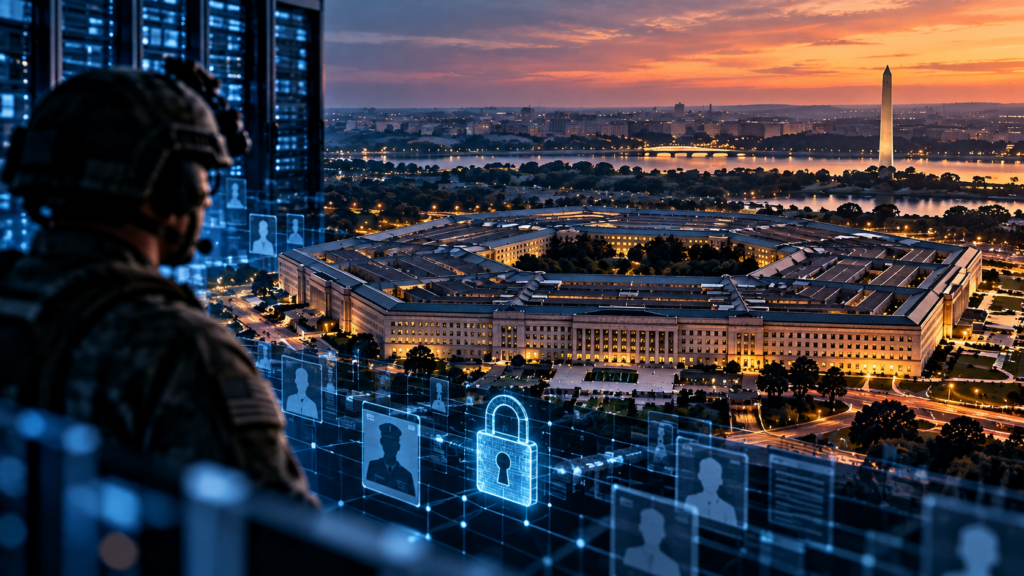
A nine-month intrusion at the Defense Manpower Data Center exposed sensitive military personnel records, raising fresh questions about cybersecurity, counterintelligence and institutional preparedness.
For nine months, unauthorized users had access to files held by the Pentagon office that knows more about American service members than any other. The records they reached included Social Security numbers, dates of birth, contact details and military occupational specialties. None of it was encrypted. The Defense Manpower Data Center discovered the flaw in a file-sharing system on July 16, 2026, according to a breach notification letter first reported by Military Times and separately reviewed by CNN. A subsequent analysis found that unauthorized users had been accessing files on the affected server since October 2025. Notification letters began going out to affected individuals on Sept. 18 two months after discovery, and eleven months after the access began. The Defense Department has not publicly confirmed a final number of people affected. Two people familiar with the incident told Military Times that approximately four million people may be affected. The final number remains unconfirmed. DMDC's own website states that it maintains more than 60 million records covering military and civilian personnel, contractors, family members, retirees and veterans. The letter states that the department has no indication the data has been misused. Affected individuals are being offered one year of credit monitoring and identity restoration through a contracted provider.
What is known, and what is not
The public record remains thin, and the gaps matter. The notification describes a "security vulnerability" in a file-sharing system. Neither the product nor the specific flaw has been identified publicly. No federal agency has attributed the intrusion to a foreign government, a criminal group, an insider or any other actor. DMDC has said it patched the vulnerability and restored the system. The assurance that no misuse has been detected deserves careful reading rather than dismissal. The absence of detected misuse does not necessarily mean the exposed data poses no continuing risk. Criminal groups monetize stolen identity data quickly, and that activity surfaces in fraud reporting. Intelligence services do the opposite: they file the data, correlate it, and wait. The absence of fraud in the first months is weak evidence about the most serious scenario.
Why this particular database
DMDC is not a peripheral system. It is the department's authoritative source for identifying and authenticating personnel, underpinning the Defense Enrollment Eligibility Reporting System, common access card issuance, benefits and medical readiness. The field that should concern counterintelligence officers most is not the Social Security number. It is the military occupational specialty. A list of names and identifiers is a fraud problem. A list of names, identifiers and job codes is a starting point for target selection it tells an analyst who works in signals intelligence, who handles nuclear surety, who maintains a particular airframe. That distinction is what separates a data breach from a national security event.
The aggregation problem
The exposed data is dangerous less for what it contains than for what it can be joined to. Justin Sherman, chief executive of the advisory firm Global Cyber Strategies, told CNN that an adversary could pair DMDC records with commercial datasets to learn about or target defense personnel through their earnings, debts, marriages, spending and browsing behaviour. He described the resulting risk as enabling "phishing, profiling, foreign intel approaches, and much more." Those are the classic recruitment vectors. Financial distress, marital difficulty and undisclosed personal circumstances are what a hostile service looks for, and the American data broker market sells much of it legally. The operational context sharpens the concern. With U.S. forces engaged in the Middle East, Central Command told lawmakers earlier this year that it had received multiple threat reports concerning adversary exploitation of commercial location data to surveil or target American personnel in theatre. A verified roster of identities and job codes makes that kind of exploitation considerably more precise.
Where artificial intelligence changes the arithmetic
The technical capability to correlate stolen datasets is not new. The constraint was always analyst time. Matching four million records against broker data, identifying the individuals worth approaching and drafting a credible personalised message was slow, expensive work that forced adversaries to prioritise. Advances in large language models may reduce the time and cost required to correlate datasets and produce tailored communications at scale. This is not a claim about who took the DMDC data or what they have done with it nothing in the public record supports such a claim. It is a claim about valuation: any stolen personnel corpus is worth more in 2026 than the same corpus was worth in 2015, because the labour required to exploit it has largely been automated away. The same shift cuts the other way, and that is the more damning observation. Anomaly detection capable of flagging sustained unauthorized access to a file server over nine months is mature, commercially available technology. The reported nine-month period of unauthorized access raises questions about the monitoring and detection controls in place on the affected system.
The right comparison is OPM, not SolarWinds
The reflex in Washington is to reach for SolarWinds. That comparison misleads. The 2020 Orion compromise, attributed by the U.S. government to Russia's foreign intelligence service, was a supply chain attack that gave an adversary a foothold inside roughly nine federal agencies and around a hundred companies. What was stolen was access. The closer analogue is the Office of Personnel Management breach disclosed in 2015, in which attackers took personnel records on 4.2 million current and former federal employees and background investigation files on 21.5 million people, along with 5.6 million sets of fingerprints. U.S. officials attributed that intrusion to China. It went undetected for roughly a year. Set the two events side by side and the pattern is uncomfortable. Both involved bulk personally identifiable information with counterintelligence value. Both featured dwell times measured in months or years. Both were disclosed to victims well after discovery. Eleven years separate them. The DMDC records are thinner than OPM's background investigation files, which contained the narrative detail of SF-86 security clearance applications. They are also more current, and they cover a population defined by its military role.
Aging infrastructure, and a known weak point
The detail that should end any argument about legacy systems is the word "unencrypted." Encryption of personally identifiable information at rest is an established security safeguard and is a baseline element of the Defense Department's own zero trust strategy, which targets department-wide implementation by fiscal 2027. There is also a pattern worth naming. Managed file transfer and file-sharing platforms have been among the most heavily exploited categories of enterprise software in recent years, across both government and industry. The reason is structural: these systems sit between organisations, they accumulate exactly the sensitive material people need to move around, and they are frequently monitored less closely than the databases they draw from. They are plumbing, and plumbing gets audited last. Nothing in the public record identifies which product DMDC used. But the category has a track record, and that track record was available to anyone doing risk assessment before October 2025.
The response, and what it does not address
The mitigation steps described so far are conventional and, as far as they go, correct: patch the vulnerability, restore the system, notify individuals, offer credit monitoring. The limitation is that credit monitoring is a remedy for identity theft. It does nothing about the national security harm. A service member cannot place a freeze on a foreign intelligence targeting file, and a twelve-month monitoring subscription is an odd response to a risk that persists for a career. Several questions remain unanswered publicly. How many people were affected. Whether logging was sufficient to distinguish access from bulk exfiltration. Why sensitive records sat unencrypted on a file-sharing server. And what detection capability existed on that system, given that the intrusion ran for nine months.
What should follow
Four measures would address the substance rather than the optics. Encrypt at rest without exception, and finish the long-promised retirement of the Social Security number as a back-end identifier. The department stopped printing them on ID cards years ago; the databases behind those cards still turn on them. Instrument the file transfer layer specifically egress volume baselines, access anomaly detection, and retention of logs long enough to reconstruct an incident. Treat this as a counterintelligence matter, not a privacy matter. Personnel whose occupational specialties make them plausible targets need threat briefings, not credit monitoring.
And put statutory teeth into notification timelines. Eleven months between first access and first letter is not a communications failure. The eleven-month gap raises questions about detection, incident response and the timeliness of disclosure. The hardest thing to say about this breach is that none of it is novel. The adversaries are better resourced and their tooling is faster, but the underlying failures unencrypted data, unmonitored infrastructure, slow detection, slower disclosure are the same ones identified after 2015. The technology changed. The institutional response has not.
References
| 1. |
Natalie Oliverio, “Military personnel data exposed in breach, agency warns,” Military Times, September 24, 2026. Breach notification letter, timeline, data categories, and estimated number of affected people. Source |
| 2. |
“Pentagon data breach of military personnel raises national security concerns,” CNN, September 25, 2026. Justin Sherman’s comments, CENTCOM warning on commercial location data, and credit monitoring. Source |
| 3. |
Defense Manpower Data Center, agency description and record holdings. Source |
| 4. | U.S. Government Accountability Office, Information Security: OPM Has Improved Controls, but Further Efforts Are Needed, GAO-17-614 (2017); Cybersecurity and Infrastructure Security Agency, Emergency Directive 21-01: Mitigate SolarWinds Orion Code Compromise (2020). |
The views presented in this article are the authors’ own and do not necessarily reflect the views of Global Strategic Forum – GSF

Copyright © 2026 by GSF Team
Comments
0No comments yet. Be the first to comment.