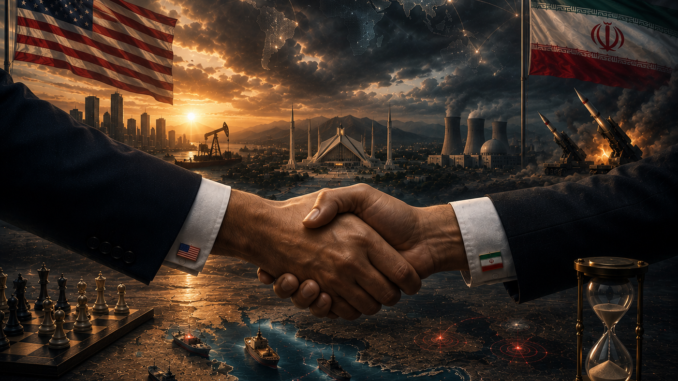
A strategic assessment of whether the US–Iran Islamabad Memorandum can deliver lasting stability
The Islamabad Memorandum of Understanding between the United States and Iran is barely a few days old, and already the region is holding its breath. Is this the start of real, lasting stability or just a pause before the next round of escalation? I’ve spent my career looking at conflict through the lens of security and cyber risk, and that’s the lens I’m bringing here: not just what the diplomats signed, but whether it can actually survive contact with reality.
How We Got Here
This deal didn’t come out of nowhere. It followed months of rising tension over Iran’s nuclear program, its network of regional proxies, and control of key shipping routes tension that eventually broke into open conflict. The Strait of Hormuz, which carries roughly a fifth of the world’s oil, became ground zero: Reports indicate that tensions around the Strait of Hormuz escalated significantly, prompting a military response from the United States. Israel’s campaign against Hezbollah in Lebanon added another layer of complexity to an already volatile picture.
According to reported details, the proposed 14-point MoU, brokered with help from Pakistan and other mediators, calls for an immediate and permanent halt to fighting on every front, including Lebanon. It reopens Hormuz toll-free, lifts the US naval blockade, offers sanctions relief tied to compliance, and sets a 60-day window extendable by mutual agreement to hammer out a fuller deal. Iran has pledged never to build or acquire nuclear weapons, with its stockpile of highly enriched uranium to be addressed under IAEA monitoring. Some reports suggest that regional partners may contribute substantial reconstruction and investment packages, although details remain unclear.
On paper, it looks like sensible de-escalation. Oil prices have eased, shipping lanes are reopening, and both Washington and Tehran are claiming a win the Trump administration pointing to a nuclear Iran averted and energy flows restored, Tehran framing sanctions relief as proof it outlasted the pressure campaign.
The Case for Cautious Optimism
Supporters of the deal argue it buys something precious: time. A 60-day negotiating window lets both sides work through nuclear safeguards, missile programs, and proxy disarmament without the constant threat of renewed strikes. If the sovereignty and non-interference commitments are actually honored, they could meaningfully reduce the proxy warfare that has destabilized Yemen, Syria, Lebanon, and beyond.
There’s an economic logic too. Reopening Hormuz and easing sanctions gives Iran room to stabilize its economy and a stronger economy could, in theory, blunt the influence of hardliners if reconstruction money actually reaches people. For Washington and its allies, avoiding a wider regional war means avoiding the inflation spikes, supply chain shocks, and military overstretch that would come with it. There’s also a quieter cyber-security dividend: less conflict generally means less appetite for state-backed cyber operations against energy, financial, and transportation infrastructure areas where both countries have shown real capability.
Markets responded the way you’d expect: gas prices dipped, equities steadied. And with the US still managing long-term competition with China and Russia, staying out of a prolonged Gulf entanglement has its own strategic value.
Why the Foundations Look Shaky
Still, a healthy dose of skepticism is warranted. History hasn’t been kind to US-Iran agreements from the JCPOA onward, paper commitments have repeatedly fallen apart without strong verification and a baseline of trust that, frankly, doesn’t exist between these two countries right now.
Nuclear Ambiguities
Iran’s promise to forgo nuclear weapons is nothing new, it’s been the official line for years. The MoU calls for down-blending enriched material under IAEA oversight, but the fine print on timelines, inspector access, and enforcement is thin. Given longstanding international concerns regarding transparency and inspection access, there is real reason to doubt full compliance. If Tehran stalls or hides material, the 60-day clock could run out amid mutual accusations of bad faith and strikes could resume.
Proxies and Regional Entanglements
The MoU covers Lebanon but barely touches Iran’s influence over Hezbollah, the Houthis, and various Shia militias. Israel has already voiced skepticism, and any continued operations or retaliatory strikes could unravel the whole truce quickly. The sovereignty language is aspirational at best, these proxy networks give Iran deniability and strategic depth it’s unlikely to give up easily.
Sanctions and Compliance Disputes
Relief is tied to performance, but “compliance” is exactly the kind of term that invites disagreement. Iran wants fast economic relief; Washington wants verifiable steps first. Frozen assets and reconstruction funds also raise questions about oversight and corruption. If economic benefits start flowing without matching security concessions, expect pressure from US critics and Israeli hawks to reimpose maximum-pressure sanctions.
Domestic Politics on Both Sides
Iran’s leadership needs to present this as a win, not a surrender, to hold onto legitimacy at home. In Washington, the deal will face scrutiny for echoing past frameworks that ultimately failed. A change in leadership, or a shift in political appetite on either side, could easily derail the 60-day extension. Disinformation campaigns and cyber operations could make an already fragile trust even harder to maintain.
An Enforcement Gap
Without strong multilateral mechanisms or automatic consequences for violations, this deal risks slipping into tit-for-tat escalation. The temporary nature of the Hormuz arrangement and the initial relief measures says it all: this reads more like a truce than a treaty.
What This Means for Global Security
From where I sit, this pause is really a window for better monitoring — IAEA access, signals intelligence, and open-source analysis all need to ramp up now to catch early signs of non-compliance. Regional allies like Saudi Arabia and the UAE are watching closely, and their buy-in will matter for whatever lasting framework eventually emerges.
A path to something durable would likely need:
- Verification protocols that go well beyond what the IAEA currently has in place
- Parallel negotiating tracks on ballistic missiles and proxy disarmament
- Economic incentives released in phased, escrow-style milestones rather than all at once
- Backchannel diplomacy shielded from domestic political theater
If those pieces don’t come together, collapse could look like renewed strikes on nuclear sites, fresh disruptions in Hormuz, or escalating proxy violence with knock-on effects for global energy markets and cyber risk alike.
Bottom Line
The US-Iran MoU is a tactical ceasefire inside a much longer strategic rivalry. It stops the immediate bloodshed and economic damage, but it doesn’t resolve the underlying conflict: Iran’s regional ambitions versus the US-led order’s insistence on denuclearization and changed behavior. Whether this becomes durable peace or just another collapse depends on political will, the rigor of verification, and how well both sides restrain the spoilers in the weeks ahead.
If there’s one lesson worth keeping in mind, it’s this: in the Middle East, ceasefires are often just intermissions. The moment calls for vigilance, not optimism — the world can’t afford another cycle of escalation that ripples through regional stability and the global systems we all depend on.
The views presented in this article are the authors’ own and do not necessarily reflect the views of Global Strategic Forum – GSF.

Imran Bhatti
Imran Bhatti holds an M.Phil. in Governance and Public Policy and professional certifications as a Certified Information Systems Security Professional (CISSP) and Project Management Professional (PMP). He is a geopolitical analyst and writer specializing in energy geopolitics, great-power competition, Eurasian strategic affairs, and South Asian security dynamics. His work explores regional geopolitics, border disputes, infrastructure, security, and economic statecraft in an increasingly multipolar world.
- Imran Bhatti

- Imran Bhatti

- Imran Bhatti

- Imran Bhatti


Leave a Reply