
Containment Never Ends on Its Own
The president says Iran is militarily finished and Washington is simply holding the status quo. The last time America held a status quo over a Gulf state, it lasted twelve years and ended with an invasion.
The sentence, and the room it was said in
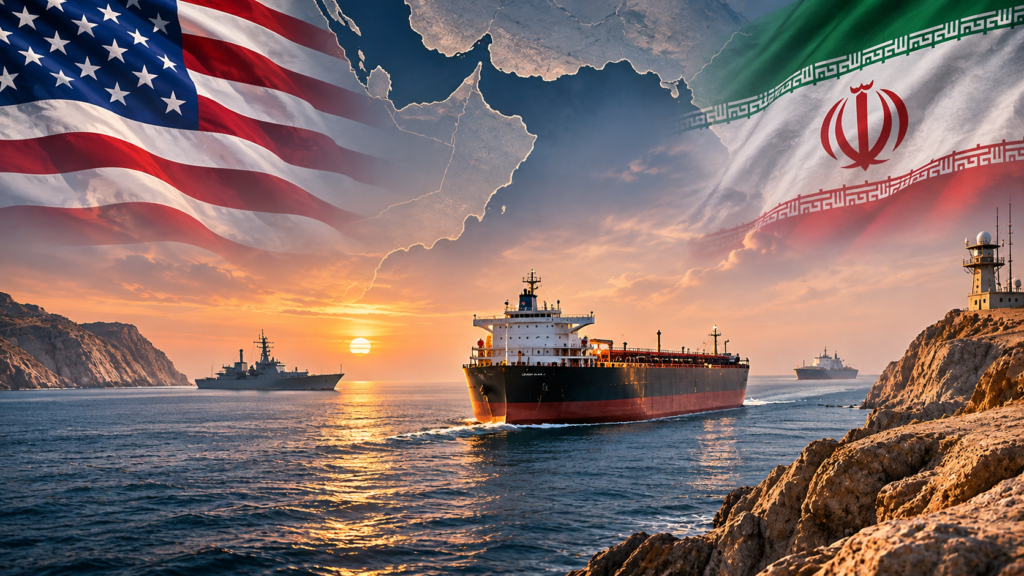
On Monday, after meeting Qatar’s prime minister, Donald Trump told reporters that Iran “militarily is effectively over”. Renewed American strikes, he said, were “highly unlikely”. The United States was “locked and loaded” if that changed. And on the blockade squeezing Iran’s ports: “We’re just keeping it the status quo. And we’re doing that really at the behest of countries that are their neighbours.” That last clause is the one to sit with. A war is not being ended and it is not being won. It is being parked at the request, we are told, of the Gulf states that live next to Iran and have spent months watching missiles and drones threaten their airports. The blockade is not presented as a means to an end. It is presented as the arrangement. The timing is not incidental. The Republicans had a bruising midterm a week earlier, and senior figures including the vice-president blamed the Iran war for it. Brent crude settled down 1.2 per cent at $91.49 a barrel on Tuesday, while US WTI crude fell 0.9 per cent to $86.04. A president who cannot end a war and cannot afford to widen it has found the third option: call it finished and keep the pressure on.
What the blockade has actually done
Credit where it is due the squeeze is real, and it is the most effective instrument Washington has deployed in this war. The blockade began on 13 April. Under the Islamabad memorandum signed on 17 June, Washington agreed to remove it within 30 days, but the arrangement subsequently broke down and the blockade was reimposed on 14 July. It applies to ships going to and from Iranian ports, which is a narrower and cleverer thing than closing the strait to everyone. The numbers are startling. A Pentagon estimate reported by Axios put the value of Iranian oil cargoes stranded at sea by 1 May at approximately $4.8 billion. On 16 October, CENTCOM commander Admiral Brad Cooper said the blockade had prevented Iranian crude exports worth approximately $25 billion. Roughly $350 million in Iranian cryptocurrency has been frozen alongside it. The physical evidence matches. Loading at Kharg Island, which handles the overwhelming majority of Iran’s crude exports, stopped at the end of July. By mid-October the country’s main oil terminals had stood empty for weeks, with Iran living off floating stockpiles accumulated before the blockade returned. For a state that funds itself through hydrocarbons, that is not pressure. That is a tourniquet.
Why 1990 is the wrong comparison, and the right one
The historical rhyme everyone reaches for is Iraq. On 6 August 1990, four days after the invasion of Kuwait, the Security Council passed Resolution 661, prohibiting all imports from and all exports to Iraq. Resolution 661 included humanitarian exceptions for foodstuffs and medical supplies. The Oil-for-Food Programme followed in 1995, initially capped at $2 billion of sales every six months. The sanctions framework remained in place for more than twelve years. It was substantially dismantled following the US-led invasion of Iraq in March 2003, rather than through an Iraqi surrender or negotiated settlement. The lesson usually drawn is that containment fails. The more precise lesson is that it has no internal brake. A sanctions regime is a machine with an on-switch and no off-switch: every year it runs it accumulates its own bureaucracy, its own constituency and its own argument for continuing and the moment it appears to be working is exactly when nobody wants to be the official who dismantles it. But 1990 also shows how much harder this is. Iraq after 1991 was a defeated army in a box with no economic leverage over anyone. Its oil was worth something only because the Council allowed it to be sold. Iran sits on the Strait of Hormuz, through which roughly a quarter of the world’s seaborne oil and a fifth of its liquefied natural gas passed before this war. That gives Tehran a lever Iraq never had, and it helps explain why crude prices remain elevated more than eight months into the conflict. There is a second difference, and it cuts the other way for Washington. The Iraq sanctions were multilateral the whole Council owned them, which is why they were so hard to lift. This blockade is American. In March, the president asked NATO and China to help reopen the strait and neither provided a firm commitment. One navy is enforcing a chokepoint that the entire global economy depends on, and paying for it out of a single defence budget.
The lever Iran still holds
Tehran’s answer has not been to break the blockade but to make it expensive. At least ten ships were reportedly hit in the first ten days of November, according to Reuters. Videos verified by Reuters showed a Navig8 tanker burning near the Omani coast. Iranian forces reportedly targeted navigation infrastructure on Oman's Didamar Island, which is a way of saying that the waterway can be made blind. Iranian officials have also named the Gulf’s subsea data cables as a target the same cables that carry the region’s financial traffic. None of this wins a war. All of it makes the status quo more expensive to maintain than it looks on a briefing slide. A blockade is a claim about the future: that the other side will crack before your patience or your insurance premiums do. Iran has decided to test the second half of that sentence.
Seventy-one per cent
There is a domestic clock too, and it is louder than the naval one. A Reuters/Ipsos poll found that 71 per cent of Americans want the new Congress to pass legislation ending the Iran war, not a marginal plurality but a substantial majority, arrived at in an election the governing party lost and blamed on this conflict. Which means the policy now has an unusual shape. It is militarily aggressive, politically defensive and diplomatically stalled. The blockade continues because ending it would look like conceding. Strikes have stopped because resuming them would look like losing. The result is something that neither side planned and neither can easily leave: a permanent, low-grade, expensive pressure campaign that is described as stability.
The honest part
The sceptical reading of the president’s words is not that he is lying. It is that “effectively over” is a description of the battlefield rather than of the conflict. Iran's air defences have been severely degraded, its missile production capabilities have been damaged, senior elements of its leadership have been eliminated, and its crude exports have been severely constrained. All of that appears to be broadly true, and the blockade deserves much of the credit. But a military result is not a political settlement, and the gap between them is where the last twenty years went. Nobody in Washington has described what Iran is supposed to do to make the blockade end. There is no inspection agreement in force, no verification regime, no timetable. The Islamabad memorandum envisaged lifting the blockade, reopening the Strait of Hormuz and making frozen Iranian assets available. Its 60-day negotiating period passed in August without a final agreement. What replaced it is a squeeze with no defined exit. So, a deal or a bigger conflict? Probably neither in the short term, which is the least examined possibility and the most likely one. The risk is not that Washington decides to invade Iran the terrain, the population and the politics all forbid it. The risk is that a temporary arrangement is left running long enough to become the policy, that a hundred small incidents in a narrow waterway accumulate into a large one, and that a future administration inherits a machine nobody remembers how to switch off. Containment bought twelve years in Iraq. It did not buy a peace. Its bill arrived anyway.
The views presented in this article are the authors’ own and do not necessarily reflect the views of Global Strategic Forum – GSF

Copyright © 2026 by GSF Team
Comments
0No comments yet. Be the first to comment.