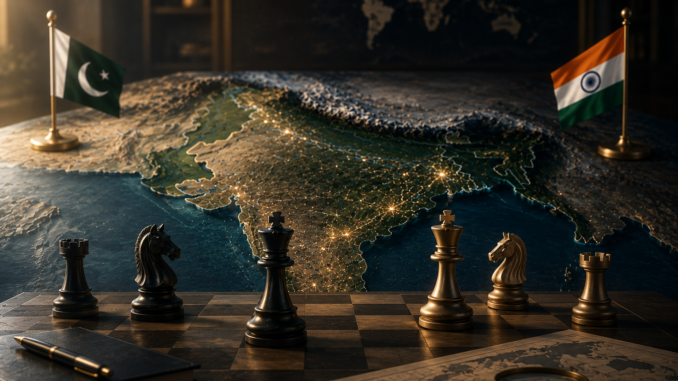
South Asia remains one of the world’s most strategically sensitive regions, where enduring geopolitical rivalries continue to undermine regional peace, economic integration, and collective security. Despite its immense potential for cooperation, India and Pakistan have remained locked in a cycle of mistrust, military crises, and diplomatic confrontation. This article argues that India’s pursuit of regional predominance, particularly since 2014, has reinforced strategic competition over constructive engagement, contributing to recurring security crises and diminishing prospects for lasting peace. By examining key episodes of military escalation, diplomatic disputes, and evolving regional security dynamics, the article explores how competing strategic narratives have shaped bilateral relations and contends that sustained dialogue, mutual recognition of legitimate security concerns, and diplomatic engagement remain essential to achieving long-term stability and prosperity in South Asia.
India’s hegemony has been the most excruciating impediment in the path to peaceful parlance and progress in South Asia as the two nuclear armed neighbours have strained relationships ever since the emergence and installation of the BJP government in India in 2014. In pursuance of its hegemonic designs and nefarious political dispensations against Pakistan India has carried out three major kinetic aggressive operations against Pakistan in September 2016 in the wake of an attack on an army base in Uri sector.
Likewise Pakistan rejected India’s allegations over the Pulwama attack and described the incident as a false flag operation in Indian Occupied Jammu & Kashmir (IOJK ) in 2019. Following the Pahalgam attack in May 2025, military hostilities escalated between India and Pakistan. Pakistan responded militarily and claimed to have shot down eight Indian fighter aircraft, including three Rafale jets, during the conflict. It also merits mention here that soon after the Pehlgam attacks, India placed the Indus Waters Treaty in abeyance, a move that Pakistan has described as contrary to the treaty’s legal framework and international norms.
Apart from these disputes and conundrums, Pakistan has repeatedly accused India of supporting destabilizing activities in Azad Jammu and Kashmir through proxy networks, allegations that India denies. Similarly, Pakistan has also accused India of supporting insurgent groups in Balochistan, an allegation consistently rejected by India.
It is also imperative to analyse the Indian malicious intent and malevolent ambitions to subdue Pakistan through any trivial tactics on international forums. India has sought to diplomatically isolate Pakistan by portraying it as a state that supports terrorism. Pakistan, however, maintains that Operation Bunyan-un-Marsoos demonstrated the effectiveness of its military response and challenged perceptions of India’s conventional military superiority. Despite the military confrontation during Operation Sindoor, Pakistan maintains that it achieved its strategic objectives. India still adamantly harbours whims and wishes for four critical factors in its foreign policy. It wants absolute dominance in south Asia bypassing Pakistan and its nuclear capabilities which is not possible for any sane segment to rule this critical factor out. Apart from this ,there is also a chronic distress and mistrust between the two neighbouring countries.
Amid these mounting tensions and conflicts between the two neighbours India is intensively inclined towards hostilities instead of reconciliation. It is also an undeniable fact that neighbours cannot be changed as geopolitical scenario is not a man made phenomenon.
Peace initiatives between India and Pakistan have repeatedly stalled due to persistent political and security tensions specifically after the BJP assuming the office in New Delhi. Recently, some of the sane segments have voiced their ingenious concerns to offer peace negotiations to Pakistan to cease hostilities while bring down the level of rancour against each other but the confrontational policies adopted by both sides have continued to impede meaningful dialogue.
Since the successful culmination of the Operation Bunyanun Marsoos during the Maarka e Haq, Pakistan has sought to enhance its diplomatic role through active regional engagement and dialogue with multiple international stakeholders. These diplomatic engagements have enhanced Pakistan’s regional diplomatic profile and international visibility.
So , it is imperative for India to reckon Pakistan’s status and instead of locking horns with Pakistan it must come out of its shell to mutually coordinated and cooperate with Pakistan to establish durable peace and economic stability in the region with shared objectives of elimination of rampant poverty and ubiquitous joblessness from South Asia.
The views presented in this article are the authors’ own and do not necessarily reflect the views of Global Strategic Forum – GSF.

Prof Sajjad Khattak
A freelance columnist and contributor, can be reached at sajjadkhatak30@gmail.com.
- Prof Sajjad Khattak

- Prof Sajjad Khattak
- Prof Sajjad Khattak
- Prof Sajjad Khattak

Leave a Reply