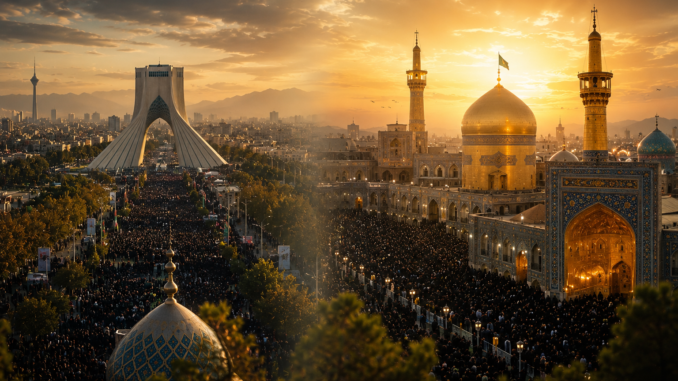
Everyone was watching Tehran. The crowds, the chants, the coffin inching down a ten-kilometer route while effigies burned overhead — it made for the kind of images that lead every news broadcast on earth. But the funeral of Iran’s Supreme Leader, Ayatollah Ali Khamenei, was never going to end in the capital. It was always going to end in Mashhad, the city where he was born, at the shrine of Imam Reza — one of the holiest sites in Shia Islam. That final destination is not a footnote. It is the point. When a state buries its most powerful figure, it is never just handling a body. It is telling a story about what comes next — and it is choosing, very deliberately, where that story should end. Tehran gave the regime its spectacle: the crowds, the cameras, the world’s attention. Mashhad gives it something else entirely roots. Sacred ground. A closing scene written not in the language of politics, but in the language of faith.
Two Cities, Two Messages
Think of it as a story told in two acts, staged in two very different theaters. Tehran is the theater of the state. It is where the government wanted the world to see millions of mourners, military escorts, and a capital very much still in control after months of war and unrest. That image matters enormously right now. A regime that has just survived direct conflict with the United States and Israel, and that has weathered serious internal protest, needs the world — and its own people — to see order, not chaos.
Mashhad is the theater of the soul. There is no shrine in Iran more sacred than that of Imam Reza, the eighth Imam of Shia Islam. Ending the funeral there — after processions through Tehran, Qom, and even the Iraqi holy cities of Najaf and Karbala — completes a journey that is as spiritual as it is political. It ties the Supreme Leader’s death, and by extension the continuity of his office, to something far older and far more stable than any single government: thirteen centuries of Shia devotion. In governance terms, this is what legitimacy-building actually looks like on the ground. It is not just laws and institutions. It is ritual, geography, and timing, all working together to answer one unspoken question hanging over every succession: does this system survive the man who built it?
A Succession Playing Out in Public
The choreography matters even more because the succession itself has been anything but smooth. Khamenei’s son, Mojtaba, has been widely discussed in media reports and political analysis as a leading successor, although the succession process remains closely watched. In moments like this, every procession, every image, every carefully chosen city becomes a way of filling that silence with reassurance. A funeral that moves from the capital to the country’s holiest shrine is, among other things, a message: the institution endures even when its next leader has not yet stepped into the light. Whether or not that message is fully believed by the Iranian public is a separate question — but the staging appears intended to reinforce continuity and institutional legitimacy.
Perception Is a Battlefield Too
This is where my other professional lens comes in. Years spent thinking about cybersecurity — about what it actually takes to defend a system under pressure — leaves you with an instinct for spotting the same patterns everywhere, including in a funeral procession. A national mourning event on this scale is, in effect, an attack surface. Every crowd is a potential target. Every broadcast is a potential vector for disinformation or manipulated footage. Every gap in the official narrative — like an heir who won’t appear in public — is an opening that rumor and propaganda will rush to fill, online just as much as in the street. Just as a security team hardens physical infrastructure and digital infrastructure at the same time, a state managing a moment like this has to protect the story on two fronts: the ground and the feed. Get the physical staging right but lose control of the narrative online, and the carefully built image of continuity can unravel in hours. That is not a hypothetical. It is exactly the kind of vulnerability that modern information operations are designed to exploit.
Why This Matters Beyond Iran
It’s tempting to file this away as a uniquely Iranian story — a detail of Shia ritual and regional politics. It isn’t. Every government that has ever managed a leader’s death, from monarchies to modern republics, has faced the same underlying problem: power needs a story that outlives the person who held it. What changes from country to country is the vocabulary used to tell that story. Some reach for military parades. Some reach for constitutional ceremony. Iran, at this moment, is reaching for sacred geography — literally walking its late leader’s body toward the holiest ground it has. Policymakers and analysts who study transitions of power would do well to pay attention not just to who takes over, but to where and how the old leader is laid to rest. The choreography is rarely accidental, and it is rarely just about the past. It’s about signaling what the future is supposed to look like.
The Long Shadow of Precedent
Iran has done this before, and the memory of it shapes everything about how this funeral has been handled. When Revolutionary Guard commander Qasem Soleimani was buried in 2020, the crowds that turned out were so large, and the crush so severe, that dozens of mourners were killed before the burial even took place. That tragedy may also have influenced planners to spread the funeral over several days and locations. Spreading the mourning across Tehran, Qom, Najaf, Karbala, and finally Mashhad isn’t only about symbolism it also serves practical crowd-management purposes alongside its religious symbolism.
That combination of sacred purpose and practical control is itself revealing. Historically, states have often expressed political authority through religious tradition, public ritual, and national heritage, particularly during moments of leadership transition. The safest crowd is a reverent one, moving with purpose toward a destination that already means something to it. Mashhad didn’t just give the funeral a spiritually resonant ending; it gave the state a way to marshal a nation’s mourning without losing its grip on the streets.
The Bottom Line
Mashhad was never simply the last stop on a funeral route. It is where a regime under real strain — from war, from protest, from an uncertain succession — chose to make its final and most enduring statement: that its authority rests on something deeper than any one man, and deeper than any single crisis. In politics, as in security, the details people assume are just logistics are often the ones doing the most work. Location, timing, and symbolism aren’t set dressing around power — in moments like this, they are power. And for anyone trying to read where Iran goes next, the road to Mashhad is as good a place as any to start looking.
The views presented in this article are the authors’ own and do not necessarily reflect the views of Global Strategic Forum – GSF.

Imran Bhatti
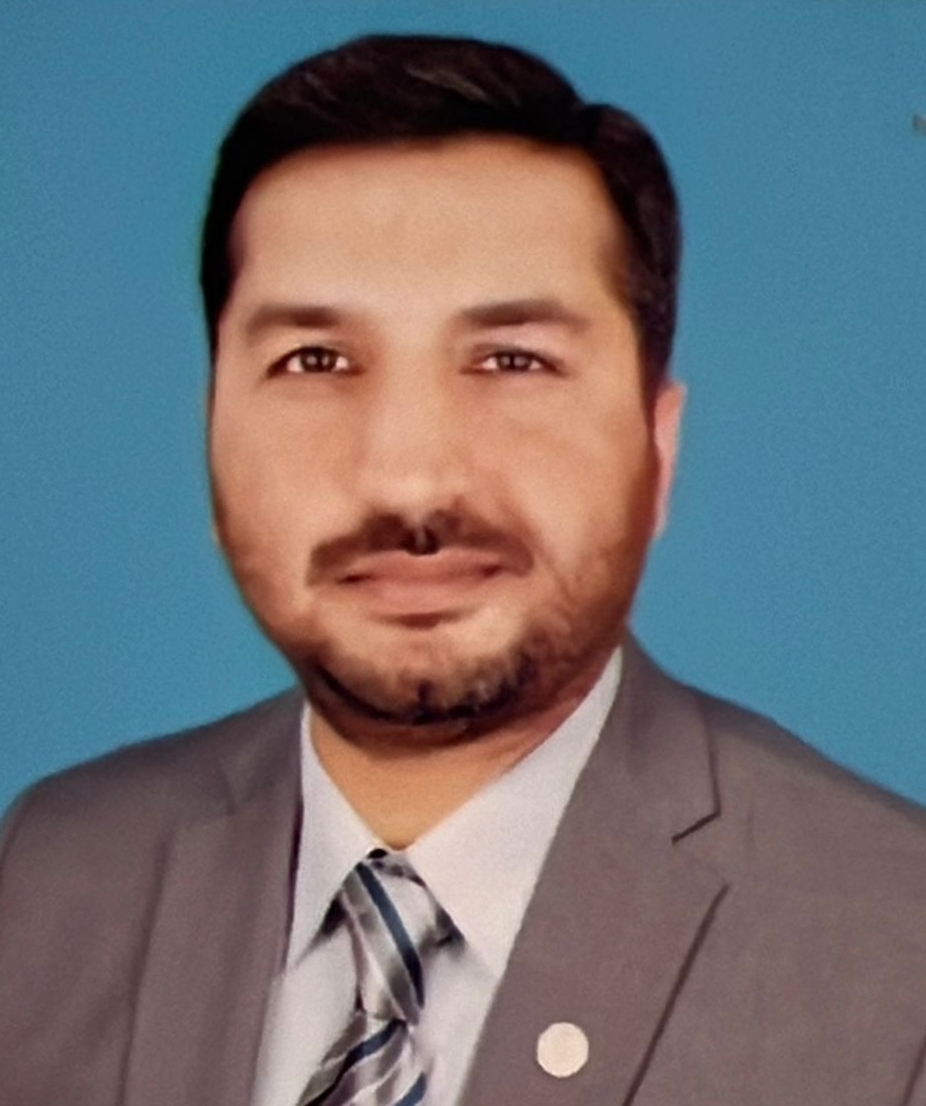
Imran Bhatti holds an M.Phil. in Governance and Public Policy and professional certifications as a Certified Information Systems Security Professional (CISSP) and Project Management Professional (PMP). He is a geopolitical analyst and writer specializing in energy geopolitics, great-power competition, Eurasian strategic affairs, and South Asian security dynamics. His work explores regional geopolitics, border disputes, infrastructure, security, and economic statecraft in an increasingly multipolar world.
- Imran Bhatti

- Imran Bhatti
- Imran Bhatti

- Imran Bhatti
Leave a Reply