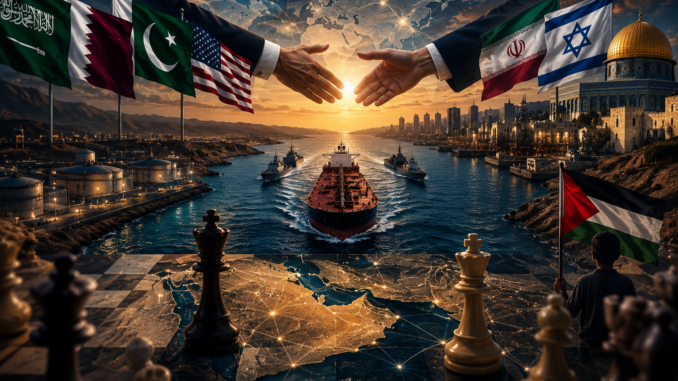
High Stakes Diplomacy, Maritime Security and the New Direction of the Islamic World
There is an unprecedented convergence of traditional statecraft, maritime strategy and asymmetric leverage in the global geopolitical landscape. U.S. President Donald Trump has dramatically altered the parameters of Middle Eastern diplomacy, sending shock waves through diplomatic corridors from Riyadh to Islamabad.
American and Iranian negotiators are edging toward a historic settlement to defuse decades of hostility but Washington appears to be introducing a high-stakes diplomatic variable into the mix, encouraging broader regional normalization involving key Muslim-majority nations.
This is not a case of a localized diplomatic move.
The Abraham Accords appear to be evolving from a first-term diplomatic achievement into a broader instrument of regional realignment, with some analysts suggesting that future diplomatic arrangements could involve discussions on normalization involving Saudi Arabia, Qatar and Pakistan. Some analysts interpret the emerging diplomatic approach as increasing pressure on regional actors to participate in a broader regional framework.
This is a moment that demands critical dissection by geopolitical analysts, cybersecurity strategists and public policy architects. It signals a paradigm shift in which maritime trade security, national sovereignty, kinetic deterrence, and domestic political stability are weaponized simultaneously on a single macro-level chessboard.
Anatomy of the Ultimatum: Beyond the First Wave
To get a sense of the seriousness of the current crisis, you have to compare it to the original Abraham Accords. The early accords bypassed the core Palestinian issue and normalized Arab-Israeli relations through commercial, technological and defense arrangements, primarily involving the UAE, Bahrain, Morocco and Sudan. As those countries blazed new trails, the bedrock of Islamic geopolitics has always rested on a different order of regional giants.
Now Washington’s crosshairs are on three far more consequential actors:
- Saudi Arabia: Keeper of Islam’s holiest sites and economic powerhouse of the Arab world.
- Qatar: the diplomatic pivot state and global titan in liquefied natural gas (LNG).
- Pakistan: The only nuclear-armed Muslim-majority country in the world, at a vital crossroads between South Asia, Central Asia and the Middle East.
Washington appears to be testing a profound hypothesis by encouraging key regional actors to consider normalization: will these regimes prioritize immediate economic security, technological defense integration, and the neutralization of Iran’s nuclear ambitions over decades of deeply entrenched foreign policy doctrine?
The Chokepoint Weaponization Problem in Maritime Trade
The core of this diplomatic pressure campaign is the ultimate lever of global commerce: maritime security. The central operational driver behind the broader regional peace deal is permanent stabilization of the Strait of Hormuz, the jugular vein of global energy markets, through which one-fifth of the world’s petroleum transits.
For the Gulf states, the protection of this corridor from asymmetric threats, mine-laying operations and state-sponsored maritime interdictions is an existential imperative. The economic blueprints of these nations, none more so than Saudi Arabia’s Vision 2030, rely heavily on unfettered maritime transit and steady foreign direct investment into safe logistical havens.
From a strategic policy perspective, the U.S. administration is taking advantage of this urgent requirement for maritime stability as a forcing function. Washington offers, concretely, a globally underpinned maritime framework capable of defusing regional frictions and securing global energy supply chains. But the price of entry is the jettisoning of decades of consensus on Palestinian statehood, forcing regional powers to weigh ideological capital against operational survival.
The Pakistani Paradox: Nuclear Leverage, Fiscal Fragility, and Internal Backlash
Among the countries reportedly facing growing pressure to consider normalization, Pakistan confronts one of the most complex strategic dilemmas. But unlike its wealthier Gulf neighbors, Islamabad has to navigate this crisis in the face of serious macroeconomic vulnerabilities and a highly volatile domestic political environment.
Pakistan relies heavily on financial support from the Gulf, including central bank deposits, deferred oil payment facilities and investment flows from Saudi Arabia and the UAE. Pakistan’s strategic doctrine has simultaneously shifted to the nexus of conventional deterrence and asymmetric hybrid warfare, including the protection of its critical digital infrastructure against foreign intelligence operations.
But the domestic political cost of recognition of Israel would be high.
In Pakistan, support for the Palestinian cause is not merely a foreign policy stance, it is a fundamental pillar of national identity and public feeling. Any government move toward normalization could trigger public opposition, political controversy and potential exploitation by non-state actors seeking to delegitimize the state. What this produces is a sharp security dilemma:
- Selection of accord: Possible access to Western-backed financial relief, advanced technology corridors, and integrated cyber-defense frameworks for Pakistan but risk of domestic implosion and catastrophic public backlash.
- Repudiate the Accords: Preserves domestic stability and ideological harmony, but risks economic isolation, withdrawal of vital Gulf financial lifelines, and exclusion from the emerging security architecture of Western Asia.
The Ultimate Wildcard: A Total, Irreversible Reorientation
Perhaps most astonishingly of all, the very possibility that even Iran could one day be folded into an expanded Abrahamic framework is being floated. This shows the real scale of the strategy. Washington is not after a temporary ceasefire or a band-aid truce to halt Tehran’s uranium enrichment; it is attempting a permanent structural shift of the entire Islamic world.
In trying to dismantle the traditional resistance axis from within, the U.S. is extending the prospect of regional integration to Iran. For decades the binary polarization between Riyadh and Tehran has defined the geopolitical fault lines of the Middle East. If both powers are integrated into a single, overarching security and economic architecture linked to Western markets and normalized relations with Israel, those fault lines would be structurally erased and rewritten.
In terms of governance and public policy, the strategy represents a shift from containment to forced integration, seeing regional conflict not as a political debate to be negotiated but as an inefficient market friction to be removed by maximum diplomatic and economic coercion.
Conclusion: Structural Collapse or the Birth of a New Pax Americana?
The current deadlock places the international community at a real inflection point. The tactic of using maximum leverage to drive total regional realignment is a high-reward gambit but it’s also got profound risks. If Saudi Arabia, Qatar and Pakistan refuse the ultimatum – and say there can be no formal recognition without a viable, independent Palestinian state, the entire diplomatic architecture could come crashing down.
The breakdown of this scale would not just restore the status quo. That would likely increase regional fragmentation, sharpen shadow conflicts across critical maritime corridors, and pull states such as Pakistan and Iran into alternative Eurasian security alliances.
Should they, conversely, collapse under the weight of economic coercion and maritime security imperatives, it will be the dawn of a new age, one in which historical ideological redlines are supplanted by cold, transactional calculations of trade security, technological integration, and collective defense.
Stakes have never been higher. The world watches as the powers weigh their options, to see if this aggressive diplomatic architecture will forge a historic, permanent peace or if the mandatory conditions imposed will cause the entire fragile structure to collapse under its own weight.
The views presented in this article are the authors’ own and do not necessarily reflect the views of Global Strategic Forum – GSF.

Imran Bhatti
Imran Bhatti holds an M.Phil. in Governance and Public Policy and professional certifications as a Certified Information Systems Security Professional (CISSP) and Project Management Professional (PMP). He is a geopolitical analyst and writer specializing in energy geopolitics, great-power competition, Eurasian strategic affairs, and South Asian security dynamics. His work explores regional geopolitics, border disputes, infrastructure, security, and economic statecraft in an increasingly multipolar world.
- Imran Bhatti

- Imran Bhatti

- Imran Bhatti

- Imran Bhatti


Leave a Reply