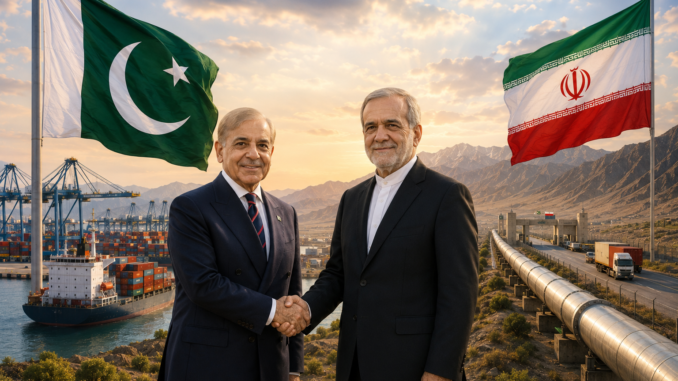
Opportunities from President Masoud Pezeshkian’s Visit to Islamabad
Something shifted quietly in the region earlier this year. As Pakistan continued to support regional dialogue and maintain constructive engagement with both Washington and Tehran, its diplomatic role gained renewed regional attention. But the people paying close attention noticed. And now, with President Masoud Pezeshkian landing in Islamabad on 23 June 2026, it feels less like a routine state visit and more like a follow-through — a moment to convert diplomatic goodwill into something tangible.
The question hanging over this visit is one Pakistan and Iran have faced before: can the potential between these two countries finally be realised, or will it be another round of warm statements and slow-moving committees? The honest answer is that this time the conditions are more favourable than they have been in years. Both governments are led by people with strong incentives to deliver. Both countries are under economic pressure. And both share a border that, managed well, could become a corridor of real opportunity rather than a chronic headache.
A Relationship Older Than Its Problems
Iran was one of the first countries to recognise Pakistan after partition in 1947. That’s not a small thing. It set a tone of solidarity that has survived decades of turbulence — the Cold War, the Soviet invasion of Afghanistan, the Iranian revolution, successive rounds of Western sanctions, and the complicated post-9/11 era that reshaped the entire region.
The relationship has never been simple. Pakistan has had to balance its ties with Iran against its relationships with Saudi Arabia and the Gulf states, its dependence on American support, and the domestic sensitivities around Shia–Sunni dynamics. Iran, for its part, has at times viewed Islamabad with suspicion, particularly over cross-border Baloch militancy and Pakistan’s alignments during regional conflicts. These tensions are real and shouldn’t be papered over.
But what’s different today is the disposition on both sides. Pezeshkian ran on a platform of ‘neighbourly diplomacy’ and economic pragmatism. He isn’t approaching Pakistan as an ideological ally or a proxy battleground — he’s approaching it as a neighbour with whom Iran needs to do more business. Pakistan’s current leadership, wrestling with IMF programmes and energy costs, is similarly uninterested in grand geopolitical theatre. They want deals that work. That shared pragmatism is, actually, quite rare in this region, and it’s worth building on.
Trade: The Gap Between Numbers and Potential
Here is an uncomfortable fact: two countries that share a long border, have cultural and linguistic overlap, and have been formally friendly for over seven decades still only manage $2–3 billion in annual bilateral trade. The target of $5–10 billion that officials on both sides have cited isn’t aspirational — it’s a recognition that the current figure is embarrassingly low given the underlying conditions.
The reasons for the gap are well understood, even if they’re hard to fix. Sanctions have choked off banking relationships, making routine payments a logistical nightmare. Border infrastructure at crossings like Rimdan–Gabd is underdeveloped. Traders on both sides face bureaucratic friction that discourages the kind of consistent, high-volume commerce that builds a real economic relationship. A Free Trade Agreement has been discussed for years without finalisation.
What would actually move the needle? A few things deserve priority:
- Getting serious about local currency and barter arrangements. Dollar-based transactions carry sanctions exposure; alternatives exist and need to be formalised rather than tolerated informally.
- Physical upgrades at border crossings — storage, logistics, banking facilities. Small investments here have outsized returns.
- Sector-specific push in pharmaceuticals, agricultural produce, and textiles, where complementarity is obvious and where the private sector is already trying to move.
- Exploring how Chabahar and Gwadar can function as complementary ports rather than rivals — a framing that opens up Central Asian connectivity for both countries.
The private sector needs to be in the room for these conversations, not briefed afterwards. Joint investment councils with real authority and short timelines tend to outperform the high-level commission model that produces elegant minutes and limited outcomes.
Energy: The Most Obvious Deal That Hasn’t Happened
The Iran–Pakistan gas pipeline is one of the stranger stories in regional infrastructure. The project has been agreed, partially designed, partially built on the Iranian side, and repeatedly delayed on the Pakistani side — largely because Islamabad has remained cautious about advancing the project because of concerns over potential international sanctions while balancing its domestic energy requirements. Meanwhile, Pakistan has continued to pay premium prices for LNG from distant suppliers while a massive gas reserve sits right next door.
The calculation may be shifting. Recent diplomatic developments have created an opportunity to revisit broader Pakistan–Iran energy cooperation. Pezeshkian’s visit is a chance to have that conversation — not just about the pipeline itself, but about the broader energy relationship.
The possibilities go well beyond gas. Iran has surplus electricity at times when Pakistan is in deficit. Interconnection across the border, even at modest initial capacity, would have immediate relief value. Renewable energy collaboration — solar, in particular — makes geographic and economic sense for border regions. And on the commercial side, refinery and petrochemical cooperation could anchor the kind of long-term industrial relationship that survives political fluctuations better than purely trade-based ties.
What’s needed is a shift in framing: from treating energy cooperation as a hostage to geopolitics, to treating it as a humanitarian and economic necessity that deserves its own protected lane in the relationship.
Security: Getting Honest About the Border
The Pak–Iran border has a complicated personality. It’s a place where cross-border families maintain ties that predate the modern states, where trade has historically flowed in both official and unofficial channels, and where, periodically, violent incidents have tested the bilateral relationship badly. Early 2024 saw tit-for-tat strikes across the border — a reminder of how quickly things can escalate when communication breaks down and domestic pressures spike.
Both sides have since pulled back from that edge and resumed dialogue. The question now is whether this visit produces lasting institutional improvements or just another period of cautious calm before the next incident.
The honest security priorities look something like this:
- Better real-time communication between border forces — the kind of direct operational channel that prevents misunderstandings from becoming incidents.
- Shared intelligence on militant groups operating in border areas, where both countries have an interest and where mistrust has previously limited information exchange.
- An honest conversation about the Baloch question. Both countries host Baloch populations with grievances; neither benefits from those grievances being weaponised by third parties.
- Counter-narcotics cooperation, which is both a genuine shared interest and a useful domain for building the kind of trust that can later extend to more sensitive areas.
None of this is easy. But the security relationship doesn’t need to be perfect to be functional. The goal should be a floor of reliable coordination that holds even when the broader relationship gets bumpy — which, given the region’s history, it inevitably will.
Diplomacy: Playing a Longer Game
Pakistan tends to undersell its own regional significance. It sits between South Asia, West Asia, and Central Asia in a way that almost no other country does. Iran has a similar geographic advantage. Together, they have the potential to anchor a web of connectivity that could genuinely reshape how goods, energy, and people move across this part of the world.
That’s a longer game than the current visit can win, but the current visit can lay important groundwork. Coordinating positions in the OIC, the ECO, and the SCO isn’t glamorous diplomacy, but it builds the kind of habitual cooperation that matters when a real crisis hits. Cultural and educational exchange programmes are chronically underfunded relative to their impact — people who studied together or visited each other’s countries tend to handle disputes differently than those who haven’t.
On Afghanistan, both countries have more to gain from coordination than from parallel approaches. Iran has longstanding relationships with specific Afghan factions; Pakistan has its own network of influence. The current situation calls for pragmatism over positioning, and there is more room for that conversation between Islamabad and Tehran than either side typically acknowledges publicly.
The Gwadar–Chabahar framing deserves particular attention. The two ports have been talked about primarily as competitors for Central Asian trade. A more mature framing would see them as complementary nodes in a regional logistics system — one that serves both countries better than either could serve alone. China, already invested in both, has obvious interest in that outcome.
What Could Go Wrong — and How to Prevent It
Optimism about Pakistan–Iran relations has a track record of not surviving contact with reality. Sanctions have a habit of tightening just when momentum is building. Domestic politics in both countries can make economic pragmatism look like political weakness. And the broader regional environment — the US–Iran dynamic, Gulf tensions, the situation in Afghanistan — has a way of bleeding into bilateral matters that both sides would prefer to keep insulated.
The safeguards against these risks aren’t complicated, but they require discipline:
- A standing bilateral commission with regular, scheduled meetings — not a response mechanism for crises, but a standing architecture that keeps the relationship moving even in quiet periods.
- Pilot projects with genuinely short timelines and public visibility. Small, completed things build more trust than large, perpetually pending ones.
- Private sector involvement that creates a constituency for cooperation beyond government. When businesses on both sides have skin in the game, they become advocates for maintaining the relationship through political rough patches.
- Transparent tracking of commitments. Both countries have signed agreements that later faded from institutional memory. A shared monitoring mechanism — even a simple one — changes the accountability dynamic.
There is also a role for international financial institutions and development banks in financing infrastructure that neither country can fund alone. Identifying those opportunities and preparing the groundwork should be part of what technical teams discuss during this visit, even if it doesn’t make the final communiqué.
What This Visit Could Actually Mean
There’s a version of this visit that produces a joint statement with the usual language about ‘fraternal ties’ and ‘shared destiny,’ a few MoUs that sit in ministry drawers, and a period of warm atmospherics before things drift back to business as usual. Pakistan and Iran have been through that cycle more than once.
There’s another version. One where the energy conversation produces a concrete timeline on the pipeline or a cross-border electricity agreement. Where the trade discussion leads to a functioning FTA negotiation with a real deadline. Where security coordination is upgraded through a direct channel that survives the next crisis rather than collapsing under it. Where both countries leave the visit with something they can point to six months from now as having actually happened.
President Pezeshkian has emphasized economic recovery, regional engagement, and pragmatic diplomacy during his presidency. Pakistan’s civilian and military leadership is under real domestic pressure to show economic results. Neither side has the luxury of purely symbolic diplomacy right now. That pressure, uncomfortable as it is, may be exactly what’s needed to make this visit count.
Pakistan and Iran share a border, a history, and a set of problems that neither can solve alone. The civilisational connection between these two peoples goes far deeper than any political cycle. If the leadership on both sides brings even a fraction of that long view to the table over the next few days, the visit will be remembered as something more than another entry in a long diplomatic calendar. It could mark the moment the relationship finally started working the way it always should have.
The views presented in this article are the authors’ own and do not necessarily reflect the views of Global Strategic Forum – GSF.

Imran Bhatti
Imran Bhatti holds an M.Phil. in Governance and Public Policy and professional certifications as a Certified Information Systems Security Professional (CISSP) and Project Management Professional (PMP). He is a geopolitical analyst and writer specializing in energy geopolitics, great-power competition, Eurasian strategic affairs, and South Asian security dynamics. His work explores regional geopolitics, border disputes, infrastructure, security, and economic statecraft in an increasingly multipolar world.
- Imran Bhatti
- Imran Bhatti
- Imran Bhatti

- Imran Bhatti
Leave a Reply