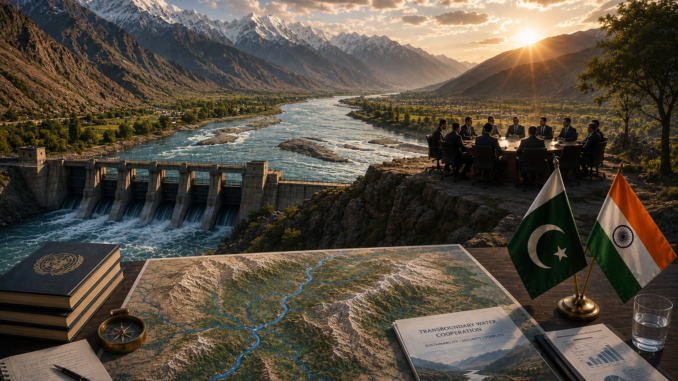
As tensions surrounding the Indus Waters Treaty continue to shape regional discourse, water security has emerged as one of the most consequential dimensions of India–Pakistan relations. This analysis examines the interplay of diplomacy, strategic signalling, and regional geopolitics, arguing that sustained dialogue and cooperative transboundary water governance remain essential to preserving peace, stability, and resilience across the Indus Basin.
For more than sixty years, the Indus Waters Treaty has done something few agreements in South Asia have managed: it has simply held. Signed in the middle of the Cold War, it survived three wars, countless border skirmishes, and decades of mutual suspicion between India and Pakistan. That track record was very much on people’s minds this week in Islamabad, where officials, diplomats, and analysts gathered for a conference on the Indus Waters Treaty held in Islamabad in 2026. Pakistan’s leadership used the occasion to send an unmistakable message to the region and the world: access to the Indus system is not negotiable, and no single country has the right to walk away from the 1960 accord on its own terms.
That headline-grabbing firmness was the story most people took away from the convention. But sit through the panels and side conversations, and a more layered picture starts to emerge — one involving a sharpened political warning from Pakistan’s opposition, an unusually assertive intervention from China, and a room full of experts who, despite the tough talk on stage, kept circling back to the same conclusion: this gets solved through dialogue, or it doesn’t get solved well at all.
A Warning From Bilawal Bhutto-Zardari
PPP Chairman Bilawal Bhutto-Zardari used his platform at the convention to draw a sharper line than most. He described India’s move to place the treaty in “abeyance” not as a bureaucratic technicality but as something closer to an attempt to hollow out the agreement from within. In his framing, this is not a paperwork dispute — it is a slow erosion of the structure that has kept water disputes between the two countries from spilling over into something far more dangerous. If that erosion continues unchecked, he warned, the two neighbours could find themselves pushed past the point where normal diplomatic tools are enough to pull things back.
It was a pointed remark, and it captured something that has been building in Pakistani political discourse for a while now: a growing sense that the treaty is not simply a formula for splitting rivers, but one of the last remaining guardrails on the relationship as a whole.
China Steps Into the Room
The more striking development, at least from a geopolitical standpoint, came from Beijing. China used the moment to signal that it no longer views the Indus Waters Treaty as a matter strictly between India and Pakistan. As a country that sits upstream in parts of the wider Indus system, China has an interest in regional water governance. The conference also highlighted broader questions about regional cooperation on transboundary water governance, although no officially endorsed multilateral framework was announced. Greater regional cooperation on transboundary water governance could reshape how shared water resources are managed, although no formal multilateral framework has been proposed. It could open the door to new mechanisms for cooperation and shared monitoring. It could just as easily bog everything down in competing interests and slower decision-making. Either way, China’s increasingly active engagement in discussions related to the Indus basin is a development worth watching closely.
The Consistent Message: Talk, Don’t Fight
What stood out across nearly every session at the convention was how consistently speakers landed on the same basic point, regardless of their background or affiliation. However hard the public rhetoric got, the underlying message was almost always the same: confrontation is not a realistic path forward, and dialogue — however slow and frustrating — remains the only route that actually protects the interests of the people who depend on this river system. Panelists repeatedly called for sustained technical engagement, functioning communication channels between the two governments, and a willingness to resolve disagreements inside the spirit of the treaty rather than outside it.
What’s Happening Behind the Scenes
The public statements out of Islamabad take on more meaning once you factor in what has been happening away from the podium. China has maintained diplomatic engagement with both India and Pakistan through high-level contacts in recent months. Islamabad and New Delhi have also exchanged updated prisoner lists — a modest but symbolically important gesture that governments in this region typically reserve for moments when channels are still functioning, even if the public tone suggests otherwise.
Taken together, these quieter developments point to a fairly familiar diplomatic pattern. Both sides are staking out hard public positions to reassure their own domestic audiences and to signal that they will not simply fold on core interests. At the same time, they are keeping the back door open, because both governments understand that a genuine breakdown over water would carry costs neither can easily absorb.
Why This Goes Beyond a Water Dispute
It is worth stepping back and remembering just how much is riding on this system. The Indus basin sustains hundreds of millions of people across India and Pakistan, supporting agriculture, drinking water, and hydropower across some of the most densely populated regions on the planet. That system is already under strain from causes that have nothing to do with treaties or politics — shrinking glaciers, erratic monsoon patterns, and steadily rising demand from growing populations. Layer a unilateral suspension of the treaty on top of that environmental stress, and the risk stops being purely diplomatic. It becomes a humanitarian and ecological problem as well, one that would be far harder to walk back than any political statement.
Seen in that light, Pakistan’s hardened public stance is doing more than one job at once. It reassures a domestic audience that is understandably anxious about water security. It may raise the political cost for India of pursuing further unilateral steps. And it puts the issue squarely in front of the international community at a moment when water scarcity is climbing up the global agenda anyway. None of that rules out compromise — in fact, testing negotiating positions in public while keeping a working channel open in private is a fairly standard playbook in high-stakes diplomacy, not a sign that talks have collapsed.
China’s growing interest in the basin adds a new and genuinely unpredictable variable. Whether broader regional cooperation on transboundary water governance gains traction or remains limited, the fact that China is taking a more active interest in the conversation changes the strategic dynamic. How India, Pakistan, and China navigate this emerging triangle will likely shape more than just river-sharing arrangements — it could influence the broader balance of power across South and Central Asia for years to come.
Where Things Stand
The 2026 convention in Islamabad did not resolve anything, and it was never going to. What it did do was sharpen everyone’s understanding of where the red lines sit, without slamming any doors shut. The combination of tough public positioning and continued private engagement suggests that all sides recognise just how costly an actual breakdown would be — for their people, their economies, and their standing in the region.
The treaty has weathered worse storms than this one. Whether it weathers this one too will come down to whether the current posturing eventually gives way to real technical cooperation — and whether a broader, more inclusive framework can be built that reflects today’s realities: a changing climate, growing populations, and a basin whose importance now stretches well beyond just two countries.
Taken together, recent developments suggest that Pakistan seeks to firmly protect its water rights while leaving room for dialogue within the treaty’s framework. The real test over the coming months will be whether this current phase of leverage-testing gives way to the kind of patient, practical problem-solving that has kept the Indus Waters Treaty alive for over sixty years.
Rivers do not recognise borders. If the basin is going to be managed wisely for the next sixty years, the countries that share it may need to stop treating that fact as an inconvenience and start treating it as the starting point.
The views presented in this article are the authors’ own and do not necessarily reflect the views of Global Strategic Forum – GSF.

Imran Bhatti
Imran Bhatti holds an M.Phil. in Governance and Public Policy and professional certifications as a Certified Information Systems Security Professional (CISSP) and Project Management Professional (PMP). He is a geopolitical analyst and writer specializing in energy geopolitics, great-power competition, Eurasian strategic affairs, and South Asian security dynamics. His work explores regional geopolitics, border disputes, infrastructure, security, and economic statecraft in an increasingly multipolar world.
- Imran Bhatti

- Imran Bhatti

- Imran Bhatti

- Imran Bhatti


Leave a Reply