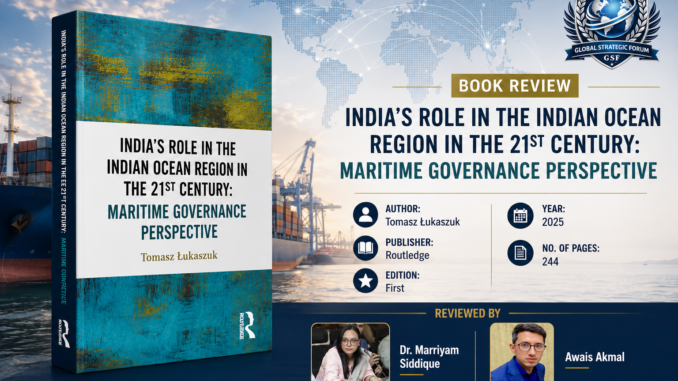
Book Review
- Author: Tomasz Lukaszuk
- Publisher: Routledge
- Edition: First Year: 2025
- No. of Pages: 244
The Indian Ocean Region (IOR) emerges as one of the most strategically consequential maritime spaces of the 21st century. The IOR becomes central to global geopolitics due to vital Sea Lines of Communication (SLCs), energy corridors, chokepoints such as the Straits of Hormuz and Malacca, and growing presence of extra-regional powers.
In this background, this book seeks to examine India’s evolving maritime posture and its aspirations to shape political, legal, and security architecture of the region. This book situates India as a pivotal regional actor, whose maritime engagement is increasingly being framed through concepts of governance, cooperation, and normative leadership rather than to overt power projection alone.
This book aims to move beyond traditional realist interpretations of maritime power by emphasizing India’s role in maritime governance, regional institutions, legal regimes, and cooperative security mechanisms. In doing so, it attempts to present India as a responsible stakeholder, capable of contributing to regional stability, rule-based order, and sustainable development in the IOR.
This perspective aligns with India’s own strategic narratives, particularly with its self-image as a benign power and an emerging Net Security Provider (NSP) in the region.Overall, this book makes valuable contribution by broadening analytical lens through which India’s maritime role is assessed.
It offers a comprehensive and normative rich account of India’s engagement in the IOR. Along with this, it also exhibits notable limitations, particularly its India-centric framing and relative underestimation of power politics and regional contestation.This book is structured around thematic exploration of India’s role in the IOR, rather than narrow military or naval analysis.
Central argument of this book is India’s influence in the region should be understood through prism of maritime governance. It defines maritime governance as combination of legal frameworks, institutional cooperation, capacity-building initiatives, and norms that regulate maritime activities. By adopting this framework, this book seeks to demonstrate that India’s engagement extends beyond its naval deployments to include diplomacy, law, environmental protection, and regional developments.
Significant portion of this book is devoted to trace historical evolution of India’s maritime outlook. It highlights that despite of having its own extensive coastline and maritime heritage, India remains largely a continental in its strategic orientation for much of post-independence period. However, changing geopolitical environment after cold-war coupled with globalization and increased independence on maritime trade compels India to re-evaluate strategic importance of the IOR. It also argues that this shift laid down the foundation for India’s contemporary maritime strategy.
This book further examines India’s participation in regional and multi-lateral institutions such as the Indian Ocean Rim Association (IORA), the Indian Ocean Naval Symposium (IONS), and various UN-led maritime initiatives. These platforms are presented as instruments through which India seeks to promote cooperative security, capacity building, and rule-based maritime order. This book underscores India’s advocacy for freedom of navigation, adherence to international maritime law, and collective approaches to non-traditional security threats, such as the piracy, illegal fishing, and maritime terrorism.
Another key theme is India’s naval modernization and maritime security posture. Although, this book acknowledges India’s expanding of naval capabilities, but it deliberately refrains from portraying India as hegemonic power. It also frames India’s naval growth as means of enabling security cooperation, humanitarian assistance, disaster relief, and maritime domain awareness across the IOR. This reinforces the book’s broader argument that India’s role is fundamentally stabilising and cooperative in nature.
This book also engages with growing presence of extra-regional powers, particularly China. It recognizes China’s increasing maritime footprints in the IOR but interprets India’s response largely through diplomatic and governance-based mechanisms rather than competitive balancing. According to this book, India seeks to differentiate its approach by emphasizing transparency, inclusivity, and respect for sovereignty.The most significant contribution of this book is its conceptual framing about India, as a maritime governance actor rather than a traditional power maximizer.
This approach is refreshing and adds depth to existing literature, which often focuses narrowly on naval capabilities or strategic rivalry. By integrating legal, institutional, and normative dimensions, it offers more holistic understanding of maritime influence in the IOR.
However, this conceptual strength also constitutes a limitation. Sometimes, emphases on governance and normative leadership underplay enduring relevance of power politics in the region. Although, maritime governance is important, but the IOR remains a contested strategic space, shaped by military presence, alliance politics, and geopolitical rivalry. Tendency of this book is to prioritize cooperation over risks of competition, presenting optimistic assessment of regional dynamics.
Its treatment with India’s narrative of Net Security Provider (NSP) warrants scrutiny, particularly. Although this book implicitly supports the idea that India is at well-position to act as net security provider, but it does not sufficiently interrogate practical constraints, associated with this role. Limited attentions are given regarding issues like, resource limitations, internal security challenges, and divergent perceptions among smaller IOR states.
As a result, NSP concept is treated more as aspirational identity, than as critically examined strategic posture. Another notable limitation of this book is India-centric perspective. Regional actors such as, Pakistan, Iran, and several smaller littoral states are largely discussed in relation to India’s initiatives rather than autonomous strategic actors with their own interests and agency. This model reinforces hierarchical regional order that may not align with lived realities of the IOR politics.
A more balanced engagement with alternative perspectives would have strengthened analytical credibility of this book.Although discussions about China exists but relatively restrained. A deeper analysis of Sino-Indian maritime competition would be required, if we look at China’s growing naval presence, infrastructure investments, and strategic partnerships in the IOR. Governance-based explanations’ preference of this book tends to sideline structural drivers of rivalry, such as power asymmetry and strategic mistrust.
From methodological perspective, this book relies heavily on policy documents, institutional records, and legal frameworks. Although this is appropriate for governance-focused study, but it limits engagement with empirical case studies that could have tested effectiveness of India’s initiatives on ground. Absence of comparative analysis with other regional powers further restricts analytical scope of this book.
Primary strength of this book is its interdisciplinary approach. By combining insights from international law, maritime studies, and strategic analysis, it provides a nuanced account of India’s role in the IOR. Emphasis on institutions and norms offers valuable counterbalance to militarized narratives of maritime power.
This book is also commendable for its clarity and coherence. Complex concepts like, maritime governance and regional security cooperation are explained in accessible manner, making it suitable for both scholars and practitioners.
Its policy relevance is particularly strong, offering insights that are useful for diplomats, naval officers, and strategic planners. Despite of these strengths, normative bias of this book remains most significant weakness. Portrayal of India, as an inherently stabiliser and a benevolent actor, risk to integrate intention with outcome. Counter-arguments and alternative regional perceptions with lack of sustained engagement, limit robustness of this analysis.
Furthermore, underrepresentation of hard security dynamics reduces utility of this book for readers seeking comprehensive strategic assessment. Observing growing militarization of the IOR, more explicit engagement with naval competition and deterrence, would have enhanced relevance of this book for military institutions.Conclusively, the book “India’s Role in the Indian Ocean in the 21st Century” offers thoughtful and conceptually rich examination of India’s maritime engagement.
By foregrounding governance, institutions, and norms, it broadens analytical horizons of the IOR studies, and challenges purely realist interpretations of maritime power. Its emphasis on cooperative security and legal frameworks aligns well with contemporary debates on rule-based order in maritime domain. However, normative orientation of this book and India-centric framing limit its explanatory power in the region characterized by strategic competition and contested interests.
Although it succeeds in articulating India’s aspirations and self-perception, but it is less effective in critically assessing feasibility and reception of these ambitions among other regional actors. Despite of these limitations, this book remains a valuable contribution to literature on maritime security and regional order in the IOR. It is particularly useful for scholars and practitioners interested in non-traditional approaches to maritime influence and governance.
For professional military, research-based, and educational institutions of Pakistan, this book provides an important reference point for understanding India’s strategic narratives even it invites critical engagement from alternative perspectives.
The views presented in this article are the authors’ own and do not necessarily reflect the views of Global Strategic Forum – GSF.

Dr. Marriyam Siddique
Dr. Marriyam Siddique is a Senior Research Fellow at Maritime Centre of Excellence, Lahore, holding PhD in International Relations from China. She can be reached at drmarriyam16@gmail.com.

Awais Akmal
Awais Akmal is a researcher specialising in Central Asia, China, and the IOR geopolitics. A former Research Internship fellow at the Maritime Centre of Excellence (MCE), Pakistan Navy War College, he holds an MPhil in Political Science and has authored numerous articles in HEC-recognised journals and strategic think tanks. He can be reached at awaisakmal80@gmail.com .
- Awais Akmal
- Awais Akmal
Leave a Reply