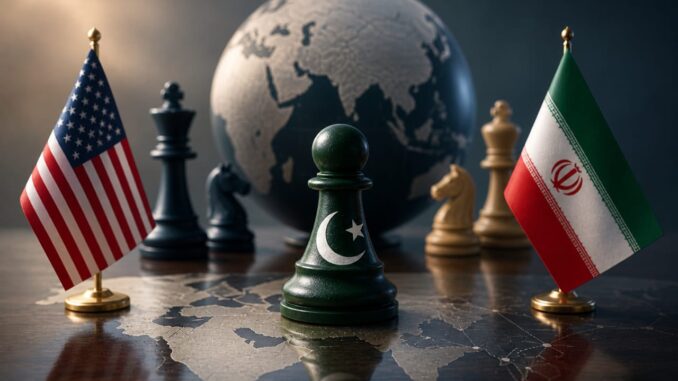
Pakistan’s diplomacy reflects compelled alignment, producing short-term relevance but constraining long-term strategic autonomy amid structural limitations.
It is argued that Pakistan is active and relevant, while India appears strategically silent. Islamabad’s evolving diplomatic role between Washington and Tehran constitutes a diplomatic victory over India. It is simple and appealing. But it is not only premature, it is misleading.
What is being celebrated as a breakthrough, it reflects a long-standing pattern in Pakistan’s foreign policy. It is necessary to move beyond the rhetoric and examine the structural forces that continue to shape Pakistan’s external behaviour.
Since independence, aligning with the major powers, especially the United States, has been one of the most consistent features of Pakistan’s foreign policy. From joining US-led alliances in the 1950s to facilitating the US-China rapprochement in the 1970s, and from serving as a frontline state in the Soviet-Afghan war to partnering with Washington after 9/11, Pakistan has repeatedly positioned itself at the centre of major geopolitical shifts.
Each episode brought short-term gains. Each reinforced the perception that Pakistan was indispensable. Yet the long-term outcomes tell a different story. US support has often been transactional. It has often been inconsistent, shaped by the shifting priorities rather than the enduring commitments.
Sanctions in the 1990s, post-Cold War disengagement, and tensions during the War on Terror, all reflect a recurring pattern. It is not merely a series of policy missteps. It is structural.
Enduring rivalry with India has pushed Pakistan toward external balancing. In an asymmetric relationship, where economic and conventional disparities persist, alliances become a rational choice. At the same time, chronic economic vulnerabilities limit Islamabad’s room for manoeuvre. Dependence on external financing makes sustained strategic autonomy difficult.
Geography adds another layer of complexity. Situated at the crossroads of South Asia, Central Asia, and the Middle East, Pakistan’s location enhances its importance but also exposes it to competing pressures. Rather than enabling neutrality, it often compels engagement.
Taken together, these dynamics produce what can be described as “compelled alignment”, a condition in which states align not out of preference, but necessity.
Acting as a mediator does not automatically confer strategic influence. It more reflects temporary utility within a system still dominated by the great powers. Mediation may enhance visibility, but it rarely alters the underlying balance of power. It carries risks. If efforts fail, the mediator may share in the blame.
The comparison with India is equally flawed. India’s foreign policy is often described through the lens of non-alignment during the global conflicts. But in practice it has evolved into a strategy of multi-alignment.
Simultaneously, India has engagedwith the United States, Russia, and the regional groupings. What appears as “silence” is often a deliberate choice to avoid entanglement in conflicts that do not serve its interests.
A larger economy, greater technological capacity, and far less dependence on external assistance, India’s flexibility is underpinned by material strength. India can choose when to engage. Pakistan often cannot.
None of this suggests that Pakistan gains nothing from its alignments. Such partnerships have historically provided critical support at key moments. But these gains have been largely tactical. They have not translated into sustained economic transformation, durable alliances, or consistent leverage in times of crisis. This gap between short-term relevance and long-term outcomes lies at the heart of Pakistan’s foreign policy dilemma.
If Pakistan seeks to break this cycle, the focus must shift inward. Strategic autonomy cannot be secured through the alignment alone. It requires economic resilience, institutional stability, and technological advancement. Without these foundations, even the most active diplomacy will struggle to produce lasting results.
India’s perceived silence is not a sign of weakness. It is a strategic choice, enabled by capabilities that Pakistan has yet to develop. In this context, triumphalist narratives are not only premature but potentially counterproductive. They risk obscuring the deeper issues that continue to limit Pakistan’s foreign policy effectiveness.
A more sober assessment would acknowledge both the opportunities and the constraints of the present moment. Pakistan is not winning a new game; it is playing an old one, under familiar conditions. The real victory will not come from mediation alone. It will come from the difficult and long-term task of building the foundations of genuine strategic autonomy.
The views presented in this article are the authors’ own and do not necessarily reflect the views of Global Strategic Forum – GSF.

Awais Akmal
Awais Akmal is a researcher specialising in Central Asia, China, and the IOR geopolitics. A former Research Internship fellow at the Maritime Centre of Excellence (MCE), Pakistan Navy War College, he holds an MPhil in Political Science and has authored numerous articles in HEC-recognised journals and strategic think tanks. He can be reached at awaisakmal80@gmail.com .
- Awais Akmal
- Awais Akmal

Leave a Reply