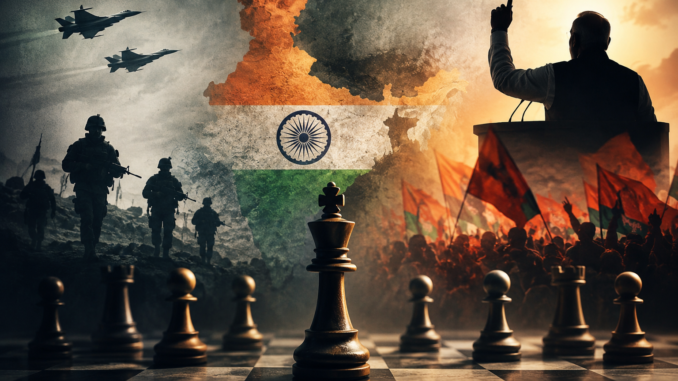
From Uri to Pahalgam: how security crises have shaped political narratives, electoral fortunes, and the language of power in contemporary India.
War is the continuation of politics by other means, organized violence as politics in a different register, pursued when diplomacy fails, was the view of Carl von Clausewitz. The dictum took as its premise that politics is the everyday state of affairs of States, and that war is their exceptional instrument.
Today, the logic has been turned upside down in Narendra Modi’s India. Politics is now the continuation of war, by other means. The ballot box is not the place to settle disagreements. It is the place where the permanent war, fought against the internal and the external enemy, is periodically re-legitimized.
This phenomenon did not occur a single time. This has occurred three times and no one could imagine it being a coincidence.
On 18th September 2016, a group of militants attacked a brigade headquarters in Uri, killing 19 soldiers. India declared “surgical strikes” on the Line of Control 10 days later. All the previous Indian governments had carried out such raids across borders in silence, due to operational security.
The BJP transformed them into a theatrical affair. Press briefings were planned. A film shoot was commissioned in the traditional Bollywood style, absurd, and utterly oblivious to logic. Indian defense commentator Mohan Guruswamy said the BJP’s use of the word ‘surgical’ is ‘political charlatanism’.
The military’s media wing of Pakistan argued that cross-border firing was just being rebranded as ‘surgical strike’. Those that examined the operation pointed out that it did not involve airpower and was shallow and more like a raid on the border than precision strikes. The state of Uttar Pradesh, one of the most electorally decisive in India, was months away from polling day. The BJP swept it.
On 14th February 2019, 40 CRPF personnel were killed in a suicide attack in Pulwama. BJP was politically bruised. In December 2018, it had just lost Rajasthan, Madhya Pradesh and Chhattisgarh to Congress, just two months ago. It was one of the significant political failures for BJP since 2014. The unemployment figures were suppressed.
The Rafale deal festered. One CNN analysis at the time noted that Modi was “starting to look weak.” Then there was Pulwama and the political landscape changed in a flash. The BJP’s campaign now focused solely on national security problems. The political vulnerabilities that had played on Modi’s mind were lost in a sea of jingoistic frenzy.
On 26th February, India struck Balakot. In a rally in the town of Latur, nearly two months into the election campaign, Modi questioned the turnout of fresh voters, asking whether they could dedicate their vote for the soldiers who died in Pulwama and struck at Balakot, blatantly ignoring the Election Commission’s directive to keep the military out of the political campaign. BJP won one of its largest majorities.
Instead, the attack was followed by what seemed more damning than the attack. Later, Governor of J&K at the time, Satya Pal Malik, confirmed that the CRPF had made a formal request to the Home Ministry to transport 2,500 personnel by five aircraft. The request was declined. The convoy travelled by road.
Malik called Modi and informed him that the responsibility was on the government’s own lapses, but Modi told him to be quiet. The responsibility will be passed on to Pakistan, and the attack will be made a matter of elections, Malik said. Army Chief General (Retired) Shankar Roychowdhury in a clear statement had said that the massacre could have been prevented and the government led by the Prime Minister was responsible for it. No enquiry was ever called. The graves of 40 jawans were harnessed for purposes, and the State’s investigatory machinery, which was created precisely for such times, turned a blind eye.
26 civilians were killed in a terrorist attack in Baisaran Valley, Pahalgam on April 22nd, 2025. The BJP was already weakened when it went into the year 2025. With the 2024 general elections behind him, Modi had returned to power for a third term, but the BJP came in a distant 240 seats short of a majority, forcing him to rely on coalition government for the first time in a decade. The sense of invincibility was broken.
Then Pahalgam happened. The three layers of security that were deployed in the area failed at the same time, the Army on the outer, the CRPF in the middle, and the Jammu and Kashmir Police on the inner. Despite of their wearing Indian Army fatigues, the attackers were never seen on their way to the meadow, which shows the critical lapse in security apparatus deployed at a turbulent location. Intelligence agencies had received reports of an attack in the area, but the inputs were about 90 kilometers away from the site of the attack.
During the all-party meeting, Amit Shah, himself admitted that the area of the meadow was opened to tourists without getting permission from the police and that the army was not allowed to deploy its personnel in tourist areas. So-called Operation Sindoor followed.
The BJP used it in rallies and even in briefings, making the 22-minute strikes a testament to a government which would go to enemy territory and punish them, the classical case of “ghar mein ghus ke marenge”. After that, Modi’s alliance won a landslide in the crucial elections in the state of Bihar, thus stabilizing Modi’s politically battered condition. The Clausewitz inversion was complete once again.
The diversionary war thesis is the theory that leaders who are at home in a crisis seek to divert popular discontent by creating or capitalizing on an external conflict. What makes the Indian case special is that it is not just a matter of political expediency, but a need of the ideology.
The RSS, BJP’s ideological parent, has from its very inception made a negative portrayal of Muslims as foreign conquerors and internal enemies of Hindu civilization which the BJP has consistently used in government narratives.
Muslims targeted as “anti-nationals” in India therefore represent, for the devotees of Hindutva, the very opposite of India (namely, Pakistan) because of their religious beliefs. There are no separate classes for internal and external enemy. They’re the same enemy on two fronts. Each terror attack that is blamed on Pakistan is thus a security incident, and a communal confirmation for the Hindutva voter base that both Indian Muslims and the Pakistani state are fighting the same civilizational battle against Hindu India.
That’s why the electoral divide is so indispensable. The strikes not only divert the attention of public, but they also confirm those propositions on which the political ideology of BJP is based. This is the reason why the structure is so averse to peace with Pakistan. Since if there is peace with Pakistan, the external enemy will no longer be available.
As a result, the political debate will revert back to mass unemployment, persisting inequality and institutional decay again. ‘War’, or the ‘performance of war’ is not BJP’s policy, but it is its life insurance. Clausewitz took on the role of a state that ruled its wars; Modi’s India has put an end to the interval.
The views presented in this article are the authors’ own and do not necessarily reflect the views of Global Strategic Forum – GSF.

Muhammad Mahad Samija
Muhammad Mahad Samija is a student at the Department of Political Science, Government College University Lahore. He is also a former research intern at the Maritime Center of Excellence (MCE), Pakistan Navy War College Lahore.

Leave a Reply