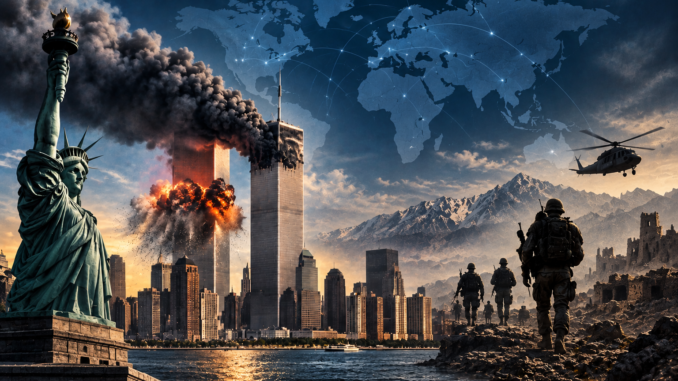
September 11, 2001, was more than a devastating terrorist attack; it marked a profound transformation in the global security landscape. The destruction of the World Trade Center and the attack on the Pentagon reshaped international security priorities, redefined counterterrorism strategies, and set in motion a series of geopolitical developments whose consequences continue to reverberate across the world.
On the bustling but fateful day of 9/11 ,2001 everything was going on smoothly as the workers were heading to their workplaces with great passion and the students were travelling to their schools to learn a new lesson of the day when all of a sudden a terrible news appeared on the TV screens showing two planes hitting the twin towers of the World Trade Centre( WTC ) claiming the lives of 2,977 victims in the 9/11 attacks. The massive terrorist attacks on New York not only stunned the American security agencies but also cast a gloom over the entire globe. Later on the Pentagon also came under attack when one of the four hijacked planes also hit the headquarters of the U.S. Department of Defense damaging the building and killing of the security personnel.
The then US president George W Bush announced a war on terror and launched military operations in Taliban-led Afghanistan in response to the 9/11 attacks, with the support of Pakistan. Gen Musharraf offered the strategic support to American allies and U.S.-led coalition forces began military operations in Afghanistan on October 7, 2001, launching air strikes and other military operations. Al-Qaeda, led by Osama bin Laden, was responsible for the 9/11 attacks on New York and U.S.-led coalition forces launched military operations against al-Qaeda and the Taliban to hunt down the perpetrators of the terrorist attacks against the US.
Pakistan was also declared as “the front line state against war on terror ” and its repercussions were also faced by Pakistan when the suicide attacks started occuring inside the Pakistani territories along the western borders and in the main cities of Pakistan. According to the Government of Pakistan, the country has suffered more than 90,000 casualties in the fight against terrorism including civilians and security personnel and this excruciating menace of cross border terrorism is still wreaking havoc in Pakistan after the re-emergence of Taliban regime in August ,2021. The terrorist attacks of 9/11 changed the entire security spectrum across the globe and the brunt was borne by Pakistan because of playing the role of a front state against war on terror.
The United States completed its military withdrawal from Afghanistan in August 2021, while terrorism and security challenges have continued across the region. The global struggle against terrorism continues, nearly a quarter of a century after the 9/11 attacks. Apart from this ,recrudescence of terrorism and proscribed terrorist outfits and the consequential threats emanating from the hotbed of terrorism could not have been neutralized or minimized so far despite the earnest efforts made by the world powers.
Instead of eliminating terrorism and terror threats by the world powers, the persistence of terrorism continues to pose a major challenge to international peace and security. It is therefore imperative and ineluctable for the world powers including Pakistan to ratiocinate collectively with mutually coordinated efforts to eliminate this menace posed by the facinorous and nefarious forces from this planet once and for all for the upcoming generations to breathe in an exclusive ambiance of peace and prosperity without any fear and fright.
The views presented in this article are the authors’ own and do not necessarily reflect the views of Global Strategic Forum – GSF.

Prof Sajjad Khattak
A freelance columnist and contributor, can be reached at sajjadkhatak30@gmail.com.
- Prof Sajjad Khattak
- Prof Sajjad Khattak
- Prof Sajjad Khattak

- Prof Sajjad Khattak

Leave a Reply