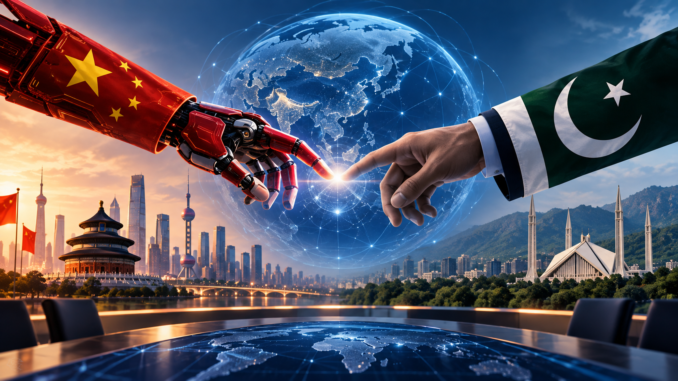
Beijing has just installed itself as the host of global AI rule-making. The founding member list includes Pakistan. What Islamabad does in the first twelve months will decide whether that seat is decoration or leverage.
On 16 July 2026, in Shanghai, representatives of 29 countries put their names to an agreement creating the World Artificial Intelligence Cooperation Organization. Headquartered in Shanghai and billed as an intergovernmental body focused on AI governance, standards, cooperation, and capacity-building, the entity has been, since its first week, the most concrete institutional answer to a question that has been forming in international meetings for the past two years: who shapes the rules that AI will run on when the rules have not yet been written. China’s role in drafting the agreement, securing the headquarters, and steering its founding agenda is not decorative.
It is central. The country’s earlier 2023 Global AI Governance Initiative set out the philosophical scaffolding; WAICO is its permanent address. The phrase that travelled with the launch — AI Cooperation, Shared Future — is the kind of soft vocabulary that protects a hard agenda. The hard agenda is the following: as AI capability becomes the most important infrastructure of the next decade, the countries that help write its standards will own the export market. The countries that adopt early will earn sustained productivity gains. The countries that watch from the sidelines will be buying, forever, what others define, build, and price.
What the architecture actually carries
The organisation is built around international cooperation, capacity-building, AI governance, standards coordination, and practical implementation. That is not the architecture of a talking shop. It is the architecture of an institution that intends to put a number on a desk and ask a cabinet to sign a cheque. The first two stages are the ones that determine whether the rest ever happens. Capacity building is, in practice, the difference between a country that consumes AI services and a country that co-authors them. Standards work is the difference between a country whose exporters will be tested for compliance and a country whose compliance regime becomes the test. Neither happens by attendance alone. Both happen through funded projects, on agreed timelines, with measurable outcomes. The question the world is now watching is whether WAICO can deliver projects at the speed its founding rhetoric promises.
The numbers attached to the founding brief
The founding brief points to significant economic opportunities from deeper AI cooperation, particularly through productivity gains, digital trade, foreign investment, and high-skilled employment. For Pakistan, these potential benefits are meaningful given the country’s growing digital economy and need for greater technological capacity. However, such gains will depend on whether WAICO can translate institutional commitments into funded projects, technology cooperation, skills development, and measurable implementation. The same opportunity comes with implementation challenges. Differences in national regulations, funding constraints, geopolitical competition, and the possibility of fragmented AI standards could limit the organization’s effectiveness. The first test for WAICO will therefore be whether its founding commitments can be converted into practical cooperation rather than remaining primarily institutional declarations.
What China has actually bought into this
The structural position of China inside WAICO is not that of a neutral convenor. Beijing provides the secretariat, the headquarters, the convening power, the largest share of technical expertise, and the commercial pipeline through which any participating country’s industry will inevitably procure some of its compute, models and tooling. The arrangement is not, on its face, coercive. It is gravitational. Many of the founding members were already procurement partners of Chinese AI vendors; their joinery makes an existing relationship visible rather than creates it. The members who signed on represent a recognisable coalition of the Global South plus a smaller bloc of Eurasian and Gulf states. ASEAN’s founding presence is significant: The ASEAN founding members include Cambodia, Indonesia, Laos, Malaysia, and Myanmar, joined by Pakistan among South Asian signatories. The geographic distribution is no accident. WAICO is the institutional counterpart of a wider diplomatic effort to give the Global South an alternative to the G7-led AI governance conversation, where rules have been drafted in capitals the Global South does not control and frequently does not recognise.
What a security practitioner notices
I work in cybersecurity, where my profession’s first reflex is to read the routing table of any new arrangement. WAICO’s routing table, to my eye, has two interesting features and one quiet concern. The interesting features are the data-localisation possibilities and the talent-circulation possibilities. If WAICO gets serious about shared compute infrastructure, member countries can negotiate residency of their data inside their own jurisdictions — not by nationalisation, but by joint planning. Talent circulation, if executed honestly, opens the door to short-term AI fellowships between member universities, which could help strengthen Pakistan’s AI skills base and accelerate the development of domestic AI capacity.
The concern is standards fragmentation in the other direction. A common framework assembled outside the OECD process could, over time, become incompatible with the one inside it. Companies in member states could find themselves maintaining two compliance regimes for the same product, which is the classic arrangement by which exporters quietly shed complexity from one and bulk up the other until the effective standard is whichever has the more rigorous oversight.
What Pakistan has to gain, in concrete terms
Pakistan is a particularly interesting test case. Its digital economy is moving in the right direction — IT exports in fiscal year 2026 reached about $4.6 billion, a roughly 21% year-on-year gain — and the country already has a National AI Policy approved by the federal cabinet at the end of July 2025. That means there is strategy on paper. What there is less of is global-grade infrastructure on the ground: limited high-end compute, an absence of large domestic model development, and a shortage of senior AI talent. WAICO offers Pakistan three kinds of leverage it can deploy right now. First, the technology transfer corridor. Small-to-medium AI projects in healthcare, agriculture, and public finance are areas where Chinese firms already have proven deployments and where Pakistan has urgent need. Pilot projects supported through WAICO could provide opportunities to acquire practical technology, expertise, and institutional capacity. Second, training and fellowships. A serious fellowship programme would convert Pakistani computer-science graduates into the kind of mid-career AI engineers who actually staff AI departments, in months rather than the years a domestic policy would require. Third, normative participation. A seat at the standards table, however decorative, gives Pakistani regulators a vocabulary to bring home, and a vocabulary, once brought home, reshapes the room.
What I would watch, on a year-one scorecard
For Pakistan, a year’s signal is best read in three places. One, whether any of the early WAICO-supported projects are developed in Pakistan rather than only in the larger ASEAN economies whose established tech sectors already have greater capacity. Two, whether the National AI Policy, which still requires substantial implementation, gets its first line of capital behind it, with the WAICO membership cited as part of the rationale. Three, whether private Pakistani AI firms find new procurement channels, particularly in manufacturing and agritech, that they were not previously able to reach. Each of those three readings would tell us, more honestly than any ministerial speech, whether the membership is beginning to mean something.
Where this leaves us
The most honest summary I can write is that WAICO is a serious bet. The opportunities associated with its founding agenda are significant but not guaranteed. The risks are explicit and not unrealistic. China’s leading role is visible and likely to remain significant because Shanghai hosts the organization and China is one of the world’s major AI powers. The Global South partnership is the gift and the constraint at once. For countries watching from Karachi, Jakarta, Lagos, or beyond, the question is not whether to join but what to bring to the room once inside. A seat is the cheap part. Projects, fellows, and a credible domestic draft of the country’s own AI standards are the parts that turn a charter into an asset. The decade ahead will reward those who read the founding brief closely and went into the room prepared. Everyone else will leave that room with a press release and a poster.
The views presented in this article are the authors’ own and do not necessarily reflect the views of Global Strategic Forum – GSF.

Imran Bhatti
Imran Bhatti holds an M.Phil. in Governance and Public Policy and professional certifications as a Certified Information Systems Security Professional (CISSP) and Project Management Professional (PMP). He is a geopolitical analyst and writer specializing in energy geopolitics, great-power competition, Eurasian strategic affairs, and South Asian security dynamics. His work explores regional geopolitics, border disputes, infrastructure, security, and economic statecraft in an increasingly multipolar world.
- Imran Bhatti

- Imran Bhatti
- Imran Bhatti
- Imran Bhatti

Leave a Reply