Abstract
Water security has emerged as one of the most significant challenges to peace and stability in South Asia. Rapid population growth, climate change, urbanization, and increasing demand for freshwater have intensified competition over shared river systems. The region is home to major transboundary rivers, including the Indus, Ganges, Brahmaputra, and Teesta, which sustain millions of people but also generate political tensions among neighboring states. From a Realist perspective, water is viewed as a strategic resource that states seek to control to safeguard national interests and security. This article examines how Realism explains interstate water conflicts in South Asia by focusing on the strategic behavior of states and the politics surrounding shared water resources. It argues that despite the existence of treaties and regional institutions, national interests continue to dominate water diplomacy, making transboundary water governance a central issue in contemporary international politics.
Introduction
Water has become one of the most valuable strategic resources in the twenty-first century. As freshwater availability declines due to climate change, environmental degradation, and increasing consumption, disputes over shared rivers have become more frequent. South Asia contains some of the world’s largest international shared river basins, supporting agriculture, energy production, and economic development across several countries. However, unequal access to water and competing national priorities have transformed these rivers into sources of political tension. Realism provides a useful framework for understanding these conflicts because it emphasizes power, national interest, and state survival in an anarchic international system. According to Realist theory, states prioritize their own security and seek control over strategic resources that enhance national power. Water therefore becomes more than an environmental concern; it becomes an instrument of political influence and strategic competition.
Water Security and Realist Theory
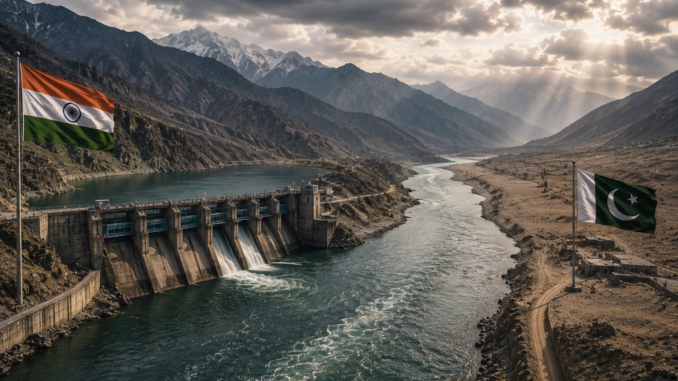
Realist scholars argue that the international system lacks a central authority capable of enforcing cooperation among sovereign states. The India-Pakistan water dispute illustrates this dynamic. In April 2025, India announced that the Indus Waters Treaty (IWT) would be held in abeyance amid deteriorating bilateral relations. Consequently, states rely primarily on self-help to protect their interests. Water resources shared across international borders often become strategic assets because they directly affect food security, energy production, economic growth, and military preparedness.
From this perspective, upstream states may attempt to maximize their control over river systems through dam construction, diversion projects, or infrastructure development. Downstream states, fearing reductions in water flow, perceive such actions as threats to their national security. This dynamic creates a security dilemma in which measures taken by one state to improve its water security increase insecurity for neighboring states, potentially leading to diplomatic crises or conflict.
Water Politics in South Asia
South Asia illustrates the strategic importance of transboundary water resources. The Indus River Basin, which spans several countries including India and Pakistan, remains one of the world’s most politically sensitive river systems. Although the Indus Waters Treaty (IWT) has survived several wars and political crises, disagreements over hydropower projects and water management continue to generate tensions, while India and Pakistan maintain differing positions on the Treaty’s current status. Pakistan has expressed concerns that upstream Indian infrastructure could affect downstream water management, while India has maintained that its projects comply with the provisions of the Indus Waters Treaty (IWT).
Similarly, disputes between India and Bangladesh over the Teesta River highlight the political nature of water sharing. The Teesta River is important for agriculture and livelihoods in Bangladesh, while water management and development priorities remain important considerations for both Bangladesh and India. The Teesta water-sharing issue remains unresolved, reflecting the complex interaction of domestic political, economic, and regional interests.
Strategic Competition and Regional Stability
Realism suggests that water scarcity increases interstate competition by strengthening the connection between natural resources and national security. Governments often view water infrastructure, including dams and reservoirs, as instruments of strategic leverage. Control over water can enhance economic development, strengthen political bargaining positions, and improve energy security. At the same time, growing populations and changing climatic conditions increase pressure on existing water-sharing arrangements. States become less willing to compromise when they perceive that concessions may weaken their long-term security. Consequently, regional cooperation remains fragile despite the existence of bilateral treaties and international legal principles.
South Asia demonstrates that water disputes rarely exist in isolation. Historical rivalries, border tensions, security concerns, and domestic political pressures frequently influence negotiations over shared rivers. Realism explains why governments continue to prioritize relative gains and strategic advantage even when cooperative solutions could generate mutual benefits.
Water security has become an increasingly important dimension of interstate relations in South Asia. From a Realist perspective, competition over transboundary rivers reflects broader struggles for power, security, and national survival within an anarchic international system. While agreements such as the Indus Waters Treaty (IWT) demonstrate that institutionalized cooperation is possible, even amid broader political tensions, persistent disputes over the Teesta, Ganges, and other shared rivers reveal the enduring influence of national interests. Climate change and growing water scarcity are likely to intensify these challenges in the coming decades, making effective water governance more difficult. Sustainable regional stability will therefore require not only technical cooperation but also political confidence-building measures that reduce mistrust among neighboring states. Nevertheless, Realism suggests that as long as states continue to prioritize strategic interests over collective management, transboundary water politics will remain a significant source of interstate competition in South Asia.
The views presented in this article are the authors’ own and do not necessarily reflect the views of Global Strategic Forum – GSF.

Zahra Ejaz
Zahra Ejaz holds an MPhil in Political Science from the University of the Punjab and is currently pursuing a PhD in Political Science. Her academic interests include political affairs, governance, international relations, and contemporary strategic issues. She can be reached at zaraejaz863@gmail.com

Leave a Reply