On Evidence, Speculation, and the Risks of Escalation in a Nuclearized Region
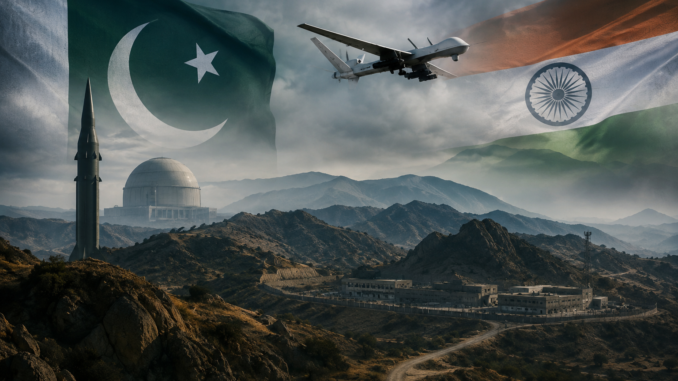
In the long ledger of South Asian rivalry, few things are more dangerous than certainty uttered at full volume about something that has not, in fact, been confirmed. Yet for several weeks now, the international discourse around Kirana Hills — a site in Pakistan’s Punjab long associated, often loosely, with the country’s strategic nuclear infrastructure — has taken exactly that shape. Loud declarations, thin proofs, and a domestic audience hungry for the next headline.
The instinct, here in Pakistan, is to dismiss the noise. That instinct is not wrong, but it is incomplete. Rejecting a claim is one thing. Understanding how the claim came to be circulated, amplified, and converted into something resembling fact is another. The latter exercise is uncomfortable, because it requires conceding that narratives do not merely describe reality — they also shape it. In the nuclearized neighbourhood we live in, what a population believes on a Tuesday can decide what a government does on a Friday. This essay is a rebuttal. It is not counter-propaganda. It does not seek to deny anything by refusing to engage with evidence; if evidence of a strike on a weapons-related site is ever produced, Pakistanis will discuss it seriously, as they always have. What it does seek to do is put the public conversation back in proportion. When claims about nuclear infrastructure travel without evidence, the burden falls disproportionately on the country being talked about; the country doing the talking gets the day. That asymmetry of consequence should worry any observer of the region — including the most committed of partisans in New Delhi.
The Anatomy of a Speculative Narrative
The Kirana Hills story began, as these stories often do, with a fragment. During Operation Sindoor in May 2025, plumes of smoke were observed rising from somewhere near the Sargodha airbase complex in Pakistan’s Punjab. Indian media, in its more wired precincts, went looking for an explanation worthy of the moment. Kirana Hills, in the Sargodha area, has long been associated in open-source reporting with Pakistan’s nuclear infrastructure. The leap from smoke to strike was made in seconds. What followed was not a forensic process. It was a chorus. Television anchors declared that India had struck Pakistan’s nuclear site. Anchors on other channels softened it to “may have been hit.” A retired naval officer described what was, at that stage, an unverified event as “a total success.” More than a year later, former Indian Chief of Defence Staff General Anil Chauhan commented on the incident. His remarks — reported variously — suggested that an Indian loitering munition may have inadvertently struck the area during the operation, perhaps running low on fuel, perhaps reaching further than intended, perhaps landing where it was not supposed to.
Each of these is a different claim, and they are not all compatible with one another. A deliberate strike and an inadvertent hit are different acts, with different intentions, different consequences in international law, and different strategic meanings. A “total success” and a fuel-exhaustion mishap are different framings. Confident assertion and tentative speculation are different stances. That some Indian media outlets and commentators cycled through all of them— sometimes within the same editorial cycle — is not, on its own, evidence of truth in any of them. It is, more soberly, evidence of an information environment in which certainty is being manufactured faster than facts can catch up. This is what a speculative narrative looks like in late-cycle form. A trigger event. A familiar location. A patriotic appetite. An anchor who knows his audience. A retired official whose words are repeatable without being verifiable. And a press corps for whom silence costs more than error.
What Kirana Hills Actually Is
A great deal of the rhetoric around Kirana Hills has, for years, rested on associations built outside any rigorous public record. The site is real. It is a hill range in the Sargodha area of Punjab province, in Pakistan, and it has a documented historical role in the country’s early nuclear programme. Open-source reporting — including well-known journalistic reconstructions and a 2004 study in the Bulletin of the Atomic Scientists — places it among the locations used by Pakistan in the late 1980s for cold tests of nuclear device designs. That is what the public record indicates.
Publicly available evidence does not establish that Kirana Hills currently functions as an active warhead storage facility. The often-repeated assertion that smoke rising from the Sargodha area is “proof” of a strike on Pakistan’s nuclear stockpile therefore presumes a great deal more than the public record supports. This matters because a rebuttal is not at its strongest when it simply says “nothing happened.” It is strongest when it says, with precision: here is what we know; here is what has been claimed; here is the gap between the two, and here is why that gap is being treated, by some, as if it were a bridge.
It is also worth saying out loud that even the strongest possible version of the Indian claim raises more questions than it answers. Suppose a loitering munition running low on fuel did reach a former cold-test site during an active military operation against a declared nuclear-armed adversary. Was that site the target? If yes, what was the strategic logic? If no, what does it tell us that an unmanned system, several decades after the location’s operational decline, was nevertheless on a flight path that intersected with it? Either answer unsettles the popular narrative that this was an unambiguous triumph.
The Burden of Proof in Nuclear Discourse
South Asia is a region in which two declared nuclear powers live within artillery range of each other, share a long and contested border, and have fought four full-scale wars in living memory. The strategic literature on deterrence is unambiguous about the price of miscalculation here. It is not a price that any of us, on either side of the border, would agree to pay. In such a region, statements about nuclear infrastructure are not like statements about conventional infrastructure. If a government, a former official, or a media outlet claims that a nuclear-related site has been struck, that claim enters the strategic calculation immediately. The country being described begins to consider its defensive posture. Its strategic partners recalibrate their signalling. Adversaries, including non-state actors, begin to draw their own conclusions. Markets move. Embassies draft opinions. And somewhere, in a situation room in Moscow or Washington or Beijing, a brief is being written on the assumption that the striking claim is, in fact, true.
The person making the claim therefore carries the burden of producing the evidence. This is not mere etiquette. It is the only sane rule of nuclear discourse in a place where premature escalation carries such an outsized downside. When the evidence cannot be produced — when, instead, we are given tentative disclosures, retrospective clarifications, and a swirl of channel-driven elaboration — the responsible position is to decline to act on the claim. Pakistan has done so. Its public posture on the Kirana Hills matter has been, on the whole, what one would hope for from a responsible nuclear-armed state: calibrated, technical, and unwilling to escalate rhetorically. That posture has its critics at home, who want louder denial. They are owed an explanation of why the calmer line is the smarter one.
Information Warfare and the Domestic Audience
Wars are fought twice: first on the battlefield, then in the living room. The Kirana Hills story is the second fight running ahead of the first. Inside India, the audience for this kind of story is well understood. A domestic television market with fierce competition for viewers thrives on patriotic intensity. A social media environment that rewards bold claims and tolerates correction grudgingly creates a permanent ratchet effect: the most assertive version of the story travels furthest and is rebutted least. A retired senior officer, in particular, becomes a kind of authoritative narrator whose words are repeated as data without undergoing the discipline of citation. This is not a phenomenon unique to one country. In Pakistan too, the temptation to convert geopolitical uncertainty into domestic confidence runs a long thread through media, punditry, and politics. Nevertheless, when one side’s narrative machinery runs at higher RPM on a particular story, the burden of discernment on the other side grows correspondingly.
The strategic point is this: a narrative inflated for a domestic audience in one country is, almost always, also read as a signal in the other. When Indian anchors describe a strike on Kirana Hills as a “total success,” Pakistani planners do not hear an editorial verdict. They hear that the Indian public now expects follow-through; that the Indian security community faces pressure to consolidate the political gain; and that the threshold for executing the next strike is, in some small but non-trivial measure, lower than it was the day before. This is the operational meaning of information warfare, and it is the reason sober analysts in Delhi, as much as in Islamabad, ought to be uneasy about the broadcast.
Rhetorical Escalation in a Nuclearized Region
The deadliest escalations in modern nuclear history have rarely begun with a deliberate decision to cross a threshold. They have begun with misreading, with assumption, with a public statement made by one side that the other side took at face value. The Cuban Missile Crisis remains the textbook. Reconnaissance imagery produced a public confrontation — Adlai Stevenson’s demand at the United Nations that the Soviet ambassador answer him, famously, without waiting for the translation. Around the same hours, and entirely out of view of that spectacle, a Soviet submarine commander beneath the quarantine line read the practice depth charges dropped by U.S. destroyers as the opening of a war and came within one officer’s dissenting vote of arming a nuclear torpedo. Each link in that chain was, by itself, explicable. Together they nearly produced a general nuclear war.
The lesson, which policymakers across the world know well, is that rhetorical escalation in a nuclearized environment is not an inert thing. It is part of the operational environment. When India’s media describes a strike on a nuclear-linked site as proven fact, the senior-most military planners in both countries factor that into their planning. And when the same media cycles through “deliberate strike,” “inadvertent hit,” and “may have occurred” across a single week, planners on both sides face a particular disadvantage: there is no stable claim on which to anchor a response. It is therefore a Pakistani position — and, to my eye, a position any serious observer should hold regardless of national origin — that audibly large claims about nuclear infrastructure are not free. They cost stability. They cost the small margin of ambiguity on which nuclear deterrence in South Asia quietly rests.
Pakistan’s Position: Evidence over Spectacle
Pakistan does not, in this essay’s view, owe the world a louder denial. It owes a steadier explanation. Where Pakistan has historical claims about an event, those claims are intelligible: a cold-test site, decommissioned and returned, is not a stockpile. A former research site in the Sargodha area is not, by itself, evidence of a current warhead storage facility. These are not denials dressed in technical vocabulary; they are technical observations consistent with what the public record permits. To the extent that the Indian public has been told those observations are denials, that telling is itself a distortion.
What Pakistan should also acknowledge is that silence, in such matters, has its own cost. Quiet calibration reads, in some quarters, as quiet acceptance of the most damning framing. That is a serious problem for any government, and it earns no applause to pretend otherwise. The corrective is not to raise the volume. It is to put technical detail on the table systematically — through IAEA channels, through academic literature, through carefully worded official briefings — so that the most credible version of the available evidence is the one that ends up being repeated. The asymmetry is well known. The country that makes the loudest claim gets the day’s headlines. The country asked to disprove it gets the next day’s newsprint, with corrections fewer and smaller than the original assertion. Working within that asymmetry is, frankly, the unsatisfying reality of public diplomacy in our age.
A Modest Proposal for Regional Stability
The exhortation that follows is directed as much at Indian writers, journalists, and former officials as at anyone in Pakistan. It is offered in a spirit of seriousness, not in the hope of being well received.
First: when a claim about nuclear infrastructure is made publicly, the burden of producing primary evidence rests with the claimant. “We have hit it” must be followed, in days rather than weeks, by satellite imagery, by IAEA-relevant data releases, or by independent technical analysis from organisations of reputation. Where the evidence cannot or will not be produced, the responsible position is to withdraw the claim.
Second: senior military officers, retired or serving, should be especially careful in their public framing of nuclear-related matters. Their words are operational. They are also symbolic. Words do not merely describe the world; they enter it. In South Asia, that is not a metaphor.
Third: media institutions on both sides face a collective choice. Report the speculation. Mark it as speculation. Decline to amplify the most bellicose framing as though it were the most accurate. There are no commercial arguments strong enough to justify, in perpetuity, the conversion of uncertainty into triumph.
Fourth: governments on both sides should treat public discourse as part of the strategic environment. Quiet diplomatic channels are necessary. They are not sufficient. If the public discourse runs hot, the channel itself cools under stress.
Conclusion: The Routine We Must Collectively Refuse
The Kirana Hills episode is a case study. It would be useful if it were also a turning point. It is not, by itself, enough to make it one — case studies rarely are. The conditions that produced it are structural. They will produce the next one, on a different site, with a different retired officer, with a different pinned-on phrase, in a slightly enlarged window of perceived risk. What can be refused, however, is the routine itself: the assumption that loud claims settle matters; the assumption that patriotic appetite is owed whatever it demands; the assumption that the country being claimed about carries a duty to disprove the loudest claim, rather than the claim’s author carrying a duty to produce the evidence. Pakistan will continue to refuse that routine, here and elsewhere. It will do so not because silence is comfortable — it is not — but because, in this region, the cost of being wrong in public about nuclear infrastructure is not something any responsible party can carry. That is the position, articulated calmly. May calmer positions, on all sides, find it easier to be heard.
This essay is a personal reflection by the author and does not represent the position of any government or institution.
The views presented in this article are the authors’ own and do not necessarily reflect the views of Global Strategic Forum – GSF.

Imran Bhatti
Imran Bhatti holds an M.Phil. in Governance and Public Policy and professional certifications as a Certified Information Systems Security Professional (CISSP) and Project Management Professional (PMP). He is a geopolitical analyst and writer specializing in energy geopolitics, great-power competition, Eurasian strategic affairs, and South Asian security dynamics. His work explores regional geopolitics, border disputes, infrastructure, security, and economic statecraft in an increasingly multipolar world.
- Imran Bhatti

- Imran Bhatti

- Imran Bhatti

- Imran Bhatti


Leave a Reply