
The Mecca Joint Defense Pact: An Act of Preventive Diplomacy?
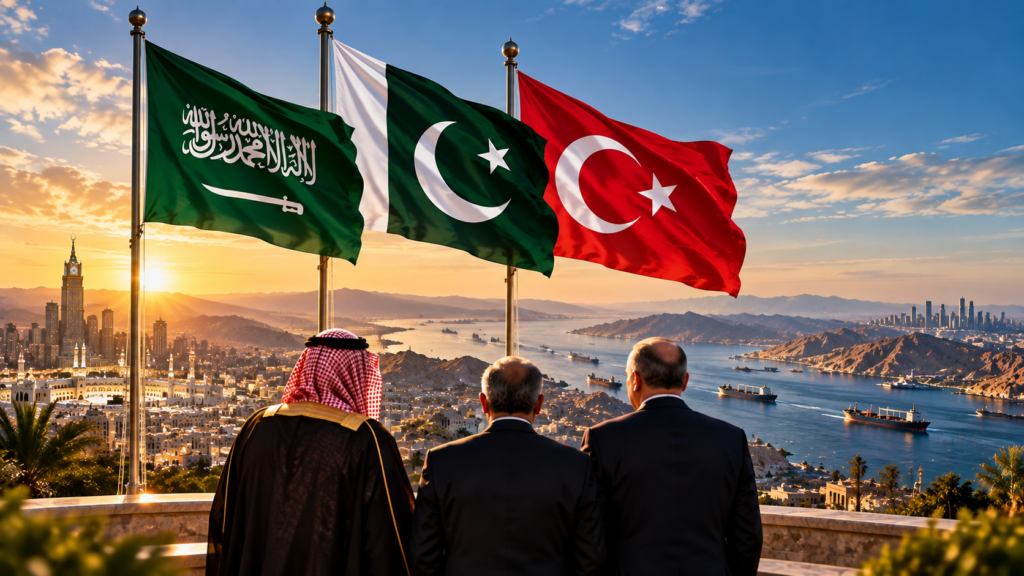
How Saudi Arabia, Pakistan and Türkiye Are Building a New Framework for Regional Deterrence and Conflict Prevention
Analyzing the causes and effects of international developments, benefiting from the chronology of events and their outcomes, and powers of deduction, are essential tools in analyzing international politics. For this reason, to understand the developments that paved the way for the emergence of the Mecca Joint Defense Pact, one should examine a few major developments that occurred last year. On June 23, 2025, amidst the on-going Israeli-Iran conflict and mutual attacks and one day after the United States strikingthe possible Iranian nuclear sites, Iran attempted to hit Qatar’s Al Udeid Air Base with missiles in retaliation.(Salem 2025). This was the first in the Gulf and it was a surprising yet clear message to the leadership of the Gulf countries: in a conflict with Israel and the United States, the US bases located in your territory will be immediate targets. To ameliorate the situation, on September 9, 2025, Israel attacked a building in Qatar’s capital Doha with a precision strike, killing five senior Hamas members and a Qatari security official who were reportedly negotiating a cease-fire between Hamas and Israel (Nimoni 2025). These developments led to vital acts of external balancing in the Gulf.
In the first act of external balancing, almost one week later, on September 17, 2025, the Kingdom of Saudi Arabia and Pakistan leaders signed a mutual defense pact according to which “any aggression against either country shall be considered an aggression against both,” yet; the officials of the two countries made it clear that the pact did not target any specific country (the Guardian 2025). This new mechanism of heightened security cooperation between Saudi Arabia and Pakistan was logical given the fact that Saudi Arabia would become a target of Iranian strikes in case of a regional conflict and Pakistan, and with its already deep and cordial ties to Saudi Arabia, its approximately 260 million population, a powerful military, and last but not least, nuclear capacity, Pakistan emerged as a reliable and obvious ally for Saudi Arabia. The second act of external balancing came in the form of extended US security guarantees for Qatar as the US President Donald J. Trump signed an executive order (no: 14353) on September 29, 2025, which stipulated that “the United States shall regard any armed attack on the territory, sovereignty, or critical infrastructure of the State of Qatar as a threat to the peace and security of the United States” (The White House 2025).
After these developments and alignments, the Gulf situation was relatively calm. Yet, the negotiations in Geneva between the US and Iran on Iran’s nuclear program and inspections “failed to produce a solution on February 26, 2026 (Reuters 2026). Two days later, on February 28, 2026, the United States launched Operation Epic Fury against Iran, targeting military sites, air force, navy, and army units and elements, command and control centers, and defense industrial base of Iran through air strikes. A statement issued by the White House about the operation listed the following as its goals: “… obliterate Iran’s ballistic missile arsenal and production capacity, annihilate its navy, sever its support for terrorist proxies, and ensure the world’s leading state sponsor of terrorism will never acquire a nuclear weapon”(the White House 2026). The US military operation targeting Iran continued with varying level of escalation and use of force since then. In retaliation, Iran targeted the Gulf countries Saudi Arabia, Qatar, the United Arab Emirates, Bahrain, Oman, and their shipping in the Strait of Hormuz, as well as Jordan, with ballistic missiles and loitering munitions. Based on media reports and other open intelligence sources, despite the high level of interception, these attacks caused damage in Saudi Arabia and killed 3 civilians while injuring 23 civilians with the last attack occurring on March 31, 2026 (Wikipedia 2026). While Greece already had a battery of Patriot air defense systems deployed in Saudi Arabia since 2021 through a defensive agreement, in May, Pakistan deployed a squadron of fighter jets, air defense systems, and 8,000 troops to support Saudi Arabia(Ekathimerini 2026), (Reuters 2026).
With varying levels of escalation and negotiations as the US resorted to coercive diplomacy throughout the operation, mediation efforts led by Pakistan resulted in the talks between Iran and the US in Islamabad in April. Pakistan’s Chief of Army Staff, Field Marshal Syed Asim Munir, Prime Minister Shehbaz Sharif, and Minister of Foreign Affairs Mohammad Ishaq Dar played an important role in facilitating diplomatic engagement between the parties, keeping the parties at the negotiation table, and organizing the Islamabad Talks. As a successful example of meticulous preventive diplomacy, the efforts led to the Memorandum of Understanding (MoU) which was signed on June 17, 2026 and ended the hostilities between Iran and the US(BBC 2026a).Türkiye, too, played a critical mediator role for reaching a peaceful solution between the parties while supporting Pakistan’s mediation initiative. Türkiye’s leadership was especially worried about the present conflict expanding and spilling into a regional war, a possibility which prompted Minister of Foreign Affairs Hakan Fidan to provide “friendly advice” to Iran (Spicer 2026).
The MoU envisaged a period of 60 days for the negotiation of a timeline for the inspections on Iran’s nuclear facilities, lifting of the US sanctions on Iran, and the releasing of frozen Iranian assets. Despite this positive step, the negotiations failed and hostilities between the US and Iran resumed on July 7, 2026 (Zengerle 2026). In this environment of a roller coaster of events, probably after lengthy prior negotiations, Türkiye announced its willingness to join the Saudi-Pakistan pact and this new regional security framework became official with the signing ceremony of the Mecca Joint Defense Pact in Meccah on August 7, 2026 by President Recep Tayyib Erdogan of Türkiye, Saudi Crown Prince Mohammed bin Salman, and Prime Minister of Pakistan Shehbaz Sharif. While the official text of the pact is not available at the moment, a joint statement underlined the aim of the pact as “to strengthen collective deterrence against any act of aggression, and stipulates that any armed attack against any one of the three States shall be regarded as an attack against them all” and to foster defense cooperation among the three states (BBC 2026b). Türkiye, with its approximately 85 million population, formidable military, growing defense industry competing with major countries in various areas, and may be equally important, power projection capability, no doubt, made a great contribution to the joint deterrence and capabilities of the pact. The timing of this new regional security framework tells a lot about its purpose. As the first of all, the hostilities between the US and Iran resumed just a few weeks ago and secondly, on July 20, 2026, the Houthis, a political and armed movement controlling the northwestern regions around the Strait of Bab-al-Mandab of Yemen and fighting the UN-backed Yemeni government which happens to be a Saudi ally, declared a naval blockade against the Saudi ships (Abdallah and Azhari 2026). Since the signing of the pact, Turkish leaders many times emphasized that it is not directed against any country; Turkish Minister of Foreign Affairs Hakan Fidan clarified this point: “We don’t have anything written down — nothing we’ve signed — that defines a common threat.
Any country that does not attack us is not a target for us” (The Associated Press 2026). Later on, President Erdogan also felt the need to underline this point: “It would not be correct to view the Mecca Joint Defense Agreement as an alliance established against Iran, Israel, or any third country” (Anadolu Ajansı 2026). From the Pakistani side, Minister of Foreign Affairs Ishaq Dar, too, underlined that the pact is “purely” defensive in nature and not targeted against any country and open to other countries willing to join (South China Morning Post 2026). Some commentators dubbed the Meccah Pact as “the Muslim NATO” since the member states consider an attack against one as an attack against all, but this understanding does not envisage an automatic military response against any attacks. Rather, it signifies the common security perceptions and dedication to close cooperation between the three states. Still, despite being at its infancy period as its organizational structure and leadership are being formed, the pact’s credibility may be seriously tested in the coming weeks, one should not underestimate the power of joint deterrence of the pact. At this point, it is worth remembering that the pact may have contributed to Iranian caution toward Saudi Arabia, although open-source evidence does not establish a direct causal relationship. These attacks can be detected on the radar screen due to their visible trajectory and can be directly attributed to Iran. Jordan, for example, was the target of Iranian ballistic missile attacks on September 9, 2026, as Iran retaliated against the US strikes on Iranian tankers. Likewise, Iran warned that tankers of Kuwait and Bahrain would be targeted also in retaliation.(Le Monde 2026). It may also be plausible at this moment to introduce an Arabic loan-word widely used in Turkish: hatır (خاطر)which can be translated into English as “favor” or “consideration.”Both Türkiye and Pakistan are Iran’s neighbors, they have trade and transportation ties with Iran, both countries have genuinely worked to help find a peaceful solution to the conflict between Iran and the US[1] and finally, personal relations also matter. Even though this did not spare Saudi Arabia from the Houthi attacks recently, as Iran has rejected claims that it directly controls or directs Houthi operations, at least, the pact may have reduced the perceived security risk for the kingdom to some degree. From this perspective, the Mecca Joint Defense Pact should be regarded as an act of preventive diplomacy that aims to contain the US-Iran conflict and prevent its spillover and evolving into an all-out conflict involving other countries.
Is the Meccah Joint Defense Pact a sign of US failure in the Middle East and its withdrawal from the region? Definitely not. It is in very much alignment with the Trump Administration’s foreign and defense policy priorities and similar to the debate about burden-sharing in NATO, in addition to the fears of the member countries emanating from potential regional conflict and instability, this new regional security framework is the result of delegation of some conventional responsibilities to the US allies in the region and fostering cooperation between them while the US still maintains its presence in the Middle East and continues providing support against more complicated security threats such as maintaining its nuclear umbrella. Is the Mecca Joint Defense Pact a ‘paper tiger’ that only issues joint statements and lacks credibility and capacity to deliver? While it is difficult to answer this question at the moment and predict the future scenarios, especially as the pact’s organizational structure and statutes are being formulated, one can still observe that the pact is built upon common security concerns, mutual respect, and deep economic and political ties and as such, it would be a mistake to assume that this rapport would fail to produce a joint approach if and when the right conditions emerge. President Erdogan also emphasized this point by stating that the nature of any response would depend on the attacked country's request and requirements; while support could include intelligence, logistics, or ammunition, with more extensive military assistance possible depending on the scale of the threat(Anadolu Ajansı 2026). Despite all the uncertainties facing the pact, probably due to its defensive nature, it may attract more countries and as Pakistan’s Minister of Foreign Affairs Ishaq Dar recently pointed out, more than six countries are keen to join the pact. Following the October 5 Riyadh meeting, the pact may face one of its real stress tests over the Houthi attacks targeting Saudi Arabian cities, particularly the Holy Cities of Mecca and Medina, while also presenting an opportunity for diplomacy and conflict prevention. (Shahid 2026).
References
| 1. |
Abdallah, Nayera, and Timour Azhari. 2026. "Yemen's Houthis declare naval blockade against Saudi Arabia." Reuters. July 20. Source |
| 2. |
Anadolu Ajansı. 2026. "Türkiye rejects East-West divide, says Mecca defense pact not aimed at Iran or Israel: President." Anadolu Ajansı. September 25. Source |
| 3. |
BBC. 2026b. "Saudi Arabia, Turkey and Pakistan sign defence pact." BBC. August 7. Source |
| 4. |
—. 2026a. "US-Iran memorandum of understanding in full." BBC. June 18. Source |
| 5. |
Ekathimerini. 2026. "Greece renews mandate for air defense missiles in Saudi Arabia." Ekathimerini. October 1. Source |
| 6. |
Le Monde. 2026. "Iran strikes US base in Jordan following attacks on its oil tankers." Le Monde. September 9. Source |
| 7. |
Mazarr, Michael J. 2018. "Understanding Deterrence." RAND. April 19. Source |
| 8. |
Nimoni, Fiona. 2025. "What do we know about Israeli strike on Hamas in Qatar?" BBC. September 9. Source |
| 9. |
Reuters. 2026. "Pakistan deploys jet squadron, thousands of troops to Saudi Arabia during Iran war." Reuters. May 18. Source |
| 10. |
—. 2026. US-Iran talks end with no deal but potential signs of progress. February 26. Source |
| 11. |
Salem, Mustafa. 2025. "How Qatar defused Iran’s attack on the largest US-run base in the region." CNN. June 29. Source |
| 12. |
Shahid, Ariba. 2026. "Pakistan says Mecca pact members to hold emergency talks on engaging Houthis." Reuters. October 2. Source |
| 13. |
South China Morning Post. 2026. "Pakistan says ‘purely defensive’ Mecca accord is open to others." South China Morning Post. August 10. Source |
| 14. |
Spicer, Jonathan. 2026. "Turkey conveying messages between Iran-US, ruling party official says." Reuters. March 25. Source |
| 15. |
The Associated Press. 2026. "Turkey says defense pact with Saudi Arabia and Pakistan is not aimed at Iran or any other country." The Associated Press. August 8. Source |
| 16. |
the Guardian. 2025. "Saudi Arabia and Pakistan sign mutual defence pact as regional tensions escalate." the Guardian. September 18. Source |
| 17. |
The White House. 2025. "Assuring the Security of the State of Qatar: Executive Order 14353." The White House. September 29. Source |
| 18. |
the White House. 2026. "Operation Epic Fury: Decisive American Power to Crush Iran’s Terror Regime." the White House. March 12. Source |
| 19. |
Wikipedia. 2026. "Saudi Arabia in the 2026 Iran war." Wikipedia. Accessed October 2, 2026. Source |
| 20. |
Zengerle, Patricia. 2026. "Trump sends Congress formal notice that Iran conflict has resumed." Al-Monitor. July 13. Source |
The views presented in this article are the authors’ own and do not necessarily reflect the views of Global Strategic Forum – GSF

Copyright © 2026 by GSF Team
Comments
0No comments yet. Be the first to comment.