How Public Data Is Being Turned into a Tool of Psychological Warfare
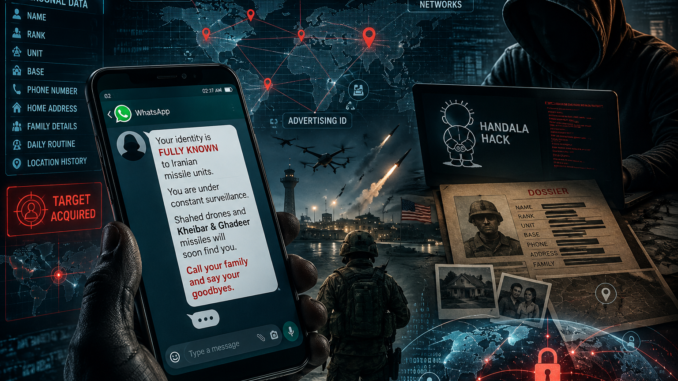
Picture a WhatsApp message landing on your phone in the middle of the night. It already knows your name. Your rank. Your unit. Your base. And it tells you to call your family and say goodbye. Nobody broke into a classified military server to send it. There was no zero-day exploit, no smuggled USB drive, no spy on the inside. The campaign appears to have exploited information that was already publicly or commercially accessible. Stitched together, that trail becomes a dossier and a way to reach someone personally, directly, and with real psychological force.
That is what happened to US Marines stationed at Naval Support Activity Bahrain in the spring of 2026. The Iran-linked group known as Handala Hack sent personalised WhatsApp messages warning service members that their identities were “fully known” to Iranian missile units, that they were under constant surveillance, and that Shahed drones and Kheibar and Ghadeer missiles would soon find them. The advice offered was chilling in its casualness: call home and say your goodbyes. The campaign did not require a conventional breach of the targeted personnel’s military systems. This isn’t really a story about Iran. It’s a story about the digital world we’ve all built, one convenience at a time — and what happens when someone far more patient than us sits down to read it.
What Is Handala, and Why Should You Care?
The name and logo come from a beloved Palestinian cartoon character: a barefoot refugee boy, back turned to the viewer, arms crossed in quiet defiance. The symbolism is carefully chosen. What sits behind it is far less innocent. The US Department of Justice describes Handala not as a grassroots hacktivist outfit but as a front for Iran’s Ministry of Intelligence and Security. The DOJ has seized its web domains; U.S. authorities, including the Naval Criminal Investigative Service, have investigated its targeting of American military personnel. In 2026 alone, the group has been linked to the breach of FBI Director Kash Patel’s personal Gmail account, a wiper attack on medical-technology firm Stryker that knocked out tens of thousands of devices without using conventional malware, and the release of personal data belonging to more than 2,300 US Marines stationed in the Persian Gulf.
What makes the Bahrain operation so instructive for security professionals and organisational leaders is precisely that it required no technical intrusion at all. The names, phone numbers, ranks, unit assignments, family details, and other personal information Handala claimed to hold “were reportedly assembled from publicly and commercially available sources — data brokers, social platforms, professional networking sites, and the advertising-ID ecosystem that quietly tracks phones everywhere they go. They turned the open internet into a targeting system. The target supplied the ammunition.
The OSINT Weapon: Hiding in Plain Sight
Open Source Intelligence — OSINT — is the discipline of gathering, correlating, and acting on information that’s already public. Used responsibly, it’s a legitimate tool for law enforcement, intelligence work, corporate security, and investigative research. Used adversarially, it becomes something closer to a scalpel. The modern data ecosystem has made that scalpel easy to pick up. Consider how much a determined stranger can learn about you without ever touching a classified system. A LinkedIn profile reveals your employer, your role, your location history, your professional connections, and often your unit or department. Location check-ins reveal where you eat, where you train, and what time you tend to leave the house. Data brokers — Whitepages, Spokeo, BeenVerified, and dozens like them — will sell a home address, a family member’s name, or a daily routine for a few dollars. And the advertising ID quietly embedded in most smartphones tracks physical movement across stores, gyms, restaurants, and bases, feeding data that is bought and sold on open commercial markets. Cross-reference all of it, and within minutes what emerges isn’t a vague silhouette — it’s a fully lit portrait of a person’s life.
Handala reportedly claimed to know the home addresses, family details, daily commutes, shopping habits, and evening routines of tens of thousands of US military personnel in the region. Whether every claim held up to scrutiny is almost beside the point. Once a Marine receives a message containing their real name, rank, and a specific threat, the psychological damage is already done — regardless of whether the sender could ever have followed through.That is the essence of OSINT-driven psychological warfare: precision without penetration.
The Convergence of Kinetic, Cyber, and Psychological Warfare
What happened in Bahrain wasn’t an isolated stunt. It reflects a broader convergence of physical, digital, and psychological operations into a single campaign. During the 2025–2026 Iran conflict, kinetic strikes rarely stood alone. They were paired with — and sometimes preceded by — cyber operations that disrupted infrastructure and communications, spoofed GPS signals across the Persian Gulf and the Strait of Hormuz, and ran psychological campaigns against military and civilian populations at the same time. Iran-linked cyber actors have operated through a broader ecosystem of groups and personas involved in cyber, information, and psychological activities, with Handala among the more prominent groups associated with such operations.
The implications reach well past the Gulf. OSINT-enabled psychological operations aren’t reserved for state actors in active conflict zones. They’re now a template available to almost any motivated adversary — criminal networks, corporate spies, extremist cells, or state proxies operating below the threshold of open war. The same playbook used against Marines in Bahrain could just as easily be turned on executives, journalists, judges, or activists anywhere in the world. This threat isn’t theoretical. It’s already operational — and largely ignored by the people best positioned to act on it.
OPSEC: The Discipline We Abandoned in the Age of Oversharing
Operational Security, or OPSEC, is a military concept dating back to the Vietnam War. Its core question is deceptively simple: what information about you, your team, or your operations would be useful to an adversary — and are you actually protecting it? For decades, OPSEC was treated as a concern mainly for intelligence officers and soldiers on the front line. The digital era changed that entirely. Today, an OPSEC lapse isn’t the exception — it’s closer to the default setting, built into the platforms we use, the convenience we’ve grown used to, and a culture that treats visibility online as a kind of virtue.
The U.S. Navy has also responded to this threat. In April 2026, Navy Secretary John Phelan issued a fleet-wide advisory urging sailors to lock down their phones, disable Bluetooth and Wi-Fi in public spaces, scrub their social media accounts, and avoid apps that encourage sharing personal photos and location data. The guidance followed a series of incidents in which adversaries sought to exploit publicly available personal information. But this isn’t only the Navy’s problem. Financial institutions, critical infrastructure operators, healthcare systems, defence contractors, and government agencies all employ people who post location-tagged content, announce work travel, link professional and personal accounts, and hand their data to brokers without a second thought. Each of those habits is a thread. Pull enough of them, and the whole fabric comes apart.
What Leaders and Organisations Must Do Now
There is no purely technical fix for this problem. Firewalls don’t reach into LinkedIn. Encryption doesn’t scrub a home address from Whitepages. Zero-trust architecture won’t stop an adversary from matching a child’s school tag on Instagram to a parent’s military unit page on Facebook. What’s needed instead is a cultural and institutional shift — and it has to start at the top. Five actions matter most:
- Audit your own exposure. Bring in a red team or a trusted security firm to run an open-source intelligence sweep of your leadership, your key staff, and your organisation’s overall footprint. The results are usually sobering; what you do with them is what counts.
- Set a real digital hygiene policy — and enforce it. Clear guidance on professional networking, social media use, data-broker opt-outs, and device management turns OPSEC from a military relic into an everyday professional standard.
- Educate everyone, not just IT. The weakest point in most security programmes is human behaviour. Regular, genuine training on OSINT risk, social engineering, phishing, and psychological manipulation needs to be part of the culture — not a once-a-year box to tick.
- Build real threat intelligence capability. Whether in-house or outsourced, organisations need ongoing visibility into what adversaries can already see about them. This isn’t a luxury reserved for large enterprises — it’s a survival skill for anyone operating in a contested environment.
- Treat psychological operations as a genuine threat category. The Bahrain incident had a significant psychological and information-operations dimension rather than relying solely on a conventional technical intrusion. Threatening messages, targeted blackmail, or impersonation campaigns aren’t just IT tickets — they’re human security incidents that call for organisational response plans, psychological support, and coordination with law enforcement.
Handala’s operation in Bahrain succeeded not because Iran’s hackers are unstoppable, but because the targets were already visible. Rank. Unit. Base. Phone number — all sitting out in the open. The weapon wasn’t a missile. It was a search bar. The line between public and private information has effectively dissolved. Every professional profile, every convenience app, every loyalty card, every tagged photo is a data point. Aggregated and correlated by a patient adversary, those points become an instrument of fear, manipulation, and disruption.
Ensar Seker, Chief Information Security Officer at SOC Radar, has emphasized the increasingly personal and psychological nature of such cyber-enabled campaigns. The real question isn’t whether your name will eventually reach an adversary before you do. It’s what you’re doing today to make sure that when it does, it finds someone prepared.
The Battle Begins Before the First Shot
Sun Tzu wrote that the height of skill in war is breaking an enemy’s resistance without fighting at all. Handala never fired a missile at the Marines in Bahrain. It sent a WhatsApp message — and in doing so, achieved something no missile alone could: it made individual service members feel personally watched, targeted, and vulnerable inside the very bases meant to keep them safe. Modern conflict no longer stays inside the perimeter of a battlefield. It now runs through every digital platform, every commercial database, every unguarded professional profile. The front line is everywhere, and anyone with a digital footprint is standing on it. Cybersecurity has stopped being a purely technical discipline. It’s now a matter of national security, organisational resilience, and personal safety — and the professionals and leaders who understand that, and act on it, will be the ones still standing when the next message arrives. Because it will arrive. The only real variable is whether it finds you prepared, or finds you unguarded.
The views presented in this article are the authors’ own and do not necessarily reflect the views of Global Strategic Forum – GSF.

Imran Bhatti
Imran Bhatti holds an M.Phil. in Governance and Public Policy and professional certifications as a Certified Information Systems Security Professional (CISSP) and Project Management Professional (PMP). He is a geopolitical analyst and writer specializing in energy geopolitics, great-power competition, Eurasian strategic affairs, and South Asian security dynamics. His work explores regional geopolitics, border disputes, infrastructure, security, and economic statecraft in an increasingly multipolar world.
- Imran Bhatti

- Imran Bhatti

- Imran Bhatti

- Imran Bhatti


Leave a Reply