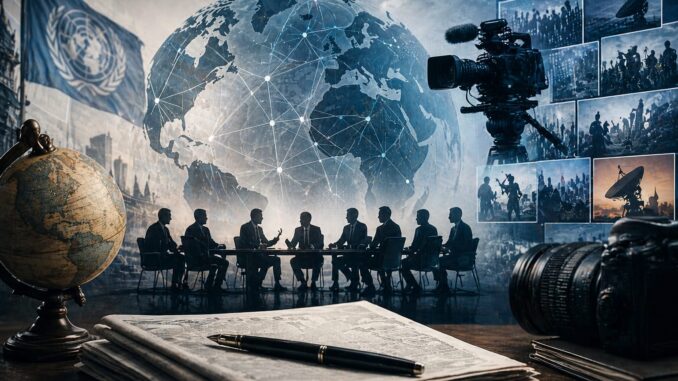
Media has become a decisive instrument of modern diplomacy, shaping global perceptions while enabling both strategic influence and misinformation.
Introduction
In the contemporary global landscape, media occupies a central position in shaping global coexistence, regional politics, and public perception. Over time, it has advanced into a powerful instrument with its ability to influence statecraft, international diplomacy, negotiations, and peace building strategies.
Often described as the “fourth pillar of the state,” media functions as an institutionalized mechanism of communication through which states articulate, frame, and at times manipulate public perception. The strategic use of media has transformed diplomacy from a closed-door practice into a publicly visible and perception-driven process.
The post–second world war period, particularly the Cold War, marked a significant breakthrough that led to the convergence of media, diplomacy, and ideology. In a bipolar world order characterized by ideological contestation between the United States and the Soviet Union, media especially newspapers, radio, and television became an indispensable resource for perception engineering and strategic influence.
Traditional security threats were augmented by psychological, informational, and communicative strategies, underscoring media’s growing relevance in international politics. An era defined by rapidly evolving digital ecosystems, understanding the complex relationship between media influence, diplomacy, and public perception has become a pressing challenge for modern international relations analysts.
Media practices such as framing, agenda-setting, gate-keeping, and propaganda significantly shape diplomatic outcomes and public perception, often blurring the line between information and manipulation.
Background and Theoretical Foundations
One of the earliest architects of modern propaganda and public relations was Edward Bernays, a psychoanalyst often referred to as the father of public relations. Drawing on early insights from mass psychology, Bernays laid the groundwork for understanding how consent can be manufactured through media and symbolic communication.
Bernays famously argued that “the intelligent manipulation of the organized habits and opinions of the masses is an invisible government.” As a member of the U.S. Committee on Public Information during World War I, he played a critical role in persuading the American public to support U.S. involvement in Europe.
With the emergence of a globalized and interdependent world in the second world war, the volume and velocity of information transfer increased dramatically. During the Cold War period (1947–1991), propaganda and psychological warfare became core elements of the state strategy.
Media served as a primary vehicle for transferring ideological narratives, seeking domestic support, and sabotaging adversaries. Psychological warfare proved most efficient at that point, when the targets were uninformed of manipulation, that primarily relied upon: misinformation, selective disclosure, and emotionally charged narratives to weaken opposition and reinforce hegemonic belief systems.
Media and Diplomacy During the Cold War
The Cold War period offers an engaging projection of media’s influence on diplomacy and public perception. Governments increased dependence on media ecosystems to communicate directly with the citizens and international audiences. A textbook example of this is President John F. Kennedy’s televised address on October 22, 1962, during the Cuban Missile Crisis.
By publicly disclosing the presence of Soviet missiles in Cuba, the address communicated the magnitude of the situation, justifying U.S. strategic responses that helped mobilize public support, both locally and internationally.
Similarly, media broadcast of the 1960 U-2 incident when a U.S. reconnaissance aircraft was shot down over Soviet territory that event played an instrumental role in shaping international public perceptions.
The extensive reporting on the U-2 incident manipulated the diplomatic processes between the US and Soviet Union, which underscored complexities of espionage in a nuclearized theatre. These cases demonstrate how media not only reports the global events but also has the ability to frame diplomacy between state actors, influencing their strategic outcomes.
Media, Public Diplomacy, and Track II Engagements
Extending the scope of traditional diplomacy, media claims strategic importance in the realm of public diplomacy, where states sought to project favorable public imaging to advance national interests abroad. This corresponds closely with Joseph Nye’s notion of soft power, which emphasizes culture, political values, and foreign policy-driven by attraction, persuasion, and agenda-setting, rather than coercion -as core components of influence in international relations. In the Cold War, media platforms enabled Track II diplomacy by facilitating dialogue outside official state channels. Journalists, academics, and civil society actors relied on opinion pieces, conferences, and public forums to achieve mutual cooperation.
Programs such as the Pugwash Conferences on Science and World Affairs and the Dartmouth Conferences mirrors how media engagements supported dialogue between American and Soviet intelligentsia. These efforts led to a conclusive détente “release from tensions”: marked by arms control negotiations, nuclear disarmament and confidence-building measures (CBMs), highlighting media’s potential role for peace-building where high stakes of nuclear war was possible.
Media in the Post–Cold War and Digital Era
In the post–Cold War period, Globalism and Digital transformations have further modified the diplomatic practices. The rise of digital ecosystems, data-driven organizational networks and technology-enabled diplomacy for the foreign ministries, diplomats, and political leaders to interact with the global audiences, bypassing traditional media gatekeepers.
The political upheavals of the Arab Spring in 2011underlined the media’s role in shaping competing perceptions around the events, creating a snowball effect through social media dissemination of information. Western media used media-framing to project the uprising events as “pro-democratic mobilizations” driven by social activism and social justice.
In contrast, state-controlled media in Middle Eastern countries portrayed the events as foreign-backed conspiracies aimed to destabilize regional peace. These divergent narratives manipulated the domestic and international perceptions, reinforcing existing power structures and ideological divides.
Media influence also intersects with broader debates on how cultural hegemony is validated by hegemonic discourses via modern digital platforms such as social media: Twitter X, Instagram, Reddit and Facebook. Antonio Gramsci’s concept of cultural hegemony gains its relevance in assessing modern-day media manipulation.
It explains how dominant international actors sustain power not merely through coercion, but by reinforcing narratives via digital media algorithm staking consent of the marginalized communities/colonized.
The European Union’s (EU’s) Digital Services Act of 2022 is a typical instance of how Global institutions promoting values such as diversity, inclusivity and tolerance seeking digital consumers coming from all societies, to agree upon the Terms and Conditions. This Act functions as a “regulatory imperialism” that enforces European standards of free speech and democratic principles.
Public Perception, Misinformation, and Media Ethics
Media’s increasing impact on public perception is often amplified by social media algorithms that create echo chambers. Such digital ecosystems expose digital users primarily to informational flow that reinforces existing beliefs, limiting exposure to alternative opinions, subsequently intensifying political polarization. The rapid dissemination of sensationalized content frequently overshadows nuanced analysis, complicating public understanding of complex international issues.
The spread of the “fake news” further challenges informed public discourse. For instance, during the 2016 U.S. presidential election, social media platforms were widely questioned for facilitating the circulation of misleading and partisan content. Such dynamics place additional pressure on diplomats to respond swiftly to public sentiment, sometimes at the expense of long-term strategic considerations.
Conclusion
Media has become an indispensable force multiplier in contemporary diplomacy that directly impacts public perception. It serves as a double-edged sword: while it enhances transparency, public engagement, and cultural disconnectedness, it also empowers manipulation, misinformation, and hegemonic discourse-building
The views presented in this article are the authors’ own and do not necessarily reflect the views of Global Strategic Forum – GSF.

Osama Ali
Osama Ali is a peace and conflict studies researcher with a strong passion for critical discourse analysis, comprehensive security, and contemporary political dynamics and can be reached at sultanimamosama@gmail.com .

Leave a Reply