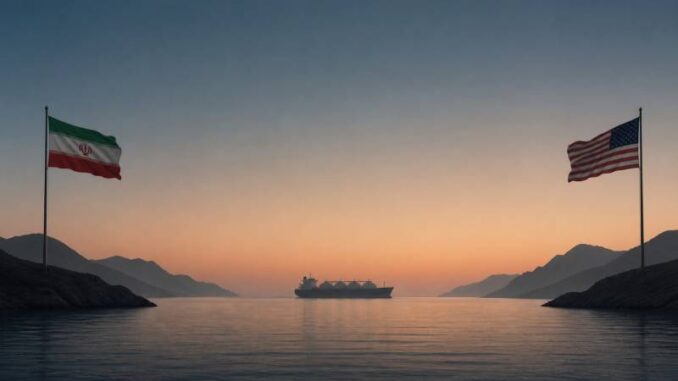
The deepening Iran–U.S. crisis, marked by the blockade of the Strait of Hormuz and failed diplomacy, reflects a dangerous breakdown of global order with severe worldwide consequences
47 years of hostility between Iran and the United States is now taking a dangerous turn. After 40 days of war, in which the United States and Israel launched relentless bombing of Iran, the fragile ceasefire reached around three weeks ago has failed to resume the second round of dialogue between Tehran and Washington.
The blockade of the Strait of Hormuz, first by Iran and then by the United States, has unleashed a dangerous fuel, food and fertiliser crisis across the world.
The lack of a crisis management mechanism to manage the Iran–U.S. crisis exposes the fragility of the world order. Neither the United Nations nor other international organisations or major powers have been able to unblock the Strait of Hormuz.
The closure of the strait has almost halted 20% of the global supply of oil and gas, and along with that, one can witness a serious food and fertiliser crisis impacting primarily the underdeveloped world. If the Strait of Hormuz was not the cause of the Iran–U.S. conflict, why has it led to a deepening global crisis?
The suspension of dialogue between Iran and the United States is also related to the blockade of the Strait of Hormuz because Tehran has made it clear that, without lifting the blockade, it will not enter into any sort of negotiations with Washington. The U.S. President, Donald Trump, is adamant about keeping the Strait blocked to deliver a heavy blow to the Iranian economy.
But Iran has faced Western sanctions for decades, and 40 days of U.S.–Israeli attacks have not forced Tehran to concede to the core objectives of that campaign: regime change, dismantling of Iran’s nuclear and missile programme, and ending Iran’s support for its allies like Hezbollah in Lebanon and the Houthis in Yemen.
The Strait of Hormuz was not a cause of the war, but later, when Iran realised that the U.S. and Israel would continue the destruction of its infrastructure and leadership, it decided to attack pro-American allies in the Gulf, such as the UAE, Saudi Arabia and Kuwait, and then block the Strait.
The manner in which the proposed second round of U.S.–Iran talks in Islamabad failed to take off, and President Donald Trump, while announcing an extension of the ceasefire, made it clear that the American delegation would not go to Islamabad, reflects an enormous trust deficit between Washington and Tehran.
Diplomacy, statesmanship and the abandonment of ego will help manage the Iran–U.S. crisis, leading to the reopening of the Strait of Hormuz and ensuring peace and stability in the Middle East
The Iranian leadership also made it clear that it would not enter into talks in the proposed second phase with the U.S. unless America lifted the blockade of its ports. Iran also rejected U.S. conditions that it should cease its nuclear ambitions and restrict its missile programme.
Diplomacy means the skilful art of negotiation. Pakistan first facilitated and then mediated in Iran–U.S. talks in Islamabad to the extent that, for the first time in the last 47 years, there were direct talks between the two adversaries.
However, the efforts of Islamabad, with the support of Saudi Arabia, Qatar, Turkey and Egypt, failed to produce any major flexibility or rapprochement in the hardline positions taken by the U.S. and Iran.
Since the second round of Islamabad talks is not happening anytime soon, the implications of the U.S.–Iran standoff are serious. The global surge in prices of fuel, gas, food and fertilisers is putting the survival of millions of people at stake.
Yet there is no realisation on the part of either the United States or Iran to manage their crisis and reopen the Strait of Hormuz. As a result, powerful actors with economic interests are taking advantage of the closure by allowing sharp increases in the prices of fuel, gas, travel and other commodities.
For how long this crisis will continue remains to be seen, but one thing is certain: the lack of authority of the UN and other global stakeholders in preventing the closure of the Strait of Hormuz is a major sign of international disorder.
It is argued that, had Iran agreed to join the second round of talks in Islamabad with the United States, things might have been better. During such talks, Iran could have made it clear to America that, without lifting the blockade on its ports and addressing issues such as respecting its sovereignty and refraining from demands to dismantle its nuclear and missile programme, pressure on the U.S. would have increased.
However, Iran, by boycotting the Islamabad talks, has further aggravated the crisis.
The deepening of the U.S.–Iran crisis, particularly that related to the closure of the Strait of Hormuz, needs to be analysed from three angles. First, the apparent failure of U.S.–Israeli objectives in attacking Iran.
Neither their goals of regime change, nor dismantling Iran’s nuclear-missile programme, nor destroying its armed forces were accomplished. Trump’s inflammatory rhetoric, such as threatening to render Iran into the Stone Age or destroy its civilisation, further aggravated the crisis.
More than Iran, it is the United States which, through its aggressive and belligerent stance, has eroded the prospects of peace in the Persian Gulf.
The resilience and courage shown by the leadership and people of Iran have demonstrated that, despite its asymmetrical position vis-à-vis the U.S., it possesses commitment and clarity. Despite spending more than 25 billion dollars in its war with Iran, the U.S. failed to achieve any of its objectives.
Yet, in order to mask its failure, President Trump has claimed that Iran was defeated in the war. In reality, Iran has been able to challenge the perception of American power.
Second, the present crisis in Iran–U.S. relations, despite Pakistan’s efforts to resume dialogue, may reach a dangerous impasse because Israel has been pressing the United States to resume attacks on Iran.
If the ceasefire ends and hostilities resume, the situation may spiral out of control because, during the last three weeks of ceasefire, Iran has reorganized its capabilities and will be able to effectively counter another round of U.S.–Israeli attacks.
It is suggested that, before the United States, under Israeli pressure, embarks on another round of hostilities, the American Congress and public opinion should prevent such an eventuality.
It is only through diplomacy and a win-win approach, rather than a win-lose strategy, that the Iran–U.S. crisis can be managed.
Finally, history may record that the United States attacked Iran while nuclear talks were ongoing in Geneva in June 2025 and February 2026. War was imposed on Iran to destroy the regime, its nuclear-missile programme and its infrastructure.
It may also be established that, if Iran withdraws from the Nuclear Non-Proliferation Treaty (NPT) and conducts a nuclear test, it would be a consequence of U.S. and Israeli pressure pushing Iran in that direction.
The example of North Korea is often cited, as it withdrew from the NPT and subsequently conducted nuclear tests in response to American pressure, leading to a situation of nuclear deterrence between North Korea and the United States.
A similar situation may emerge in the case of Iran, as it has been argued that powerful countries respond primarily to force. Therefore, if Iran goes nuclear, responsibility would be attributed to Israel and the United States, particularly as Iran had previously committed to the 2015 JCPOA and participated in the Geneva talks, while Washington’s actions undermined these processes.
Diplomacy, statesmanship and the abandonment of ego will help manage the Iran–U.S. crisis, leading to the reopening of the Strait of Hormuz and ensuring peace and stability in the Middle East.
The United States, despite its military might, failed to subdue North Vietnam even with half a million troops and relentless bombing from 1965 to 1973. Likewise, Iran has demonstrated that it cannot be easily defeated, having shown resilience and determination in its war with Israel and the United States.

Dr Moonis Ahmar
The writer is the former Dean of the Faculty of Social Sciences at the University of Karachi, and can be reached at amoonis@hotmail.com.

Leave a Reply