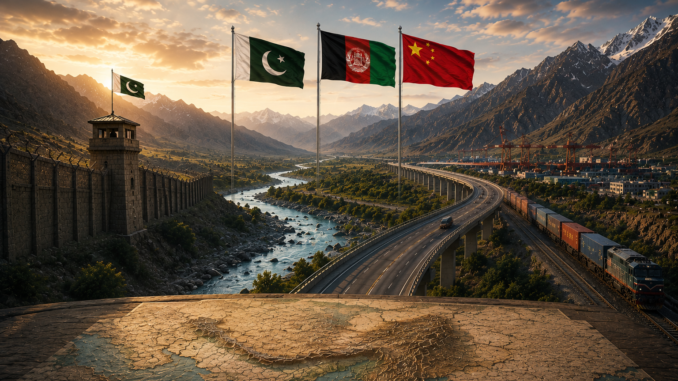
In an increasingly volatile regional environment, Pakistan’s Afghanistan policy stands at a critical strategic crossroads. Persistent cross-border terrorism has reinforced Islamabad’s security concerns, while China’s emphasis on regional connectivity, economic cooperation, and diplomatic engagement presents both opportunities and strategic challenges. As Pakistan seeks to safeguard its national security without undermining its long-term strategic partnership with China, balancing effective counterterrorism measures with sustained diplomacy has become one of the defining tests of its foreign policy. This article examines how Pakistan can navigate this complex strategic dilemma while advancing regional stability, economic connectivity, and long-term security.
The recent cross-border tensions between Pakistan and Afghanistan, following terrorist attacks inside Pakistan, have once again exposed the fragile security situation along Pakistan’s western border. Pakistan argues that terrorist groups continue to use Afghan territory to launch attacks against it, leading Islamabad to argue that limited military action may become necessary to safeguard national security. The Taliban government rejects these claims and describes Pakistan’s operations as a violation of Afghanistan’s sovereignty. Although the current tensions are mainly between Pakistan and Afghanistan, they also raise a larger strategic question: can Pakistan’s security-focused Afghanistan policy continue to remain fully compatible with China’s long-term regional interests?
Pakistan’s security concerns are based on real challenges. Pakistan has reported a significant increase in TTP-related attacks since the Taliban returned to power in August 2021. Recent terrorist attacks inside Pakistan have reinforced Islamabad’s assessment that militant groups are still operating from across the border and continue to pose a serious threat. As a result, Pakistan has shown a greater willingness to conduct cross-border operations against suspected militant hideouts when it believes diplomatic efforts are no longer sufficient.
China also wants to prevent terrorism, but it prefers a different approach. Beijing believes that lasting regional security depends on political dialogue, economic cooperation, and regional connectivity. Instead of supporting military escalation, China has continued to encourage talks between China, Pakistan, and Afghanistan. During the China-facilitated dialogue held in Urumqi earlier this year, Pakistan and Afghanistan agreed to keep communication open, acknowledged that terrorism is the main issue affecting their relationship, and expressed their willingness to seek a long-term solution instead of allowing tensions to grow further.
This difference is important. Pakistan and China share the same broad strategic goals. Both want to eliminate terrorism, support a peaceful and stable Afghanistan, and protect regional connectivity. However, they differ in the way they believe these goals should be achieved. Pakistan has become more willing to use military force to respond to immediate security threats. China, on the other hand, believes that continuous dialogue, diplomatic engagement, and economic cooperation provide the strongest foundation for lasting peace and stability.
The impact of this issue goes far beyond Pakistan and Afghanistan. Afghanistan holds an important position in regional connectivity, linking South Asia, Central Asia, and western China. Continued instability not only creates security problems for Pakistan but also threatens China’s wider economic and regional plans. Through the China-Afghanistan-Pakistan dialogue, all three sides have repeatedly stressed that no militant group, including the TTP and the East Turkestan Islamic Movement (ETIM), should be allowed to use any country’s territory to threaten regional security.
This shows that China understands Pakistan’s security concerns while continuing to support dialogue and cooperation instead of prolonged confrontation. The recent escalation has also highlighted the limits of relying on just one approach. While military operations can disrupt militant networks and reduce their ability to carry out attacks in the short term, lasting peace has remained difficult to achieve through military measures alone.
At the same time, dialogue alone cannot solve the problem if terrorist groups continue to operate without meaningful action against them. Pakistan’s security concerns are real and require a credible response. This suggests that neither military action nor diplomacy, on its own, is enough to deliver a lasting solution.
Pakistan is therefore facing a strategic dilemma, not a simple strategic choice. On one hand, it cannot ignore threats to its national security. On the other, it cannot afford long-term instability with Afghanistan, as this would harm regional trade, the China-Pakistan Economic Corridor (CPEC), and its strategic partnership with China. The real challenge is not choosing between military action and diplomacy. Instead, Pakistan needs a balanced strategy that combines effective security measures with sustained diplomatic engagement to achieve long-term regional stability.
A practical way forward would be to establish a permanent security mechanism involving China, Pakistan, and Afghanistan. Instead of relying on occasional meetings during times of crisis, the three countries should create a regular framework for political dialogue, intelligence sharing, joint border monitoring, and clear counterterrorism commitments. China is in a strong position to support this process because it maintains working relations with both Islamabad and Kabul. At the same time, efforts to expand legal cross-border trade, improve regional connectivity, and promote economic development in border areas can strengthen long-term security by reducing some of the underlying causes of instability.
In the end, Pakistan’s Afghanistan policy should not be judged only by the success of military operations. Its real test is whether it can ensure lasting border security while also protecting its strategic partnership with China. Long-term regional stability will depend on Pakistan’s ability to balance its immediate security needs with China’s broader vision of regional connectivity, economic cooperation, and development. Finding this balance is likely to remain one of the country’s most important foreign policy challenges in the years ahead.
The views presented in this article are the authors’ own and do not necessarily reflect the views of Global Strategic Forum – GSF.

Awais Akmal
Awais Akmal is a researcher specialising in Central Asia, China, and the IOR geopolitics. A former Research Internship fellow at the Maritime Centre of Excellence (MCE), Pakistan Navy War College, he holds an MPhil in Political Science and has authored numerous articles in HEC-recognised journals and strategic think tanks. He can be reached at awaisakmal80@gmail.com .
- Awais Akmal
- Awais Akmal

Leave a Reply