
Pakistan Wants New Provinces. The Harder Question Is Who Gets the Money?
A system that “has collapsed”
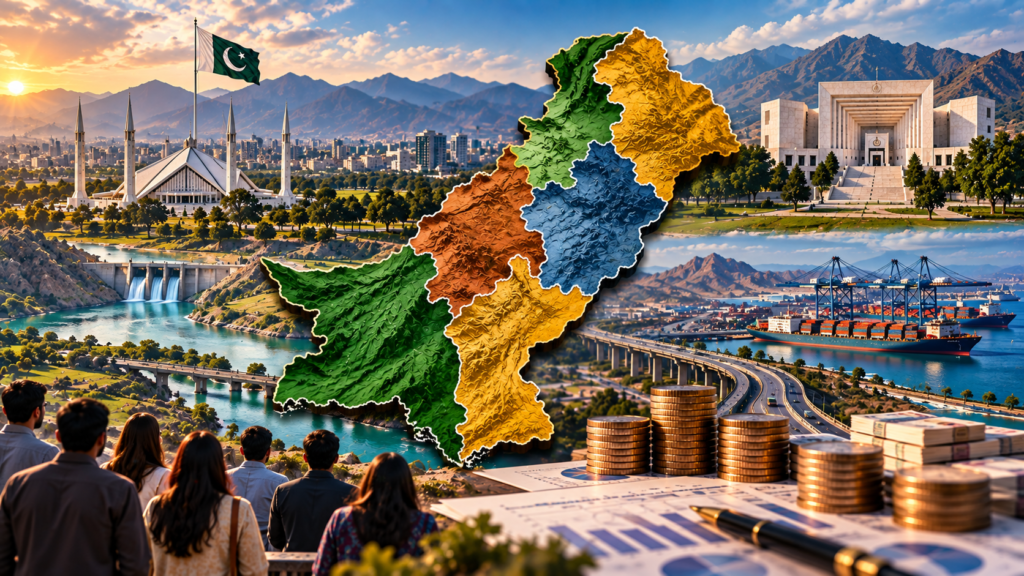
Behind the debate over administrative boundaries lies a deeper struggle over revenue, political authority, local governance and the distribution of power within the federation.
On 30 July 2026, at the Pakistan Economic Summit, Interior Minister Mohsin Naqvi said something unusually blunt for a serving minister: the system the country is living under has collapsed. His remedy was to take the question of administrative units, provinces or otherwise, to the public. A day later, military spokesperson Lieutenant General Ahmed Sharif Chaudhry linked effective governance with national security, questioned whether four provinces could adequately administer a population of this size, and stressed that any administrative restructuring should proceed through constitutional and political channels. It did not stop there. Planning Minister Ahsan Iqbal called for a national debate and floated either twelve to fifteen new provinces or 160 empowered district governments. Defence Minister Khawaja Asif argued for devolution to the grassroots. Within weeks, proposals in public ranged from about a dozen new units to more than three dozen. Little of it was new. All of it was suddenly loud.
Why the demand keeps returning
Start with the arithmetic, because it does not move. The 2023 census counted 241.49 million people; the country is now somewhere around 250 million. Punjab alone held 52.87 percent of that, more than half the federation inside one provincial boundary. Balochistan is enormous in area and thin in population, which creates the opposite problem: a government in Quetta responsible for distances that make routine administration an expedition. Smaller units, the argument runs, put decisions closer to the citizen, and that is not a wild claim. Literacy remains around 61–63 percent, while an estimated 25.15 million children aged 5–16 were out of school in 2023–24, and a school failing in Rajanpur rarely registers as an emergency in Lahore. Southern Punjab's districts have said for decades that power, posts and projects concentrate in the centre; their demand for a separate province has been endorsed at various points by the Punjab Assembly and the National Assembly. The same pattern appears in Khyber Pakhtunkhwa, where the Hazara province movement is now sixteen years old. The provincial assembly has passed resolutions in its favour three times, bills have been introduced in both the National Assembly and the Senate, and Sardar Muhammad Yousaf, who chairs the movement, keeps pressing for the parliamentary process to start. There is no shortage of paperwork. There is a shortage of votes. And then comes the objection heard in every drawing room: if four provinces are this difficult to run, why would twelve be easier?
The wall in Article 239
Under Article 239(4) of the Constitution, an amendment altering the limits of a province cannot be presented for assent until it has been passed by that province's own assembly with a two-thirds majority and the amendment itself then needs two-thirds in both houses of parliament. This makes any attempt to alter provincial boundaries a formidable political barrier, particularly because it requires the consent of the affected provincial assembly. That is not merely a procedural hurdle. It is a formidable political barrier and it explains why proposals with genuinely broad support have still gone nowhere.
The map is not the machine
The conversation treats three different things as one: a new province, a new administrative unit, and a stronger local government. A province becomes a federating unit with its own assembly, cabinet, secretariat and seat at the table. An administrative unit stays subordinate to the province. Local government moves power from the provincial capital to elected councils. Only the third one reliably shortens the distance between a citizen and a decision. Pakistan has run this experiment. The 2001 Devolution of Power Plan created district, tehsil and union council governments with elected nazims and real planning roles; after 2008, provincial governments increasingly reassumed functions and control over budgets and appointments, weakening the devolution framework. The 18th Amendment then devolved substantial authority to the provinces, but Article 140-A left them to decide how local government would work and be funded and provincial governments have subsequently altered local-government laws and, at various points, delayed elections and retained substantial control over development resources. Economists make the point plainly. Miftah Ismail, a former finance minister, calls smaller provinces no substitute for empowered local governments. Abid Qaiyum Suleri puts it more directly: without effective local government, whether there is one province or twenty-five, decision-making stays centralised at the provincial level.
Follow the money
The post-2010 fiscal settlement, which underpins everything else, is already under strain. The seventh National Finance Commission Award lifted the provinces' collective share of the divisible pool from 47.5 percent to 57.5 percent, replaced the population-only formula with a multiple-indicator arrangement, and raised the shares of Khyber Pakhtunkhwa and Balochistan in particular. The 18th Amendment barred any future award from reducing that collective share.
Since then the arithmetic has turned. Debt servicing has grown roughly sevenfold over the past decade, with external debt near $87 billion in 2025, and once transfers, debt servicing and defence are accounted for, the federal government borrows to pay pensions and run social protection while still spending in areas formally devolved to the provinces.
The 2026-27 budget negotiations made the squeeze explicit. The federal government sought roughly Rs1.1–1.2 trillion from the provinces for strategic requirements on top of the Rs1.95 trillion cash surplus already required under the IMF-backed National Fiscal Pact. The divisible pool was capped at Rs13.35 trillion, while the petroleum development levy was projected at more than Rs2 trillion, proceeds that are not shared with the provinces. None of that formally revised the NFC Award. It changed the vertical distribution anyway. Now consider what a new province means in that environment: a new claimant on a pool whose terms are already being renegotiated by other means. Khyber Pakhtunkhwa's demand for a larger share after the merger of the former tribal areas shows how quickly a territorial change unsettles an outdated formula. Supporters sell new provinces as governance reform. Opponents hear a budget negotiation. Both are describing the same document.
What a redrawn map could mean for the federation
There is a reason the reaction in Sindh was swift. The provincial assembly has opposed new provinces or units inside the province, and the Pakistan People's Party has rejected the idea outright. Karachi Division alone holds roughly 20.4 million people and is among the most ethnically mixed cities in the region, carrying the political memory of the 1990s. For opponents of dividing Sindh, redrawing its boundaries would be seen not simply as administrative restructuring, but as a contest over identity, resources and control of the country's economic centre. History explains the suspicion. The 1955 One-Unit scheme merged the western provinces and princely states into a single province, partly to balance East Pakistan, and was undone in 1970. The politics around that experiment left a durable lesson about maps being used to rearrange representation rather than serve citizens. Muhammad Shoaib of Quaid-i-Azam University warns that a partially finished division would aggravate ethnic tensions rather than relieve them.
The question being asked backwards
So does Pakistan need new provinces? Probably some. The gap between how large Punjab is and how far a provincial capital can reach is real, and the Hazara and South Punjab demands have survived long enough to count as permanent features of the political landscape rather than passing campaigns. But the debate is framed backwards. The honest question is not how many provinces there should be, but which decisions should be taken where, and who pays for them.
If the objective is schools that function, police that respond, water that arrives and municipal services that work, the relevant institution is usually a city or district government, not a new province. A new province that inherits the same centralisation could simply add a capital, a cabinet and a secretariat without solving the underlying problem. The record of devolution also shows a persistent tension between provincial demands for greater autonomy from Islamabad and the extent to which authority and resources are transferred to elected local governments. One potentially workable sequence would be, and it is unglamorous: hold local elections on time, define local functions in law, guarantee predictable transfers. Then let the question of boundaries follow from evidence rather than ambition. Pakistan does not need a bigger map. It needs a shorter distance between a citizen and the person who decides.
The views presented in this article are the authors’ own and do not necessarily reflect the views of Global Strategic Forum – GSF

Copyright © 2026 by GSF Team
Comments
0No comments yet. Be the first to comment.