
Missile Mathematics
The Economics of Cost-Exchange and the Future of Air and Missile Defence
Abstract
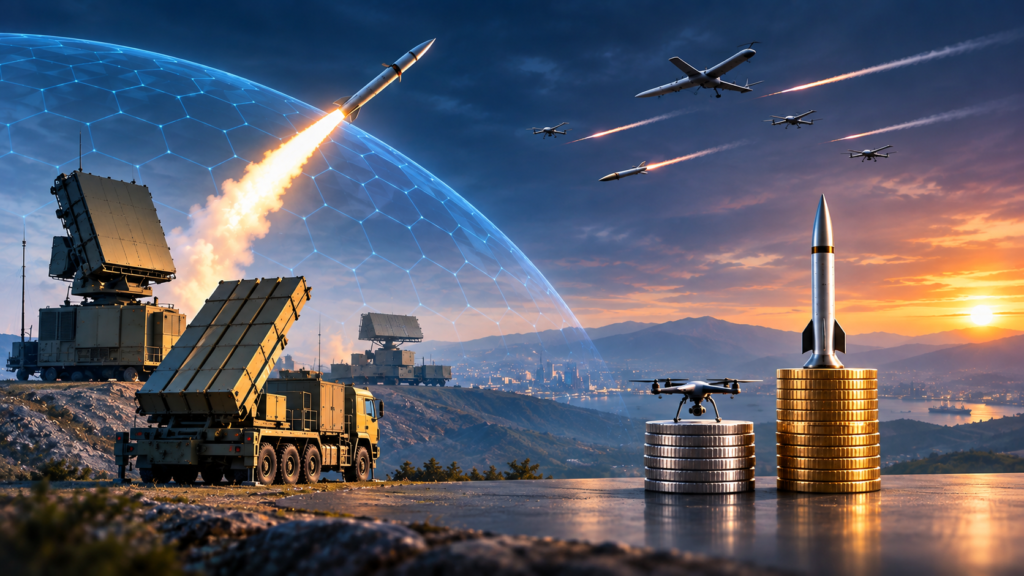
When a four-million-dollar interceptor is expended against a twenty-thousand-dollar drone, the arithmetic of defence appears to collapse. This paper examines the “cost-exchange ratio” problem now reshaping air and missile defence, in which mass-produced attritable munitions loitering drones, kamikaze UCAVs and cheap cruise missiles force defenders to burn exquisite interceptors against exquisite targets that cost a fraction of the round. Drawing on published cost data from the conflicts over Ukraine, the Red Sea and the Gulf, the paper quantifies the asymmetry, then complicates it: cost-exchange is a real pressure but an incomplete metric, since the value defended and the magazine depth of both sides matter as much as the unit price of any single engagement. The paper surveys the emerging countermeasures interceptor drones at a thousand dollars a copy, high-energy laser systems such as Israel’s Iron Beam, high-power microwave systems, and layered resilient architectures and argues that the decisive shift is doctrinal rather than technological: from defeating every threat to affordably absorbing salvos. The mathematics of missile defence is being rewritten, and the states that internalise it first will hold a structural advantage that no single platform can confer.
1. Introduction: the provocation of a simple sum
A recurring concern among defence analysts is the growing challenge of sustaining air defence against waves of relatively inexpensive unmanned systems. The proposition, echoed by practitioners across air defence communities, runs as follows. Waves of cheap one-way attack drones can be generated faster than any defender can manufacture the missiles that knock them down; interceptors built for aircraft and ballistic missiles cost orders of magnitude more than the drones they destroy; and no defence budget survives that exchange indefinitely. The only cost-effective and sustainable answers, the argument concludes, are weapons that do not expend scarce rounds per shot high-energy lasers, high-power microwaves, and other directed-energy systems because geopolitics rewards technical superiority, sustainability and survivability against unmanned systems, not the ability to win an attrition race one interceptor at a time.
This paper takes the provocation seriously and subjects it to three tests. Section 2 quantifies the arithmetic: is the cost-exchange crisis real, and how large is it? Section 3 asks why the mathematics broke what changed in the economics of munitions. Section 4 presents the counter-case, because serious analysts have pushed back hard on the simple sum. Section 5 surveys the emerging answers, from thousand-dollar interceptor drones to Israel’s operational laser umbrella. Section 6 draws the strategic implications, with particular attention to states that must plan their air defences under real budget constraints. Section 7 concludes.
2. The arithmetic of attrition
Begin with the numbers, because they are stark enough to survive scrutiny. A Patriot PAC-3 interceptor the West’s workhorse for terminal air and missile defence costs roughly four million dollars per round; a THAAD interceptor, designed for ballistic threats, costs in the region of twelve to fifteen million. Against these stand the one-way attack drones that now dominate the contemporary battlefield: the Iranian-designed Shahed-136 family, produced in the tens of thousands and used by Russia over Ukraine, at an estimated unit cost of twenty to thirty-five thousand dollars depending on configuration and production run. The New York Times’s accounting of engagements during the 2026 Gulf crisis put the imbalance in concrete terms: two SM-2 naval missiles costing approximately 4.2 million dollars expended against Shahed-type drones costing around thirty-five thousand each an exchange of roughly one hundred and twenty to one.
The aggregate picture is worse than the single engagement. Ukraine’s experience has highlighted the challenges of sustaining air defence during prolonged attacks involving large numbers of missiles and drones. Some analyses suggest that the cost-exchange ratio can become highly unfavourable for defenders in engagements involving low-cost drones. Even comparatively cheap countermeasures accumulate: two Coyote interceptor drones against a single Shahed represent a quarter of a million dollars, which is an improvement on the Patriot mathematics but still several times the attacker’s outlay.
Three structural features make this arithmetic brutal. First, the defender must intercept every leaker the attacker needs only one drone through to destroy a transformer, a runway or a radar. Second, the defender’s magazine is finite and slow to replenish, while the attacker’s drones roll off simplified, lightly regulated production lines. Third, the defender’s inventory problem compounds: interceptor production at scale takes years of investment, whereas drone production scales in months. The result is what analysts at the European Policy Centre have called the new economics of warfare a systematic advantage to the side that can afford to waste munitions.
3. Why the mathematics broke
The cost-exchange crisis is not a mystery of engineering; it is a story of two production philosophies colliding. Air defence interceptors descend from a Cold War lineage that priced reliability, guidance sophistication and lethality per shot above affordability a rational choice when each target was itself a multi-million-dollar aircraft or missile. The drone revolution inverted the design brief. A Shahed carries a motorcycle-grade engine, plywood and composite airframe, commercial navigation, and a modest warhead; its lethality derives not from sophistication but from number, endurance and the defender’s obligation to engage. Additive manufacturing, commercial component supply chains and software-defined guidance collapsed the entry price of precision-adjacent attack to a rounding error in a defence budget.
The strategic consequence is an inversion of the classical offence-defence balance. For most of the missile age, defence was the affordable side: it cost less to stop an attack than to mount one. Attritable munitions reversed that presumption for precisely the classes of target fixed infrastructure, airbases, power grids, ports that modern economies cannot do without. The attacker’s economics are one-way: the drone is expendable, the defender’s interceptor is not, and the exchange need only be repeated until the defender’s magazine or budget gives out. As the commentary that inspired this paper put it, missile interceptors will always prove costly against waves after waves of unmanned systems.
4. The counter-case: cost-exchange is not the whole story
Honest analysis requires the counter-argument, and it is strong. Analysts at the Center for Strategic and International Studies caution that the cost-exchange framework, while rooted in truth, is incomplete: the relevant comparison is not interceptor price against drone price but interceptor price against the value of what the drone would have destroyed. A four-million-dollar PAC-3 that saves a power station, an airliner or a capital’s confidence is cheap; the same missile spent against an empty field is a waste, and everything depends on the discrimination and cueing that put the round in the right place. Scholars at West Point’s Modern War Institute press the point further, warning that cost-exchange logic can metastasise into procurement doctrine that militaries seduced by the arithmetic may underbuy the interceptors whose deterrent effect, production depth and reliability no novel technology yet matches. Two further qualifications belong in the ledger. Interceptor costs may change as production scales and procurement commitments increase. And the attacker’s cheapness is conditional on the defender’s vulnerability: mass drone campaigns work best against point targets defended by exquisite missiles, and they fare worse against layered, deception-heavy, resilient architectures that dilute the attacker’s per-drone value. The mathematics, in other words, is real but it is a pressure, not a verdict.
5. The emerging answers
Three families of response are now visible, and each attacks a different term of the equation.
- Interceptor drones. Ukraine’s wartime industry has produced a family of drone-on-drone interceptors that restore parity by matching cheapness with cheapness: autonomous or remotely cued interceptors at roughly one thousand to three and a half thousand dollars per unit systems such as the ZIRKA at around two thousand dollars against Shahed-type attack drones costing tens of thousands. Reuters reported in April 2026 that Gulf states, drained by Iranian drone campaigns and four-million-dollar interceptor expenditures, are studying the Ukrainian model. These developments may improve the economic balance, although their effectiveness and affordability require further assessment.
- Directed energy. Lasers and high-power microwaves may reduce the cost of engaging certain aerial threats. Israel’s Iron Beam is a high-energy laser system intended to provide a lower-cost option. These technologies also have limitations, including line-of-sight requirements, weather sensitivity, substantial power demands and restricted engagement ranges. High-power microwave systems add an area-effect answer to swarms that single-target lasers lack.
- Layered resilience. The third approach accepts that some threats may penetrate defences and reorganises infrastructure and defensive arrangements to reduce the consequences of such penetration through hardening, redundancy, deception and dispersion of high-value assets, passive defence, and affordable defensive systems such as guns, electronic warfare and attritable interceptors at the low end of the threat spectrum, with more sophisticated missiles reserved for targets that genuinely warrant them. The lessons emerging from Ukraine and the Gulf highlight that resilience is now a term of the exchange equation, not an afterthought.
6. Strategic implications
For planners especially in states that must defend real economies on real budgets four implications follow. First, magazine depth is a strategic variable: air defence is now a contest of production and stockpiles as much as of platforms, and interceptor industrial base has become as consequential as the interceptor itself. Second, the interceptor mix must be tiered by target value: exquisite rounds for exquisite threats, cheap autonomous interceptors for drones, directed energy for the high-volume low-value layer with the mix chosen by the arithmetic of what each round is protecting. Third, deterrence calculus shifts: an attacker who can impose four-million-dollar costs with twenty-thousand-dollar drones holds a coercion instrument that operates below the thresholds at which alliances and treaties activate the grey zone made material. Fourth, the talent question migrates: the decisive capabilities autonomous perception, counter-swarm software, energy integration live closer to the commercial technology sector than to traditional defence primes, which makes national innovation ecosystems, and the human capital behind them, part of the order of battle. A final implication is doctrinal humility. Every previous generation declared a revolution upon meeting its first asymmetry, and every previous generation discovered that adversaries adapt. The same commercial technologies that cheapen attack also cheapen defence; the same drone industry that floods a sky now manufactures its own hunters. The mathematics will keep moving the advantage belongs to whichever side iterates faster.
7. Conclusion
The missile mathematics is unforgiving, and the practitioners who flag it are right about the trend: a defence that answers every twenty-thousand-dollar drone with a four-million-dollar missile is programming its own bankruptcy. But the full ledger is more interesting than the single sum. Cost-exchange is one term in an equation that also includes the value defended, the depth of magazines, the resilience of what lies beneath the flight path, and the industrial tempo behind both sides’ munitions. The responses now maturing thousand-dollar interceptor drones, directed-energy systems that may reduce the cost of some engagements, architectures that can absorb a leaker do not abolish the arithmetic; they rewrite its terms. The deeper lesson is about how military advantage is built now. It is no longer conferred by any single exquisite platform, nor by the loudest procurement promise, but by the patient alignment of economics, engineering and doctrine by being the side whose mathematics improves fastest. In that contest, sustainability is superiority, and the cheapest weapon that solves the problem is the most strategic weapon on the field. Stay informed, watch the exchange ratios, and remember: in modern air defence, the arithmetic is the strategy.
References
| S. No. | Reference |
|---|---|
| 1 | CSIS Cost and Value in Air and Missile Defense Intercepts (Washington, D.C.). |
| 2 | Modern War Institute, West Point The Indispensable Interceptor: Air Defense and the Problem of Cost-Exchange Logic. |
| 3 | Reuters (April 8, 2026) Gulf states eye cheap Ukrainian interceptor drone as Iranian attacks drain missile stockpiles. |
| 4 | The New York Times (April 18, 2026) How Iran’s Cheap, Low-Tech Drones Have Cost the U.S. |
| 5 | European Policy Centre The New Economics of Warfare. |
| 6 | Bruegel The Costs and Failures of Air Defence in the Iran Conflict and What They Mean for Europe. |
| 7 | Military Times (March 11, 2026) These Are Ukraine’s $1,000 Interceptor Drones the Pentagon Wants to Buy. |
| 8 | Defense News (March 5, 2026) Novel Interceptor Drones Bend Air-Defense Economics in Ukraine’s Favor. |
| 9 | National Defense Magazine (July 20, 2026) Israel’s Iron Dome Now Operational with Laser Weapon. |
| 10 | Rafael Advanced Defense Systems Iron Beam High-Energy Laser Weapon System (technical specifications). |
| 11 | Forbes (October 26, 2026) Russian Drones and Missiles Threaten NATO Energy Infrastructure (West Point cost estimates). |
| 12 | SSRN (2026) A Quantitative Analysis of Low-Cost Drone Warfare (cost-exchange ratios in interceptor engagements). |
| 13 | Euromaidan Press (July 1, 2026) Russia’s Shaheds Cost $10,000 Each; Ukraine Unveils the ZIRKA Interceptor at $2,000. |
The views presented in this article are the authors’ own and do not necessarily reflect the views of Global Strategic Forum – GSF

Copyright © 2026 by GSF Team
Comments
0No comments yet. Be the first to comment.