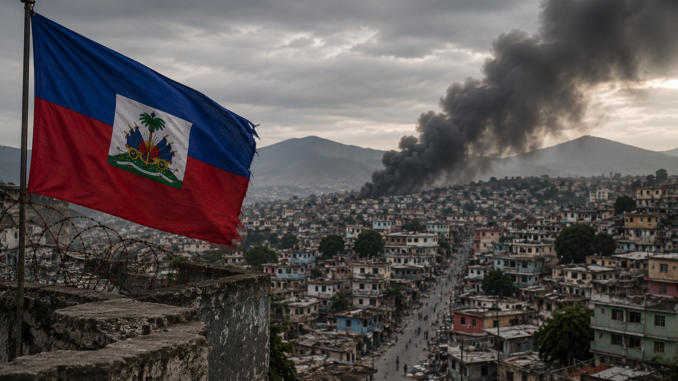
The Erosion of State Authority Amid Gang Expansion and Institutional Fragility
Sometimes, countries are not governed by their government. But armed groups operate the country according to their own interest and purposes. As not all armed groups or forces protect a country some of them seek to gain control and influence. This raises an important question: what happens when armed groups become too strong to control roads, businesses, and access to basic necessities? Yes, Haiti is a country suffering from this situation. This all shows how state authority erodes. This crisis is not only about gangs fighting for territory but it is a struggle over who can exercise authority or influence over security and economic routes. This crisis deepened after the assassination of President Jovenel Moise in July 2021. His assassination further weakened an already fragile political system and another side country struggled to organize elections and maintain government institutions. Beyond the political uncertainty, armed groups expanded their influence around Port-au-Prince, capital of Haiti.
According to the United Nations Report of 2025, armed groups controlled an estimated 85% of the metropolitan area of Port-au-Prince, including some major routes of the capital. The report also highlighted that gangs were expanding their influence into the Artibonite and Centre Departments and increasing their actions against state institutions and Haitian security forces. This expansion transformed the gangs from criminal organizations into powerful groups that directly challenged the state authority.
According to a United Nations Office on Drugs and Crime 2025 report, organized groups controlled most of Port-au-Prince and had expanded into other parts of the country. Their power sustained different ways of income including kidnapping, extortion, drug trafficking and illicit arms flows. This financial capacity allows them to recruit members, build weapons and challenge police operations. The consequences of ordinary Haitians have been devastating.
According to the United Nations Integrated Office in Haiti, more than 5,915 people were killed and 2,708 injured during 2025. This not only brings devastation of infrastructure or about influence this causes the losses of lives as well as humanity. Gangs were responsible for serious abuses, including killings, kidnappings, extortion, destruction of property and the exploitation of children. This crisis produced a massive displacement emergency. Families displaced because of fighting and all because of the criminal rate. Violence has disrupted access to school, medicine, healthcare, food and employment. Roads and ports are unsafe but still humanitarian organizations struggle to approach communities in need. The situation becomes worse when gangs have targeted the infrastructure on which the state and the economy depends, like institutions and ports. A UN Security Council Panel of Experts highlighted the repeated attacks on Haiti’s main port in Port-au-Prince. Port operations have been severely disrupted, causing insecurity, reduced economic activity and difficulties in accessing basic necessities, including food. Because of security sector weaknesses, it makes the situation more difficult.
According to the United Nations Integrated Office in Haiti, United Nations Report, at the end of 2024, Haiti had 412 police facilities, of which 75 were non-operational. Several prisons have also been damaged or disrupted by gang attacks. This all causes to reduce the state’s authority and creates space for armed groups. Port-au-Prince remains the main center of the crisis, although violence has spread beyond the capital.
According to the United Nations Human Rights Office Report of 2025, outside the capital gangs have killed more than 1000 people and displaced hundreds of thousands since October 2024.
This expansion demonstrates that the crisis has become national rather than being confined to the capital. Gangs have gained influence over trade, transportation and humanitarian access through control of important roads and routes connected to Port-au-Prince. International Communities has attempted to support Haiti’s security forces.
A Multinational Security Support Mission (MSS) was deployed with an objective of assisting the Haitian National Police in confronting armed groups and for creating stability. The mission has also faced challenges like personnel, financing, logistics and coordination. However, international support has faced significant financial, logistical, personnel and operational constraints. Although eliminating gangs is not simple, sustained support is necessary to maintain security. Security operations may regain territory temporarily but stability needs proper courts, prisons, schools, hospitals, local administrations and economic opportunities. As Haiti’s 2026 elections are scheduled, the situation highlights the connection between security and political stability. Haiti’s electoral authorities have scheduled the first round of presidential and legislative elections for 13 December 2026 but the credibility of elections depends on established security.
This crisis cannot be solved through force alone; it also requires strengthening the Haitian National Police, improving judicial institutions, controlling illegal weapons and restoring government services that are essential. International Institutions should support Haitian institutions. Ordinary Haitians need to see the state return to their communities, not only through schools, hospitals, courts, employment opportunities and public services. Otherwise armed groups will continue to exploit the vacuum that was created by weak institutions. This crisis demonstrates how organized crime can evolve into a challenge for state authority when political institutions become fragile and unstable. This turned a criminal problem into a national governance crisis. This crisis will require rebuilding the authority, legitimacy and capacity of the Haitian state.
The views presented in this article are the authors’ own and do not necessarily reflect the views of Global Strategic Forum – GSF.

Laraib Ehsan
The Author is a student of International Relations at Fatima Jinnah Women University, Rawalpindi. She has a keen interest in international affairs and is passionate about contributing to the welfare of humanity. Her academic interests reflect her commitment to understanding global challenges and exploring ways to promote peace, cooperation, and human well-being. She can be reached at laraibehsan5@gmail.com
Leave a Reply