
The Hidden Power of the Amazon: A Geopolitical Battleground
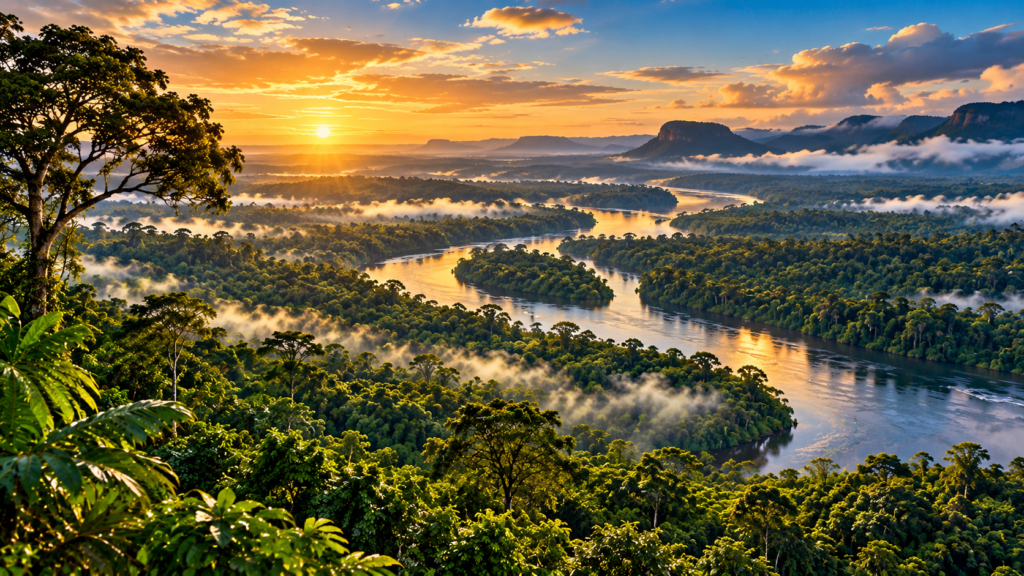
From carbon reserves and mineral resources to Indigenous rights and national sovereignty, the Amazon has become a focal point of competing environmental, economic and geopolitical interests.
Most of us simply think of the Amazon as an enormous rainforest. But behind its trees, rivers, minerals and biodiversity lies a much larger question: who has the right to decide its future? Beyond its ecological value, the Amazon is becoming increasingly important strategically and geopolitically because of its waterways, mineral deposits, agricultural land, biodiversity, Indigenous territories and role in global climate processes. The Amazon Basin covers approximately 6.7 million km² and extends across eight sovereign countries and French Guiana. More than 60% of the Amazon is within Brazil and changes to the forest in one country can impact precipitation patterns, carbon emissions, bio-diversity, the availability of water resources, agricultural development, climate phenomena and influence regional rainfall and wider climate patterns. The extent of effects beyond South America depends on the specific climate process. Scientific research identifies the Amazon as an important part of the Earth’s carbon and water cycles and in the systems that are responsible for our climate regulation.
This is where geopolitics enters the picture. Brazil and other Amazonian countries argue that the forest exists within sovereign territories and that they have the right to pursue economic development within their borders. In contrast, other countries as well as international organizations, scientific associations and NGOs argue that the forest should not only be managed by individual nation states but should also be treated as a resource of international importance. The Amazon stores vast amounts of carbon, highlighting its importance to the global climate system. Estimates suggest that 150–200 billion tonnes of carbon are stored in its vegetation and soils. A study published in Nature Communications of 2025, the Amazon stores vast amounts of carbon, highlighting its importance to the global climate system. Estimates suggest that 150–200 billion tonnes of carbon are stored in its vegetation and soils. Although carbon storage figures, like other climate statistics, remain subject to scientific uncertainty due to deforestation pressures, scientists agree that forests must be protected to continue to act as a carbon sink.
Another study published in Communications Earth & Environment in 2024 examined carbon fluxes across the Amazon region between 2010 and 2020. The Amazon is more than just trees. It constitutes one of the most significant water sources for our planet. Research published in scientific reports has highlighted the Amazon Basin’s importance to the global freshwater system. The Amazon River accounts for around 18% of the freshwater discharged by rivers into the world’s oceans. The forest also plays another key role in maintaining rainfall patterns across South America supporting agriculture, communities and economic activity that allows food and water security as well as electricity generation due to the vast number of potential hydropower stations that can be developed along these waterways. This is another reason why the management of the Amazon has implications far beyond the region especially for food security, electrical energy, transportation as well as climate.
Paradoxically, the same resources that make the Amazon environmentally as well economically important offer employment as well as income and investment. These include agricultural activities, raising of livestock, timber trade, oil extraction and the utilization of the mining and dam construction. This creates an inherent conflict since governments desire increased economic progress while environmental bodies as well as local communities worry about permanently irreversible damage. Deforestation is also a major concern. Deforestation remained a major concern between August 2024 and July 2025. According to Brazil’s National Institute for Space Research which reported 5,731 km² of deforestation, a 12.07% decrease from the previous period. However, the loss of 5,731 km² still represents a significant amount of forest. The downward trend is encouraging, though it also shows that the problem remains and requires continued efforts to address it. Mining shows the conflict between environmental protection, economic interests, indigenous rights and state authority. In 2025, the Yanomami Indigenous Territory in Roraima faced continued pressure from illegal miners who had set up numerous operations there; the activities caused mercury contamination, environmental degradation and risks to Indigenous communities and wildlife. However, through coordination between government agencies and the police and armed services of Brazil, along with FUNAI and IBAMA (Brazilian Institute of Environment and Renewable Natural Resources), Authorities conducted coordinated operations against illegal mining. Brazilian government data indicate that active mining areas in Yanomami Indigenous Territory fell from approximately 4,570 hectares in March 2024 to 269 hectares in February 2025. A subsequent Brazilian government report stated that active mining covered 56.13 hectares by the end of 2025, 98.77% below its reported peak.
These developments have made the future use of Amazon land a geopolitical flashpoint. Illegal mining networks extract resources, occupy Indigenous territories and undermine state authority. COP30, held in Belém, Brazil, in November 2025, highlighted the geopolitical significance of Amazon conservation and climate diplomacy. For Brazil, the summit was also an opportunity to establish the Amazon not merely as a natural phenomenon but also as a national development priority while also making it a subject of international cooperation as reflected in the Amazon Fund. The fund is managed under the auspices of Brazil’s development bank, BNDES, in coordination with the Ministry of environment and Climate change. It is an important source of funding for diverse initiatives including efforts to reduce deforestation, monitor ecosystems, promote sustainable development and support indigenous communities.
During COP30, BNDES signed a €18.6 million donation agreement with the European Union, of which €4.65 million had been disbursed by the time of the fund's published record. Nevertheless, COP30 also revealed a geopolitical tension since international actors sought stronger protection of the Amazon. Brazil continued to emphasize its sovereignty and right to pursue development even when development priorities may conflict with conservation efforts. This does not mean that Brazil is uninterested in environmental protection. All these issues place Amazon at the center of competing interests. For centuries, Amazonian states have emphasized their sovereignty over the territory. They argue that sovereignty gives them the right to pursue development within their territories. Nevertheless, the loss of the forest affects the global climate and wider ecosystems creating consequences beyond national borders. Other countries have offered funding and proposed ways to support its protection.
This helps explain why many countries and governments have provided the financial support the Amazon desperately needs like Germany, Britain, Norway, Japan and other countries with the EU among the most significant providers of funding. But this funding also raises important questions: Who decides how the money is spent? Who decides the environmental protection policies ?Can outside actors determine what states should do with their own land and resources? These questions make the Amazon debate about more than the environment. It also involves international politics, economics, security, Indigenous rights and national sovereignty. The situation in the Amazon is not entirely bleak. Recent declines in deforestation in Brazil and the massive reduction of illegal mining in the Yanomami territory show that governmental action can have an impact. At the same time, scientists continue to warn about droughts, warming trends, deforestation, and forest degradation all of which are putting pressure on the ecosystem.
The question is not how to choose the path of development or conservation. The challenge is finding a way to achieve both. The real question is how development can thrive while not destroying the ecological system that supports both present and future generations. The Amazon is likely to remain a geopolitical battleground. From carbon to water systems, mineral rights to Indigenous lands, the Amazon’s health will affect more than just Brazil, but the regional economy and the politics of the globe. Ultimately, the question is not only how much of the Amazon we can protect today but how much of it we can preserve for future generations.
The views presented in this article are the authors’ own and do not necessarily reflect the views of Global Strategic Forum – GSF

Copyright © 2026 by GSF Team
Comments
0No comments yet. Be the first to comment.