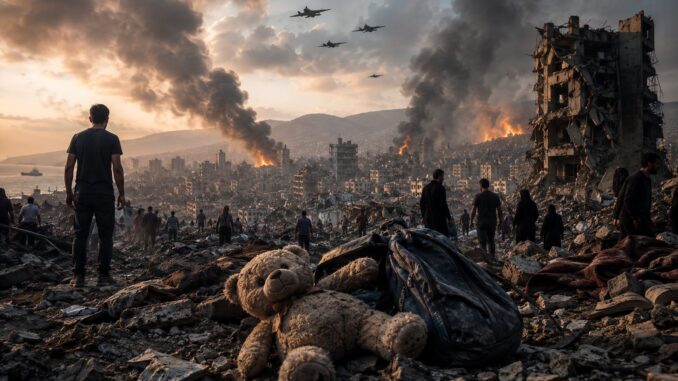
How Modern Warfare is Eroding the Laws meant to protect civilians.
On 8 April 2026, hours after Pakistan brokered a ceasefire between the United States and Iran, Israeli forces struck more than 150 locations across Lebanon in ten minutes, killing at least 303 people and wounding 1,150.
According to UN human rights experts, it was the largest coordinated wave of strikes on Lebanon since 1980 launched while diplomats were still on the phone. It crystallizes a defining crisis: international humanitarian law is not merely being strained from Tehran to Beirut. It is collapsing.
When the United States and Israel launched joint strikes against Iran on 28 February 2026, the first documented victim was a school in Minab, Hormozgan province, where approximately 150 children were killed.
Amnesty International documented that ten medical centres were damaged in the opening offensive. Iran’s retaliatory strikes were no cleaner: Human Rights Watch described Iranian strikes on desalination plants, residential towers, and civilian airports across seven Gulf states as unlawful violations of the IHL principle of distinction.
Lebanon — not a party to the original conflict — saw more than 2,000 killed. On 9 April, Israel ordered the evacuation of Jnah, a Beirut neighbourhood containing two functioning hospitals. The WHO Director-General stated publicly that there was nowhere to move the patients.
When evacuation orders encompass functioning hospitals, the question is no longer whether IHL is being stretched — it is whether it retains any operative meaning at all.
IHL rests on four pillars codified in the 1949 Geneva Conventions: distinction, proportionality, precaution, and necessity. Every major party to this conflict has violated at least one. Israel’s claim that Hezbollah’s use of civilian areas legitimises its strikes has some grounding in IHL but it cannot serve as a blanket licence.
Just Security has argued that Israel’s campaign in Lebanon fails the necessity threshold entirely, since the legal basis for the original US-Israeli strikes on Iran a state that had not attacked either country was itself a manifest violation of the UN Charter. If the predicate war is unlawful, every casualty it generates compounds the violation.
What converts these episodes into a systemic collapse is the absence of accountability. The UN Security Council has been paralysed by veto politics. As Opinio Juris has observed, sanctions raise the political cost of repression without halting ongoing violence.
Selective outrage further corrodes IHL’s legitimacy: the international community mobilised to condemn Iran’s conduct in the Strait of Hormuz while remaining comparatively silent on the strikes that triggered the crisis. Lebanese Prime Minister Nawaf Salam accused Israel of acting in utter disregard for humanitarian law “principles it has, in any case, never respected.”
IHL is the minimum grammar of civilised warfare. When it collapses, the precedents set in Beirut and Tehran become available to every armed actor in every future conflict.
The path forward demands more than condemnation it requires consistent enforcement regardless of which state is in the dock, reinvestment in the ICC and independent investigative bodies, and the political will of the international community to hold all parties including powerful ones to the same standard. History will record what happened in the spring of 2026. Whether it records a collapse or a reckoning depends on choices still being made.
The views presented in this article are the authors’ own and do not necessarily reflect the views of Global Strategic Forum – GSF.

Muhammad Mudassar
Muhammad Mudassar student of Peace and Conflict Studies at National Defence University with academic interests in geopolitics, international law, human rights.

An exceptionally well-researched column that highlights the growing gap between international law and its enforcement. A very important and timely analysis. Good research…